
TL;DR:
- A single HVAC “ton” is a cooling capacity of 12,000 BTU per hour, representing the rate at which heat is removed from a home. Proper sizing, based on Manual J calculations, prevents issues like short-cycling and humidity problems, with oversizing being a common mistake. Lucasair emphasizes precise, Manual J-based assessments for optimal system performance tailored to Central Florida homes.
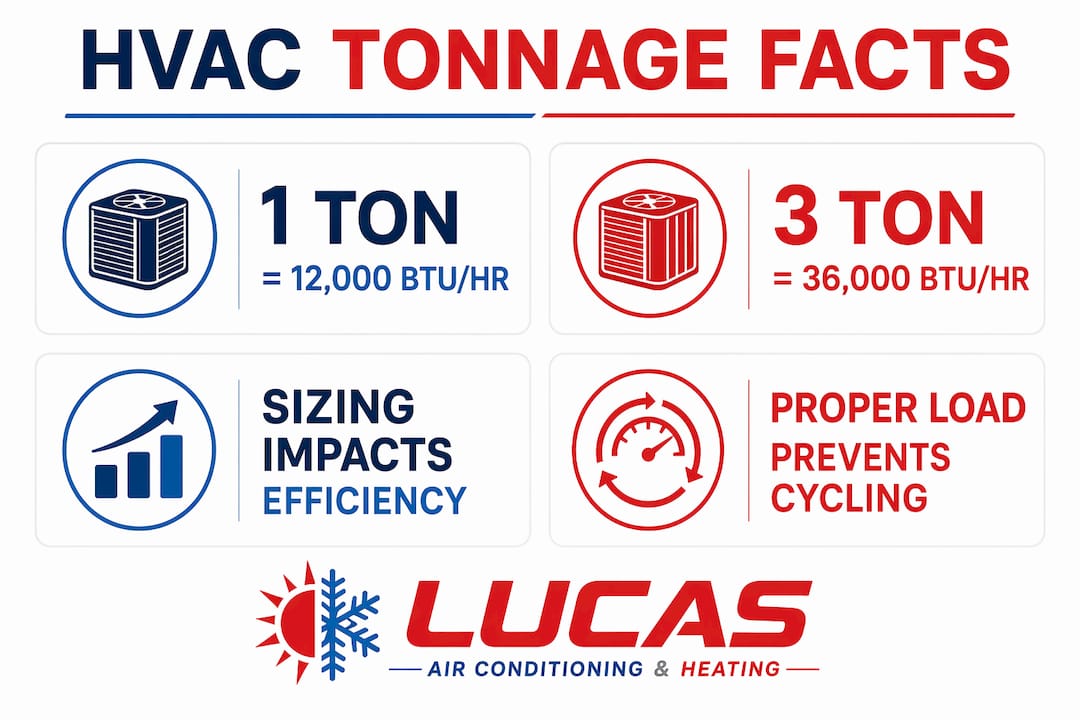
One HVAC “ton” is a unit of cooling capacity equal to 12,000 BTU per hour. It measures how fast your air conditioner removes heat from your home, not how much the equipment weighs. A typical 3-ton AC unit pulls heat out of your living space at the rate aligned with this nominal capacity. That single number drives every sizing decision a contractor makes.
Quick conversions you can use right now:
- BTU to tons: Divide the BTU/hr rating by 12,000 (36,000 ÷ 12,000 = 3 tons)
- Tons to BTU: Multiply tons by 12,000 (2.5 tons × 12,000 = 30,000 BTU/hr)
- Reading a nameplate: Look for a two- or three-digit number on the data plate (e.g., “36” means 36,000 BTU/hr, or 3 tons)
Standards from ACCA Manual J, ENERGY STAR, and ASHRAE all anchor equipment sizing to this BTU/hr rate. Lucasair uses the same framework on every Central Florida job.
Table of Contents
- What does HVAC tonnage actually measure?
- How to find the tonnage of your existing AC unit
- How to estimate the right tonnage for your home
- Why getting tonnage right matters more than you think
- When should you call an HVAC professional?
- How Lucasair approaches sizing in Central Florida
- Key Takeaways
- Proper sizing is the foundation of good HVAC work
- Get a proper sizing assessment from Lucasair
- Authoritative references and further reading
What does HVAC tonnage actually measure?
The term “ton” traces back to the ice trade. ASHRAE notes that one ton of refrigeration equals the heat-removal rate needed to freeze one short ton of ice in 24 hours, which works out to exactly 12,000 BTU/hr. That historical definition became the modern standard.
What the number actually captures is a rate, not a quantity. Your 3-ton unit doesn’t store 36,000 BTU somewhere; it removes heat at that rate continuously while it runs.
Sensible vs. latent cooling: why both matter
Cooling does two separate jobs, and tonnage has to cover both:
- Sensible cooling lowers the dry-bulb temperature you feel on a thermometer.
- Latent cooling removes moisture from the air, which is what makes a humid Florida afternoon feel tolerable indoors.
A unit that’s too large will drop the temperature quickly, shut off, and never run long enough to pull moisture out. The result is a house that reads 74°F on the thermostat but still feels sticky. ACCA Manual J calculates sensible and latent loads separately so equipment can be matched to both, not just the temperature target.
Pro Tip: In humid climates like Central Florida, latent load often drives the sizing decision more than raw square footage. A unit sized only for sensible cooling will leave you with a cool, clammy house and a mold risk.
How to find the tonnage of your existing AC unit
You don’t need a contractor to figure out what size system you already have. Here’s how to read it yourself.
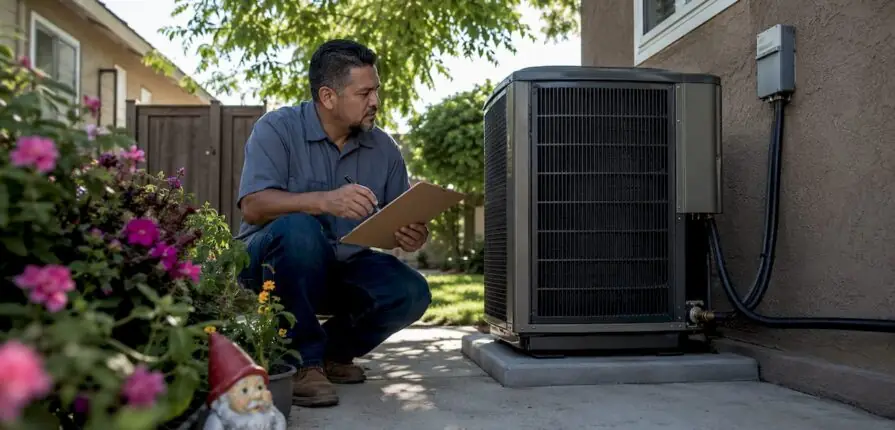
- Locate the data plate. On a split system, check the outdoor condenser unit first. The plate is usually on the side panel. Indoor air handlers have a second plate, but the condenser plate is the primary reference.
- Find the capacity number. Look for a two- or three-digit number that represents BTU in thousands. Common values: 18, 24, 30, 36, 42, 48, 60. A plate showing “48” means 48,000 BTU/hr.
- Divide by 12,000. That gives you tons. 48,000 ÷ 12,000 = 4 tons. Simple.
- Cross-check the model number. Manufacturers often embed the capacity in the model string. A model ending in “036” or “36” typically signals 36,000 BTU/hr (3 tons). A model ending in “060” signals 60,000 BTU/hr (5 tons).
A few caveats worth knowing:
- Nominal vs. actual capacity. A “3-ton” unit may deliver 34,000–36,200 BTU/hr depending on conditions. The nameplate shows nominal capacity.
- Aftermarket coil replacements. If a previous owner swapped the indoor coil without replacing the condenser, the coil and condenser may be mismatched. The nameplate on each unit tells you what that component is rated for, not necessarily what the system delivers as a matched pair.
- Manufacturer conventions vary. Some brands use different digit positions in the model number. When in doubt, pull the model number and check the manufacturer’s specification sheet, or ask a pro.
How to estimate the right tonnage for your home
The rough rule of thumb you’ll see everywhere: one ton per 500–600 square feet of conditioned space. Here’s how that plays out across common home sizes:
| Conditioned sq. ft. | Approximate tonnage | Approximate BTU/hr |
|---|---|---|
| — | 2 tons | 24,000 BTU/hr |
| — | 3 tons | 36,000 BTU/hr |
| — | 4 tons | 48,000 BTU/hr |
| — | 5 tons | 60,000 BTU/hr |
These numbers are a starting point, not a specification. Building America / DOE research makes clear that Manual J inputs, including ceiling insulation levels, window type and orientation, duct leakage, and air infiltration rate, can shift the recommended tonnage significantly from what the square-foot rule suggests. A well-sealed, well-insulated new home in the same zip code as a 1960s ranch with single-pane windows may need a full ton less capacity.
Variables that make the rule of thumb unreliable for your specific home:
- Insulation quality (attic R-value, wall insulation, slab or crawl space)
- Window area, type, and orientation (west-facing glass adds significant solar gain)
- Ceiling height (vaulted or 10-foot ceilings increase volume)
- Duct location and leakage (ducts in a hot Florida attic lose significant capacity)
- Local climate zone (Central Florida’s humidity load is higher than most national charts assume)
- Occupancy and internal heat gains (appliances, lighting, number of occupants)
The rule of thumb is fine for a ballpark estimate when you’re budgeting or doing preliminary planning. For any actual equipment purchase or replacement, a Manual J load calculation is the professional standard, required by most state and local building codes under ACCA’s 8th Edition procedure.
Manual S governs equipment selection once the load is known. Manual D covers duct design to deliver that capacity to every room. ENERGY STAR and the U.S. DOE both reference this three-manual framework as the baseline for right-sized installations.

Why getting tonnage right matters more than you think
Oversizing is the more common mistake, and it causes more problems than most homeowners expect. Industry studies estimate that 50–70% of installed residential systems are oversized, often because contractors use rules of thumb instead of running a proper Manual J.
A significant share of installed residential HVAC systems are oversized, according to field research cited by ACEEE, often by enough margin to cause short-cycling, poor dehumidification, and accelerated equipment wear.
What oversizing actually does to your home:
- Short-cycling: The unit reaches setpoint fast, shuts off, and restarts repeatedly. Each startup cycle stresses the compressor.
- Poor dehumidification: ENERGY STAR warns that oversized ACs fail to run long enough to pull moisture out of the air, leaving that cool-but-clammy feeling.
- Higher energy bills: Short-cycling is inefficient. Compressor startups draw more current than steady-state operation.
- Mold risk: Persistent indoor humidity above 60% creates conditions where mold can grow, even in a cooled space.
- Shorter equipment life: Frequent cycling wears out contactors, capacitors, and compressor windings faster than continuous operation.
Undersizing has its own costs. A unit too small for the load runs continuously on the hottest days, can’t maintain setpoint, and wears out from constant operation. You’ll notice it as rooms that never quite cool down and an electric bill that climbs in July regardless of thermostat settings. For a closer look at signs of HVAC system issues, both oversizing and undersizing leave visible symptoms worth knowing.
When should you call an HVAC professional?
Some situations call for a pro, not a calculator:
- Rooms that are consistently warmer or cooler than the rest of the house
- A “cool but clammy” feeling even when the thermostat reads your target temperature
- The system short-cycles (runs for only a few minutes before shutting off)
- You’re replacing an existing unit and want to know if the current size was right
- You’ve added square footage, changed windows, or upgraded insulation
What a qualified contractor does on-site goes well beyond measuring the house. A proper sizing visit includes a Manual J load calculation (accounting for your specific insulation, windows, duct condition, and local climate data), Manual S equipment selection to match the load, and a Manual D duct review to confirm airflow delivery. They’ll also verify refrigerant charge and actual airflow at startup, because a correctly sized unit installed with an undercharged refrigerant circuit or a restricted duct still underperforms.
Before the visit, have these ready:
- Square footage of conditioned space (floor plan or tax record)
- Recent utility bills (12 months if possible)
- Model numbers from existing equipment (outdoor condenser and indoor air handler)
- Any known issues: rooms that don’t cool, humidity complaints, recent additions
Pro Tip: When reviewing quotes, check that the evaporator coil and condensing unit are matched (same manufacturer, compatible ratings). A mismatched coil can cut system efficiency significantly. Also confirm the quote specifies sealed ductwork and a measured airflow verification at startup, not just a visual inspection.
Check the HVAC installation questions list for a full checklist to bring to your first appointment.
How Lucasair approaches sizing in Central Florida
Every Lucasair job starts with a site visit, not a square-foot estimate. The workflow follows ACCA’s three-manual framework: Manual J for the load, Manual S for equipment selection, Manual D for duct design.
- Initial site visit: Measure conditioned area, inspect duct routing and condition, note window orientation and insulation access points.
- Manual J calculation: Input local climate data, envelope characteristics, and occupancy to produce separate sensible and latent loads.
- Manual S equipment selection: Match equipment to both load components, not just the sensible total.
- Duct inspection and sealing: Confirm that delivered capacity matches calculated capacity, especially for ducts running through unconditioned attic space.
- Startup and airflow verification: Measure actual airflow and refrigerant charge at commissioning.
Founded by Army Veteran Cameron Lucas in 2018, Lucasair serves homeowners and businesses across Central Florida with a commitment to ACCA-based design practices on every installation.
Key Takeaways
One HVAC ton equals 12,000 BTU/hr of cooling capacity, and getting that number right for your home prevents short-cycling, humidity problems, and premature equipment failure.
| Point | Details |
|---|---|
| 1 ton = 12,000 BTU/hr | Divide any BTU/hr rating by 12,000 to find tonnage; multiply tons by 12,000 to go the other way. |
| Read your nameplate first | Find the two- or three-digit capacity number on the outdoor condenser data plate before calling anyone. |
| Square-foot rules are a starting point | Climate, insulation, windows, and duct condition all shift the real load away from the rule-of-thumb estimate. |
| Oversizing is the common mistake | An estimated 50–70% of systems are oversized, causing short-cycling, poor dehumidification, and higher energy costs. |
| Lucasair uses Manual J | Every Lucasair sizing job follows ACCA Manual J, Manual S, and Manual D for accurate, code-compliant results in Central Florida. |
Proper sizing is the foundation of good HVAC work
Correct tonnage isn’t a technicality. It’s the single decision that determines whether your system actually makes your home comfortable or just keeps the thermostat number low. Every oversized unit I’ve seen installed with good intentions ends up creating the same complaints: humidity that won’t drop, a compressor that cycles out early, and an energy bill that doesn’t match what the homeowner expected.
The square-foot rule exists because it’s fast. Manual J exists because fast isn’t always right. In Central Florida especially, where attic temperatures can exceed 140°F in summer and humidity loads are among the highest in the country, the gap between a rule-of-thumb estimate and an accurate load calculation can be a full ton of capacity in either direction. That gap costs money and comfort for the life of the system.
Lucasair’s commitment to ACCA-based sizing practices isn’t a marketing point. It’s what separates a system that works from one that almost works.
Get a proper sizing assessment from Lucasair
Knowing your tonnage number is useful. Having a pro confirm it with a Manual J is what actually protects your investment.

Lucas Air offers on-site sizing assessments for Central Florida homeowners that include a full Manual J load calculation, matched equipment selection per Manual S, duct inspection, and startup airflow verification. No guesswork, no rules of thumb applied where they don’t belong. You get a system sized for your specific house, your specific climate, and your specific comfort needs.
Ready to get it right? Schedule your installation assessment with Lucasair, or review the step-by-step installation process to know exactly what to expect before the first visit.
Authoritative references and further reading
- ACCA Manual J, 8th Edition — The national ANSI-recognized standard for residential HVAC load calculations; required by most U.S. building codes.
- ENERGY STAR: Right-Sized Air Conditioners — U.S. DOE/EPA guidance on how oversizing reduces dehumidification and increases energy use.
- ASHRAE: Choosing the Right System for Your Home — Explains the historical and technical definition of a ton of refrigeration and system selection principles.
- Building America / DOE: Right-Size Heating and Cooling Equipment — Details how envelope improvements (insulation, windows, air sealing) reduce required tonnage.
- ACEEE: Peak Demand and Energy Savings from Properly Sized and Matched Air Conditioners — Field research on oversizing rates and the energy and peak-demand impacts of right-sizing.
- Energy Vanguard: What Is a Properly Sized Air Conditioner? — Practical explanation of sensible vs. latent loads and why Manual J/S/D matter for equipment selection.
Recommended
- HVAC Terminology Explained: Smart Decisions for Florida Homes – Lucas Air Conditioning and Heating
- Air Conditioning Terminology: A Homeowner’s Guide – Lucas Air Conditioning and Heating
- Air Volume in HVAC: What Homeowners Need to Know – Lucas Air Conditioning and Heating
- HVAC load calculation guide for Florida homes – Lucas Air Conditioning and Heating