
TL;DR: Some of the best AC energy saving tips in Central Florida are free: set the thermostat higher when you’re away, use ceiling fans so you can raise the setting, close the blinds against afternoon sun, and keep the fan on AUTO. Cheap weekend fixes and a yearly professional tune-up add to the savings. If your bill stays high after all that, the system itself may need attention.
The AC energy saving tips that work best in Central Florida are simple. Raise the thermostat when you’re away. Use ceiling fans so you can set the AC higher. Block the afternoon sun, keep the outdoor unit clear, and get a tune-up once a year. Together, these cut how long your system runs during Tavares’s long, humid cooling season.
Below are 12 tips, sorted from free habits to jobs for a licensed tech. We kept them practical for homes in Tavares and nearby places like Grand Island and Zellwood, where the AC often runs hard from spring well into fall. Here’s how the four groups compare:
| Tip group | Examples | Typical cost | Who does it |
|---|---|---|---|
| Free habits (tips 1–4) | Thermostat setback, ceiling fans, blinds, fan on AUTO | $0 | You |
| Low-cost fixes (tips 5–8) | Filters, clearing the outdoor unit, open vents, weatherstripping | Low: basic supplies | You |
| Pro maintenance (tips 9–10) | Yearly tune-up, ductwork check | $125 tune-up or $129/year maintenance agreement at Lucas | Licensed technician |
| Upgrades (tips 11–12) | Smart thermostat, replacing an aging system | Varies by equipment; new installs start at $7,500 at Lucas | Licensed contractor |
Which AC energy saving tips cost nothing?
Four habits cost nothing, and you can start them today.
1. Set the thermostat higher when nobody is home
The U.S. Department of Energy says you can save as much as 10% a year on heating and cooling by turning your thermostat back 7–10°F for 8 hours a day from its normal setting. In summer, back means up. If the house is empty during work hours, let it get warmer, then cool it down before you get home. Snowbirds and landlords with empty units should raise the setting instead of shutting the AC off. Some cooling keeps Florida humidity under control.
2. Run ceiling fans, then actually raise the setting
Fans don’t lower the room temperature. They make you feel cooler. According to University of Florida IFAS Extension, a running ceiling fan usually lets you raise the thermostat by up to four degrees with no loss of comfort. UF/IFAS also notes that raising the setting by just two degrees can cut cooling costs by at least 4–6%. In summer, set fans to spin counterclockwise. Turn them off when you leave the room, because fans only help the people under them.
3. Close the blinds on west- and south-facing windows
The Department of Energy reports that heat moving in and out through windows accounts for 25%–30% of home heating and cooling energy use. In Lake County, the strongest sun hits west-facing glass in the late afternoon. That’s right when your AC is already working hardest. Close blinds or curtains on those windows from early afternoon until sunset.
4. Keep the thermostat fan on AUTO, not ON
In ON mode, the indoor blower runs nonstop, even when the compressor shuts off. Water that collected on the indoor coil can get blown back into your home instead of draining away. Damp air feels warmer, so people turn the thermostat down. AUTO lets the coil drain between cycles.
What cheap fixes can you handle this weekend?
These take an hour or two and very little money.
5. Change the filter on a schedule
A clogged filter chokes airflow, so the system runs longer to cool the same house. Florida’s long cooling season fills filters faster than in colder states. Check yours monthly and write the date on the frame.
6. Give the outdoor unit room to breathe
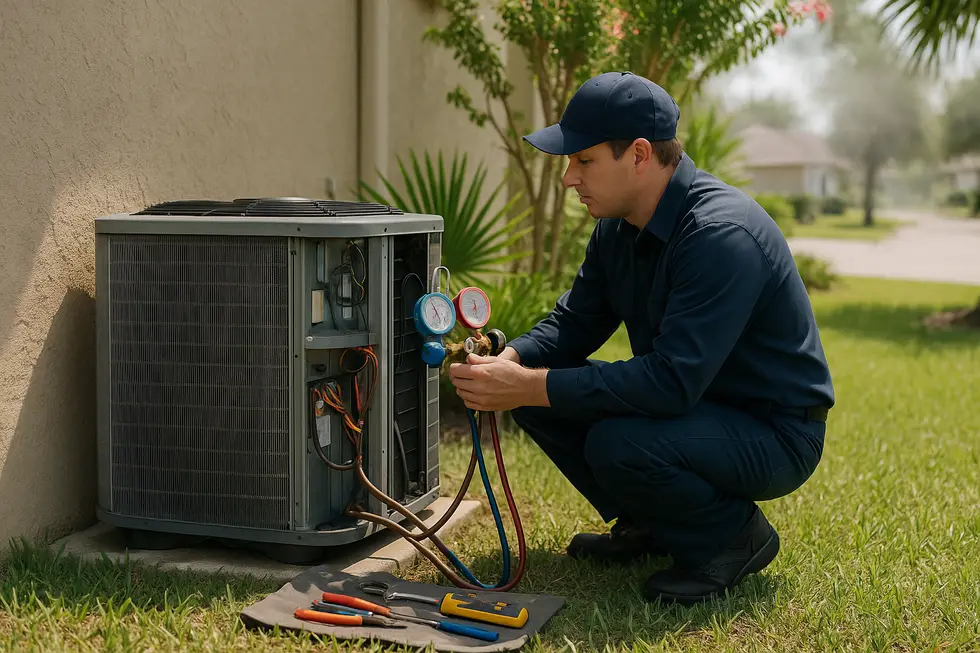
Your condenser gets rid of heat through its coil fins. Grass clippings, oak leaves, sand and vines block that. Clear about 2 feet around the unit. Turn off power at the disconnect, then rinse the fins gently with a garden hose. Never use a pressure washer. Shade from a tree is fine, but don’t box the unit in with fencing or shrubs.
7. Open every vent and clear the returns
Closing vents in unused rooms doesn’t help most central systems. It builds up pressure in the ducts and can make leaks worse. Keep furniture, rugs and curtains off the supply registers and the return grille.
8. Cut heat and moisture at the source
Run the bathroom fan during showers and the range hood when you cook. Grill outside on hot days. Save the dryer and dishwasher for evenings. Add weatherstripping around doors where you can see daylight.
Which AC energy savings need a licensed tech?
The last four tips need tools, training or a license. These are often where an older system’s biggest losses hide.
9. Book a tune-up before peak heat
A tune-up usually includes cleaning the coils, checking the refrigerant level and electrical parts, and clearing the condensate drain. Each of these affects how hard the system works. At Lucas Air Conditioning and Heating, a Precision Tune-Up is $125. The Preventative Maintenance Agreement is $129/year and includes one tune-up, 15% off parts and priority scheduling. You can check the current seasonal specials before you book.
10. Have the ductwork checked
ENERGY STAR estimates that in a typical home, about 20 to 30 percent of the air moving through the ducts is lost to leaks, holes and poorly installed ducts. It adds that leaky ducts can cut system efficiency by as much as 20 percent. In many Central Florida homes the ducts run through hot attics. When those ducts leak, you pay to cool air that never reaches your rooms. Ask your tech to look for loose connections and crushed sections.
11. Install a smart thermostat
A smart thermostat runs tip 1 for you on a schedule. You can also change the setting from your phone. That’s handy for seasonal residents up north or landlords with empty units. Savings depend on how you use it, so set the schedule and leave it alone.
12. Replace an aging system with the right size
If your system is old and breaking down often, newer two-stage or inverter equipment can run at lower speeds for much of the day instead of cycling on and off at full blast. Size matters as much as efficiency. A unit that’s too big cools fast but shuts off before it pulls enough moisture out of the air.
What signs mean a high bill is a system problem?
If you’ve tried the habits above and the bill keeps climbing, something in the system probably needs attention. Call a pro if you notice:
- The AC runs nonstop and never reaches the set temperature.
- Vents blow cool but not cold air. See our guide to reasons your AC isn’t cooling enough.
- Ice on the copper line outside or on the indoor coil.
- Water pooling around the indoor air handler.
- New buzzing, grinding or clicking. Our guide to what AC noises mean explains which ones are urgent.
- A bill well above the same month last year with no change in your habits.
- The house feels sticky even when the thermostat reads cool.
Why do Tavares-area homeowners call Lucas Air Conditioning and Heating?
We’re a veteran-owned, licensed HVAC contractor in Tavares, based at 15800 Old US Hwy 441.
U.S. Army veteran Cameron Lucas, who served with the 82nd Airborne Division, founded the company in 2018.
We hold Florida licenses CAC1819409 and CAC1819837.
We serve homes and businesses across Lake County and Orange County, including Clarcona.
We carry a 5.0-star Google rating.
Style Magazine named us Best of the Best 2025, and we’re a four-time Nextdoor Neighborhood Favorite.
New installations start at $7,500 and include the unit, the permit, a one-year labor guarantee and a ten-year parts warranty.
Estimates on new installations are free, and KwikComfort financing is available.
Emergency service is available outside our regular hours of Monday–Friday, 8:00 AM–5:30 PM.
If your bill is still high after trying these tips, call (352) 805-0359 or book an appointment online, and we’ll help you figure out what’s going on.
Frequently Asked Questions
Is it cheaper to turn my AC off when I leave home in Florida?
Usually it’s better to raise the setting than to shut the AC off. In Florida’s humidity, a house with no cooling can get muggy fast, and the system then has to work hard to pull out that moisture. The Department of Energy’s setback guidance is based on raising the setting for about 8 hours, not turning the system off.
What should snowbirds do with their AC while they’re away for the season?
Leave the system on at a higher setting instead of off so it keeps controlling humidity. A smart thermostat lets you check on the house and change the setting from your phone. It’s also smart to have the system checked before you leave.
Do ceiling fans save money if no one is in the room?
No. Ceiling fans cool people, not rooms, so a fan in an empty room just uses electricity. The savings come from raising the thermostat while you’re sitting under a running fan.
Will a new high-efficiency AC lower my electric bill right away?
A newer, more efficient system can use less energy, but how much you save depends on correct sizing, the condition of your ductwork, and how you set the thermostat. Leaky ducts or an oversized unit can eat up much of the gain.
Recommended Reads
- HVAC Contractor in Tavares, FL
- Landing Page for Seasonal Specials – Online Booking – Lucas Air Conditioning and Heating
- Landing Page for Seasonal Specials – Lucas Air Conditioning and Heating