
TL;DR:
- Florida’s commercial HVAC standards are governed by the Florida Building Code and ASHRAE 90.1-2022 and 62.1-2022.
- Proper equipment sizing, ventilation, and documentation are crucial to pass inspections and ensure compliance.
- Early involvement of local HVAC experts helps prevent costly errors and inspection failures.
Most commercial property managers in Central Florida assume that if their HVAC system cools the building, it must be compliant. That assumption is costly. Commercial HVAC standards in Central Florida are governed by the Florida Building Code and incorporate major national standards, covering everything from equipment sizing to ventilation rates and energy documentation. Miss one requirement and you face failed inspections, permit delays, or tenant safety issues. This guide walks you through every major compliance area so you can manage your property with confidence.
Table of Contents
- Key codes and standards governing commercial HVAC in Central Florida
- Equipment sizing, efficiency ratings, and what counts as ‘commercial’
- Ventilation, air quality, and filtration requirements
- Energy code compliance, commissioning, and documentation
- What most guides miss about Florida’s commercial HVAC code
- Get expert help with commercial HVAC compliance
- Frequently asked questions
Key Takeaways
| Point | Details |
|---|---|
| Florida follows national codes | Commercial HVAC in Central Florida must comply with the Florida Building Code, IMC, and ASHRAE standards. |
| Correct sizing and efficiency required | Systems must be properly sized for humidity and meet stringent efficiency benchmarks unique to commercial setups. |
| Ventilation rates matter | Meeting ASHRAE 62.1 ventilation rates is critical for both compliance and occupant health. |
| Documentation is essential | Proper permitting, COMcheck reports, and commissioning are necessary for code compliance. |
| Local expertise prevents mistakes | Partnering with experienced Central Florida HVAC professionals helps avoid costly code errors and delays. |
Key codes and standards governing commercial HVAC in Central Florida
To understand what counts as compliant, start with which codes and standards actually apply to your building.
The Florida Building Code (FBC), 8th Edition (2023), adopts the International Mechanical Code (IMC) and ASHRAE 90.1-2022, making it the single controlling document for commercial HVAC in the state. ASHRAE stands for the American Society of Heating, Refrigerating and Air-Conditioning Engineers, and their standards carry legal weight once adopted by the FBC. There is no picking and choosing which parts apply.
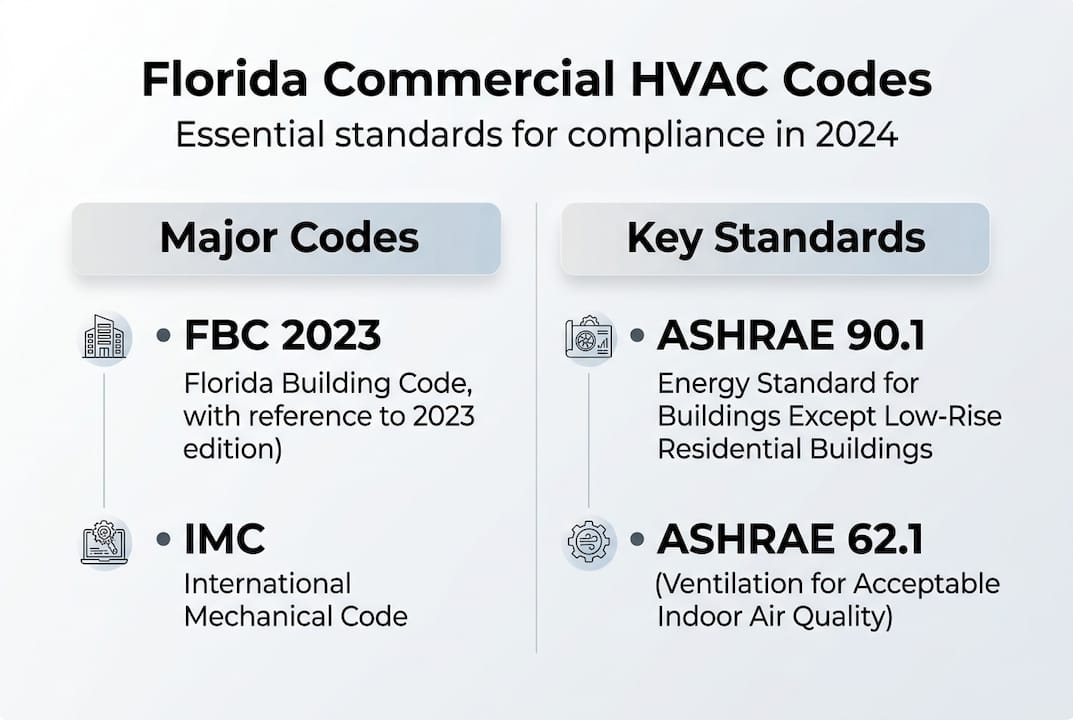
Two ASHRAE standards matter most for day-to-day compliance. ASHRAE 90.1-2022 governs energy efficiency requirements for equipment and building systems. ASHRAE 62.1 governs ventilation and indoor air quality, setting minimum outside air rates for every occupancy type. Both are mandatory, not optional guidelines.
Central Florida municipalities like Lake County, Orange County, and Osceola County each have their own permitting offices. They may add local administrative steps, but they cannot override the FBC. If you manage properties across multiple jurisdictions, the Mount Dora HVAC services area and the Fruitland Park commercial HVAC corridor both fall under the same FBC framework, even if permit timelines differ.
Here is a quick comparison of the major standards that govern commercial HVAC in Central Florida:
| Standard | Scope | What it controls |
|---|---|---|
| FBC (8th Edition) | Florida statewide | Overarching building compliance |
| IMC (adopted by FBC) | Mechanical systems | Installation, clearances, materials |
| ASHRAE 90.1-2022 | Energy efficiency | Equipment ratings, duct insulation |
| ASHRAE 62.1-2022 | Ventilation | Outside air rates, air quality |
| ASHRAE 170 | Healthcare facilities | Specialized ventilation requirements |
It is also worth noting that Florida uses its own Florida Building Code Energy Conservation (FBC-EC) rather than adopting the International Energy Conservation Code (IECC) directly. The FBC vs IECC standards differ in several technical areas, so do not assume that IECC compliance automatically satisfies Florida requirements.
Key codes that apply to virtually every commercial property:
- Florida Building Code (FBC), 8th Edition: Primary authority
- International Mechanical Code (IMC): Adopted within FBC for mechanical systems
- ASHRAE 90.1-2022: Energy efficiency benchmarks
- ASHRAE 62.1-2022: Ventilation and indoor air quality
- ASHRAE 170: Required for healthcare, labs, and similar spaces
Equipment sizing, efficiency ratings, and what counts as ‘commercial’
With the foundational codes clear, the next step is to understand what exactly qualifies as commercial and how to select equipment that meets Florida’s standards.
A system is classified as commercial under the FBC when it exceeds 65,000 BTU/h in capacity. High-rise multifamily buildings over three stories are also treated as commercial regardless of individual unit size. This matters because commercial systems face stricter efficiency requirements and more detailed permitting than residential equipment.
Sizing is where many projects go wrong. Equipment sizing uses ACCA Manual N or the ASHRAE Handbook, with strong emphasis on latent cooling loads due to Zone 2A humidity. Zone 2A is the hot and humid climate classification that covers most of Central Florida. Latent load refers to the moisture that the system must remove from the air, separate from simply lowering the temperature. Undersized systems leave buildings humid and uncomfortable. Oversized systems short-cycle, fail early, and never properly dehumidify.
Efficiency ratings vary by equipment type. Minimum efficiencies per ASHRAE 90.1-2022 are adopted with no major deviations in Florida. Here are the benchmarks by equipment category:
| Equipment type | Rating metric | Minimum threshold |
|---|---|---|
| Rooftop units (less than 65k BTU/h) | EER / IEER | Varies by capacity class |
| Rooftop units (65k BTU/h and above) | IEER | Per ASHRAE 90.1 table |
| Chillers | IPLV / NPLV | Per ASHRAE 90.1 table |
| VRF systems | IEER / COP | Per ASHRAE 90.1 table |
| Split systems (commercial) | SEER2 / EER2 | Federal minimums or higher |
For a compliant equipment selection, follow these steps:
- Confirm the building’s climate zone (Central Florida is Zone 2A).
- Calculate both sensible and latent cooling loads using ACCA Manual N or ASHRAE methods.
- Select equipment with efficiency ratings at or above ASHRAE 90.1-2022 minimums.
- Verify the unit is listed on the AHRI (Air-Conditioning, Heating, and Refrigeration Institute) directory.
- Submit equipment specifications with your permit application.
If you are working on a property in Lake County, the Leesburg HVAC code guide covers local permitting nuances that affect equipment selection timelines.
Pro Tip: In Central Florida, humidity control should drive your system selection, not just cooling capacity. A system that handles latent loads well prevents mold growth, reduces callbacks from tenants, and keeps your building compliant with both ASHRAE 62.1 and local health codes.
Ventilation, air quality, and filtration requirements
Selecting the right equipment is only half the equation. Proper ventilation and air filtration are essential for code compliance and occupant health.
ASHRAE 62.1-2022 determines ventilation rates using a formula based on cfm per person and cfm per square foot. CFM stands for cubic feet per minute, the standard measure of airflow. The formula accounts for both the number of occupants and the floor area of the space, so a large open office with few people is treated differently than a crowded conference room.
Office ventilation example (ASHRAE 62.1-2022): A 2,000 sq ft office with 20 occupants requires a minimum of (20 x 5 cfm/person) + (2,000 x 0.06 cfm/sq ft) = 100 + 120 = 220 cfm of outside air.
Specialized spaces follow different rules. Healthcare facilities, laboratories, and similar spaces must comply with ASHRAE 170, which sets stricter air change rates and pressure relationships between rooms. If your portfolio includes medical office buildings or outpatient clinics, ASHRAE 170 is not optional.
For ventilation standards in Florida, filtration requirements are equally specific. The minimum air filter standard is MERV 8 or higher. MERV stands for Minimum Efficiency Reporting Value, and higher numbers indicate finer filtration. MERV 8 catches most dust, pollen, and mold spores. Healthcare and cleanroom applications require MERV 13 or better.
Common ventilation and filtration compliance errors include:
- Skipping the ventilation rate calculation and assuming the existing system handles it
- Using MERV 4 or MERV 6 filters because they are cheaper, which fails inspection
- Blocking economizer dampers to reduce outside air during humid periods, which violates code
- Failing to account for occupancy changes after a tenant buildout or renovation
- Ignoring exhaust air requirements for restrooms, kitchens, and parking garages
For properties near the waterfront areas served by Fruitland Park HVAC services, outdoor air quality and humidity levels make proper economizer controls especially important. Economizers bring in outside air when conditions allow free cooling, but they must be controlled to avoid flooding the building with humid outdoor air during Florida summers.
Energy code compliance, commissioning, and documentation
Now that you know the systems and air quality requirements, here is how to ensure your installation actually passes inspection and remains efficient.
Florida’s energy conservation rules draw from both ASHRAE and IECC frameworks, but the FBC-EC is the controlling document. You have two compliance paths available. The prescriptive path requires you to meet every specific requirement in the code tables, covering duct insulation, equipment efficiency, controls, and more. The performance path allows trade-offs, meaning you can exceed requirements in one area to compensate for falling short in another, as long as the overall building energy model meets the target.
Most commercial projects use the prescriptive path because it is faster and easier to document. The performance path requires energy modeling software and a qualified energy analyst, which adds cost and time.
Here is what commissioning and documentation typically require for a commercial HVAC project in Central Florida:
- COMcheck report: A free Department of Energy tool that verifies mechanical and envelope compliance. Submit with your permit application.
- Equipment cut sheets: Manufacturer specifications showing efficiency ratings match or exceed ASHRAE 90.1-2022.
- Duct leakage test results: Maximum allowed duct leakage is 4% of system airflow for supply ducts and 4% for return ducts in most commercial applications.
- Commissioning report: A third-party or contractor-verified document confirming the system operates as designed.
- Signed permits and inspections: Local jurisdiction sign-off at rough-in and final stages.
For ASHRAE 90.1 compliance, economizer controls are mandatory for most commercial systems above a certain capacity threshold. Fault detection and diagnostics (FDD) requirements also apply to rooftop units above 110,000 BTU/h, meaning the system must be able to alert you to common faults like low refrigerant or failed economizers.
Properties in the Fruitland Park area should review the Fruitland Park HVAC compliance guide for local permit office contacts and inspection scheduling.
Pro Tip: Run your project through COMcheck before submitting your permit application. It takes about 30 minutes and catches most prescriptive path errors before an inspector does, saving you weeks of delays and resubmission fees.
What most guides miss about Florida’s commercial HVAC code
Compliance checklists make the process look linear. In practice, it is not.
The single biggest gap we see in commercial HVAC projects across Central Florida is the treatment of latent load as an afterthought. Engineers and contractors trained in other climate zones often size systems for sensible cooling, the temperature drop, and undersize the dehumidification capacity. The result is a building that feels cool but stays humid, creating mold risk, tenant complaints, and potential code violations under ASHRAE 62.1’s indoor air quality requirements.
Documentation failures are the second most common problem. Many projects fail their first inspection not because the equipment is wrong, but because the COMcheck report is missing a section or the commissioning form is incomplete. Inspectors follow a checklist, and a missing signature carries the same weight as a wrong efficiency rating.
What truly separates successful projects is involving a local HVAC contractor early, before the design is finalized. A contractor familiar with Central Florida’s permit offices knows which local amendments apply, how inspectors interpret gray areas, and which documentation formats each office prefers. The Leesburg HVAC expert tips we share with clients consistently emphasize one thing: a 30-minute design review before you pull a permit is worth far more than a week of corrections after a failed inspection.
Pro Tip: For any major upgrade or new installation, schedule a pre-permit meeting with your contractor and the local permit office. Most offices in Central Florida offer this at no cost, and it eliminates the most common causes of inspection failure.
Get expert help with commercial HVAC compliance
If this all sounds daunting, partnering with an experienced local HVAC contractor can make compliance much less stressful.
Navigating commercial HVAC standards takes more than reading the code. It takes experience with local permit offices, knowledge of how inspectors apply ASHRAE requirements in practice, and the ability to catch sizing and documentation errors before they cost you time and money. At Lucas Air Conditioning and Heating, we provide commercial HVAC installation services across Central Florida, including compliance consulting for new builds and system upgrades. Whether you manage a single commercial property or a portfolio of buildings, our team handles the technical details so you can focus on your tenants. Explore our full HVAC services or contact our HVAC contractor in The Villages team to schedule a consultation today.
Frequently asked questions
What are the main commercial HVAC codes in Central Florida?
The primary codes are the Florida Building Code (FBC), which includes the International Mechanical Code and ASHRAE standards 90.1 and 62.1. These govern everything from equipment efficiency to ventilation rates and installation practices.
How do I know if my building’s HVAC system is considered commercial?
Systems above 65,000 BTU/h and high-rise multifamily buildings over three stories are classified as commercial under the Florida Building Code, triggering stricter efficiency and permitting requirements.
What is the minimum efficiency required for a commercial rooftop HVAC unit in Florida?
Florida adopts ASHRAE 90.1-2022 minimums for rooftop units, with IEER or EER thresholds that vary by unit capacity class. Always verify the specific rating for your unit size before purchasing.
How much outside air is required for office ventilation?
ASHRAE 62.1-2022 sets office ventilation at 5 cfm per person plus 0.06 cfm per square foot, so the total required outside air depends on both occupant count and floor area.
What documents do I need to prove my building is HVAC compliant?
Standard compliance documentation includes a COMcheck report, equipment specifications, duct leakage test results, a commissioning report, and signed local permits from the jurisdiction where the work was performed.
