
TL;DR:
- Refrigerant prices have doubled since 2025 due to EPA phase-outs, making repairs expensive. Upgrading now with modern, efficient systems can save homeowners up to 50% on energy bills. Waiting risks higher costs, expired incentives, and equipment failure during peak season.
Refrigerant prices have doubled since 2025 due to the EPA’s phase-out of R-410A, and Central Florida homeowners are feeling it in repair bills and permit headaches. If your HVAC system is more than a decade old, 2026 is not a neutral year to wait things out. New federal refrigerant rules, updated Florida efficiency standards, and expiring federal incentives have created a narrow window where upgrading now saves you real money and legal hassle. This guide walks you through every major reason to act: regulatory changes, monthly savings, available rebates, and the tech choices that determine whether your upgrade actually delivers.
Table of Contents
- Regulatory and environmental shifts in 2026: What’s changed for HVAC
- How HVAC upgrades slash energy bills and boost comfort in Central Florida
- Understanding costs, rebates, and ROI for HVAC upgrades in 2026
- What most people miss: Tech choices, installation quality, and future-proofing
- Our take: The costly risks of waiting to upgrade in 2026
- Upgrade with confidence: Your next step with Lucas Air
- Frequently asked questions
Key Takeaways
| Point | Details |
|---|---|
| 2026 code changes matter | EPA and Florida laws mean new units must meet SEER2 and refrigerant rules or risk higher costs. |
| Major savings on bills | Upgrading HVAC can slash cooling and heating bills by 30-50% in Central Florida. |
| Rebates and ROI | Utility rebates and efficient tech offer a payback window of 4-7 years for most home upgrades. |
| Tech and install quality count | Only quality variable-speed, professionally installed systems truly deliver on comfort, humidity control, and energy claims. |
Regulatory and environmental shifts in 2026: What’s changed for HVAC
The biggest shift hitting Central Florida homeowners right now is refrigerant compliance. The EPA AIM Act has phased R-410A down to 60% of its baseline, banning it in all new systems since January 2025. That means if your older unit breaks down and needs a refrigerant recharge, you are looking at a shrinking supply of R-410A and prices that have already doubled. Repairing an old system is no longer the budget-friendly fallback it used to be.
New installations must now use low-GWP (global warming potential) refrigerants like R-454B. These alternatives are better for the environment and, in many cases, more efficient. But they require entirely new equipment. You cannot simply swap refrigerants in an existing unit. If you are patching an aging system, you are essentially throwing money at a dead end.
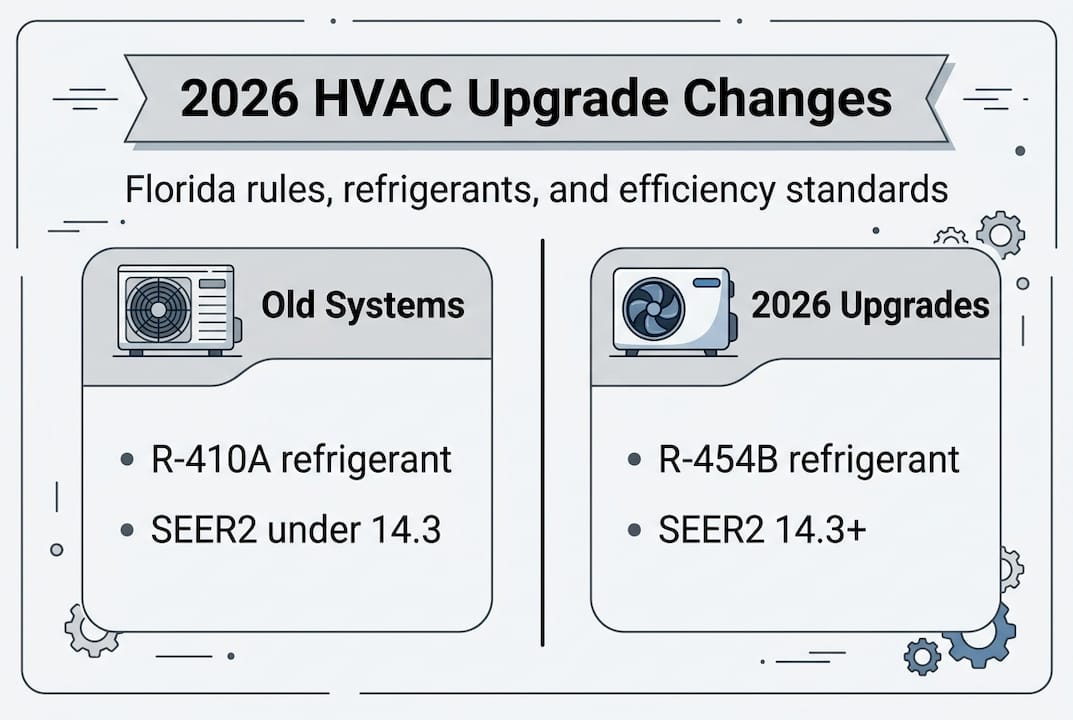
On top of refrigerant rules, Florida has updated its minimum efficiency standards. Florida mandates SEER2 14.3 as the minimum for new HVAC installations in climate zone 2A, which covers most of Central Florida. SEER2 stands for Seasonal Energy Efficiency Ratio 2, the updated testing standard that more accurately reflects real-world performance. Any new system installed without meeting this threshold can trigger permit failures and legal complications.
Here is a quick comparison of what the regulatory landscape looks like before and after 2026:
| Factor | Pre-2025 systems | 2026-compliant systems |
|---|---|---|
| Refrigerant | R-410A (high-GWP) | R-454B or R-290 (low-GWP) |
| Minimum efficiency | SEER 14 | SEER2 14.3 |
| Permit approval | Standard process | Requires compliant equipment |
| Repair cost trend | Stable | Rising fast |
| Environmental impact | High CO2 output | Significantly reduced |
The environmental case is real too. Switching from R-410A to low-GWP refrigerants can cut the climate impact of refrigerant leaks by up to 75%. For homeowners who care about their footprint, and for property managers facing increasing ESG (environmental, social, governance) scrutiny from tenants, that matters. Understanding the Florida HVAC upgrade factors behind these changes helps you make a smarter decision. The Florida HVAC efficiency picture is shifting fast, and compliance is no longer optional.
Now that you see the 2026 landscape, let’s dig into why energy efficiency directly impacts your home’s comfort and your wallet.
How HVAC upgrades slash energy bills and boost comfort in Central Florida
Apart from regulatory and environmental benefits, the numbers for monthly savings and comfort are compelling. Central Florida’s climate is brutal. Summers push humidity to 70-80% relative humidity (RH) for months at a time, and your HVAC system is working overtime from April through October. An older, low-efficiency system is not just costing you more to run. It is also struggling to keep your home feeling comfortable.
Upgrading to SEER2 15.2+ saves 20-50% on cooling and heating costs in Florida, with 30-50% savings common for homes replacing 10 to 12 year old units. That is not a rounding error. On a $250 monthly electric bill, a 40% reduction means $100 back in your pocket every single month.
Here is how modern systems compare on key performance metrics:
| System type | Typical SEER2 | Humidity control | Estimated monthly savings |
|---|---|---|---|
| Old single-stage AC (10+ yrs) | 10-12 | Poor | Baseline |
| New standard AC (SEER2 14.3) | 14.3 | Moderate | 20-30% |
| Inverter heat pump (SEER2 18+) | 18-22 | Excellent | 35-50% |
| Geothermal system | 25+ | Excellent | Up to 60% |
Key comfort and efficiency benefits of upgrading include:
- Variable-speed inverter technology runs at partial capacity most of the time, making longer, gentler cooling cycles that pull far more moisture from the air
- Duct sealing and testing, now required on new installs, eliminates the up to 30% of cooled air lost through leaky ducts in older homes
- Better dehumidification means your thermostat can be set a degree or two higher while still feeling cooler
- Quieter operation because inverter compressors ramp up gradually rather than slamming on at full power
Pro Tip: If your home feels clammy even when the AC is running, that is a classic sign your system is short-cycling. It cools the air fast but does not run long enough to pull humidity out. An inverter system fixes this directly.
The link between comfort and efficiency in Florida is tighter than most people realize. A more efficient system is almost always a more comfortable one in this climate.
Understanding costs, rebates, and ROI for HVAC upgrades in 2026
Once you know the financial upsides, the question becomes how to maximize comfort and minimize future risk through smart system choices. The upfront cost of a new HVAC system is the number that stops most homeowners. But it is the wrong number to focus on alone.
Replacement costs in Central Florida range from $5,800 to $15,500, depending on system type, size, and ductwork needs. That range is wide because a basic 2-ton AC replacement is very different from a full inverter heat pump install with duct testing and sealing. Here is what typically makes up the total:
- Equipment cost: $2,500 to $8,000 depending on brand, SEER2 rating, and system type
- Installation labor: $1,200 to $3,500 based on complexity and home layout
- Ductwork testing and sealing: $500 to $2,500 if required (and it often is)
- Permits and inspections: $150 to $400 depending on county
Available rebates and incentives can meaningfully offset these numbers:
- OUC and Duke Energy rebates offer cash back for qualifying high-efficiency equipment, often $200 to $800 per unit
- Federal IRA 25C tax credits provided up to $600 for qualifying HVAC equipment, though this program’s future is uncertain beyond 2026
- Multifamily property manager rebates through OUC’s program offer up to $2,500 per unit for qualifying upgrades in apartment and rental properties
- Manufacturer rebates are often stackable with utility rebates during promotional periods
Pro Tip: Always ask your contractor to help you apply for rebates before the install. Some programs require pre-approval or specific equipment models to qualify.
The typical ROI (return on investment) timeline for a Central Florida HVAC upgrade runs 4 to 7 years when you factor in energy savings, reduced repair costs, and available incentives. Working with trusted HVAC contractors who know the local rebate landscape can shorten that window significantly.
What most people miss: Tech choices, installation quality, and future-proofing
The final piece is understanding how tech, installation, and compliance fit together in a future-ready upgrade strategy. Most homeowners focus on the brand name or the price tag. The factors that actually determine real-world savings are less obvious.
Inverter vs. single-stage systems is the most important tech decision you will make. Single-stage systems run at 100% capacity or not at all. In Florida’s humidity, that means short bursts of cooling that never fully dehumidify your home. Inverter systems modulate output continuously, and variable speed inverter heat pumps are now considered essential for proper humidity control in humid climates like Central Florida’s.
Duct integrity is equally critical. Duct sealing and testing are now mandated for new installs in Florida. If your ducts are leaking, a brand-new high-efficiency system will underperform from day one. Leaky ducts can wipe out 20 to 30% of your efficiency gains before the air even reaches your living space.
Refrigerant compatibility is non-negotiable. Low-GWP refrigerants like R-454B offer superior efficiency compared to R-410A, but they require entirely new system components. There is no drop-in replacement option. If a contractor tells you they can just swap refrigerants in your old unit, walk away.
Key factors that separate a great install from a mediocre one:
- Proper system sizing using Manual J load calculations (not just matching the old unit’s tonnage)
- Verified duct sealing with blower door or duct blaster testing
- Correct refrigerant charge verified with gauges, not estimated
- Full permit pull and inspection to protect your warranty and home insurance
“The difference between a system that delivers its rated efficiency and one that falls short almost always comes down to installation quality, not the equipment itself.”
When you are upgrading HVAC in Florida, the installer matters as much as the equipment. Choose accordingly.
Our take: The costly risks of waiting to upgrade in 2026
We have seen this play out dozens of times. A homeowner holds off on replacing a 13-year-old system, figuring they will get one more summer out of it. Then it fails in August, during peak demand, and they are scrambling for emergency service. Now they are paying premium prices for whatever is available fast, with no time to compare rebates or equipment options.
In Central Florida, the risk calculus is worse than most places. Coastal corrosion, rising insurance premiums, and expiring federal incentives make waiting genuinely expensive. Salt air from nearby coasts accelerates coil corrosion. Severe storm seasons can damage aging outdoor units. And if the 25C federal tax credit disappears after 2026, you lose a meaningful incentive that may not return.
The idea that waiting saves money is a myth we see cost homeowners thousands. Utility rebates exist now. Compliant equipment is in stock now. Contractors have availability now. That combination will not last indefinitely. Choosing the right HVAC system type before you are forced into an emergency decision is the smartest financial move you can make this year.
Upgrade with confidence: Your next step with Lucas Air
At Lucas Air Conditioning and Heating, we have been helping Central Florida homeowners and property managers navigate exactly these kinds of changes since 2018. We know the 2026 compliance requirements, the local utility rebate programs, and which equipment actually performs in Florida’s heat and humidity.
When you work with us, you get hands-on help with rebate applications, duct sealing, and permit paperwork, not just a new box installed and a handshake. We match you with the right system for your home, your budget, and your goals. Explore the HVAC upgrade benefits that are available to you, walk through our step-by-step installation process, or schedule a free consultation through our residential and commercial HVAC installation page. Let’s get you set up before the summer heat arrives.
Frequently asked questions
Is it mandatory to upgrade my HVAC system in 2026 in Central Florida?
You are not legally required to replace a working system, but Florida code and EPA rules mean any new installation or major permitted repair must use compliant refrigerants and meet SEER2 14.3 minimums.
How much can I really save by upgrading my HVAC in 2026?
Most Central Florida homes cut bills by 30-50% when replacing a 10 to 12 year old system with a SEER2 15.2+ unit, with inverter heat pumps delivering the highest savings.
What incentives are available for HVAC upgrades in 2026?
OUC and Duke rebates are currently active, and property managers may qualify for up to $2,500 per unit through multifamily programs. Federal 25C tax credits have expired for most equipment, so act on utility rebates now.
Will new refrigerants work in my old HVAC system?
No. R-454B and R-290 require fully compatible new systems and cannot be retrofitted into legacy R-410A equipment. There is no drop-in option.
