
TL;DR:
- Proper HVAC selection impacts guest comfort, energy costs, and long-term maintenance in hotels.
- VRF systems offer the highest efficiency and zoning flexibility for mid to large-sized hotels.
- Budget properties benefit from PTAC units, while chillers suit mid-sized hotels seeking reliability.
Choosing the right HVAC system for your hotel is one of the most consequential decisions you’ll make as a property manager or owner. Get it right, and guests sleep soundly, energy bills stay manageable, and your maintenance team isn’t fielding emergency calls at 2 a.m. Get it wrong, and you’re looking at noise complaints, soaring utility costs, and rooms that feel like saunas in July. In Central Florida, where summer humidity is relentless and cooling demands stretch across most of the year, the stakes are even higher. This guide breaks down the most common hotel HVAC options, compares their real-world performance, and helps you match the right system to your property.
Table of Contents
- Key criteria for selecting a hotel HVAC system
- PTAC units: Budget-friendly classics for small hotels
- Chillers and fan coil systems: Reliable comfort for mid-sized hotels
- VRF systems: Top-tier efficiency and control for modern hotels
- Which HVAC system fits your hotel? Situational recommendations
- The surprising cost of getting HVAC wrong: Our hands-on hotel experience
- Take the next step: Expert HVAC solutions for Central Florida hotels
- Frequently asked questions
Key Takeaways
| Point | Details |
|---|---|
| Selection Criteria | Consider energy use, noise, cost, and comfort when choosing a hotel HVAC system. |
| PTAC Use Cases | PTAC units are cost-effective for small hotels but may generate unwanted noise. |
| VRF Advantages | VRF systems offer the best efficiency, guest comfort, and smart control features. |
| Tailored Approach | Match your HVAC choice to property size, guest expectations, and Central Florida’s unique climate. |
Key criteria for selecting a hotel HVAC system
With clear stakes in mind, let’s define what matters most when picking your hotel’s HVAC solution. Before you start comparing equipment, you need a decision framework. Every hotel is different, but the core criteria stay consistent across property types and sizes.
HVAC can account for 40-70% of a hotel’s total energy use. That single number should anchor every conversation you have with vendors and contractors. Energy efficiency isn’t just a green initiative. It directly affects your bottom line every single month.
Here are the key criteria every hotel manager should evaluate:
- Energy efficiency: Look for systems with strong EER (Energy Efficiency Ratio) or COP (Coefficient of Performance) ratings. In Central Florida’s climate, cooling load is heavy, so efficiency pays off fast.
- Guest comfort: Temperature consistency, humidity control, and quiet operation all shape the guest experience. One bad night’s sleep from a noisy unit can mean a one-star review.
- Installation complexity: Some systems require significant structural changes. Others drop in with minimal disruption. Know what your building can accommodate.
- Noise levels: Measured in decibels (dB), this is often overlooked until guests start complaining.
- Maintenance requirements: Some systems need specialized technicians. Others are straightforward. Factor in service availability in your area.
- Lifecycle cost: Upfront price matters, but a cheaper system that costs more to run and repair can be the more expensive choice over ten years.
The benefits of upgrading HVAC systems go well beyond comfort. Newer equipment reduces energy waste, lowers repair frequency, and improves indoor air quality for guests and staff alike.
Pro Tip: Always request the noise rating (in dB) for any unit before purchasing. A system that runs at 50 dB or above can disrupt light sleepers, and in the hospitality industry, that translates directly into negative reviews.
A solid HVAC maintenance guide can also help you plan for ongoing costs before you commit to a system type.
PTAC units: Budget-friendly classics for small hotels
Now, let’s look at one of the most common systems for small hotels. Packaged Terminal Air Conditioners, or PTAC units, are the self-contained wall units you’ve seen in countless budget hotels and motels. Each unit serves one room independently, handling both heating and cooling without connecting to a central system.
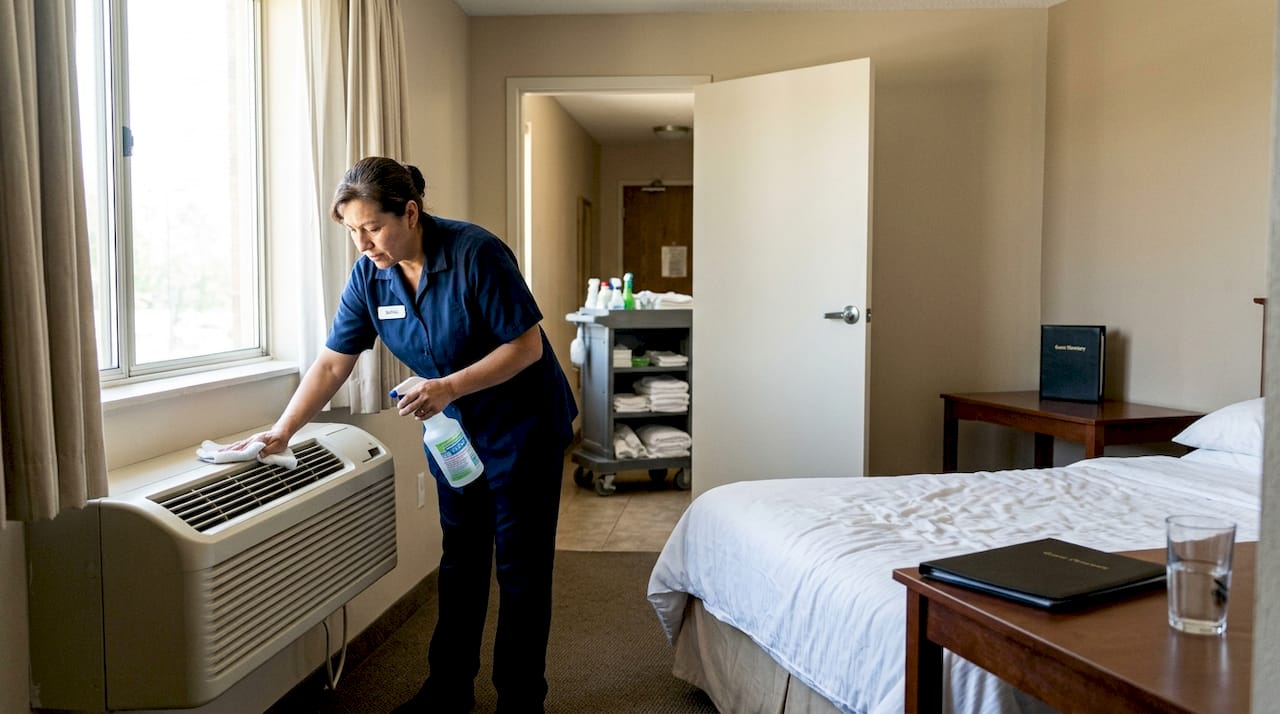
For economy properties and small hotels under 50 rooms, PTACs make a lot of practical sense. Installation is straightforward, replacement is fast, and if one unit fails, only that room is affected. There’s no cascading system failure.
However, the tradeoffs are real. PTAC units cost $500-1,500 per unit, carry a moderate efficiency rating of EER 9-10, and generate noise levels averaging 45-50 dB. That noise level is noticeable in a quiet room, especially for light sleepers.
Pros of PTAC units:
- Low upfront cost per room
- Simple installation and replacement
- Independent operation per room (no system-wide failures)
- Easy for general maintenance staff to service
Cons of PTAC units:
- Moderate energy efficiency compared to newer technologies
- Higher operational noise that can affect guest satisfaction
- Limited zoning or smart control integration
- Aesthetic limitations (wall-mounted units are visible and bulky)
For Central Florida motels and budget properties, PTACs remain a viable entry point. The key is managing expectations. You won’t get boutique-level quiet, but you will get reliable, affordable room-by-room control.
Pro Tip: If you’re running PTACs and getting noise complaints, check the unit’s mounting seal first. A loose or worn seal amplifies vibration noise significantly and is an easy fix that many operators miss.
Staying ahead of wear and tear is critical. Reviewing hotel HVAC maintenance essentials can help you extend the life of your PTAC units and reduce unexpected failures during peak season.
Chillers and fan coil systems: Reliable comfort for mid-sized hotels
Next, for hotels needing more robustness and quieter performance, consider chillers with fan coils. A chiller system works by cooling water centrally, then distributing that chilled water through pipes to fan coil units in each room. The fan coil unit then conditions the air locally, quietly, and consistently.
This approach is a mainstay for mid-sized hotels, typically properties with 50 to 300 rooms, because it delivers centralized control with room-level comfort. Guests rarely hear the system running, which is a significant advantage over PTACs.
“Chillers outperform PTAC units in efficiency, especially at part load, making them a strong long-term investment for properties with consistent occupancy.”
The tradeoffs involve upfront cost and maintenance complexity. Chillers require more physical space for mechanical rooms, and servicing them demands skilled technicians rather than general maintenance staff.
| Feature | PTAC | Chiller + Fan Coil |
|---|---|---|
| Efficiency (EER/COP) | EER 9-10 | COP 4-6 |
| Upfront cost | Low | High |
| Noise level | 45-50 dB | 25-35 dB |
| Maintenance complexity | Low | High |
| Central control | No | Yes |
Operational and maintenance considerations:
- Requires a dedicated mechanical room
- Annual chiller inspections and water treatment are non-negotiable
- Fan coil units in rooms need periodic filter cleaning
- System failures affect multiple rooms, so redundancy planning matters
- Skilled HVAC technicians must be on call or under contract
For professional HVAC system installation of chiller-based systems, working with an experienced commercial contractor from the start prevents costly retrofits later.
VRF systems: Top-tier efficiency and control for modern hotels
If maximizing efficiency and precision matters most, let’s explore what VRF can offer. Variable Refrigerant Flow (VRF) technology works by circulating refrigerant directly to indoor units throughout the building, adjusting the flow precisely based on real-time demand in each zone. There’s no chilled water loop and no central air handler pushing air through ducts.
The result is impressive. VRF systems deliver 20-40% energy savings versus traditional options, with a typical ROI in 3-7 years. For a mid-to-high-tier hotel running year-round in Central Florida, that payback period is genuinely achievable.
VRF also excels at flexibility. You can heat one zone while cooling another simultaneously, which is useful for hotels with conference rooms, lobbies, and guest rooms all operating under different load conditions at the same time.
| Feature | PTAC | Chiller + Fan Coil | VRF |
|---|---|---|---|
| Energy efficiency | Moderate | Good | Excellent |
| Upfront cost | Low | High | Medium-High |
| Noise level | 45-50 dB | 25-35 dB | 20-30 dB |
| Payback period | N/A | 8-12 years | 3-7 years |
| Zoning flexibility | None | Moderate | Excellent |
Steps to evaluate if VRF is right for your property:
- Assess your building’s layout and number of zones needed.
- Review your current energy bills to estimate potential savings.
- Confirm refrigerant line routing is feasible in your structure.
- Get a load calculation done by a licensed HVAC engineer.
- Compare total lifecycle cost, not just installation price.
VRF suits boutique hotels, mid-tier properties, and any new construction where design flexibility matters. For existing properties, the VRF system installation process requires careful planning but is often less disruptive than installing a full chiller system.
Pro Tip: Pair your VRF system with a smart building management system (BMS). Automated scheduling and occupancy-based controls can push your energy savings even further, sometimes an additional 10-15% beyond the system’s baseline performance.
Which HVAC system fits your hotel? Situational recommendations
Armed with system details, here’s how to make the right call for your hotel. The best system isn’t the most expensive one or the most technically advanced. It’s the one that matches your property’s size, budget, guest expectations, and operational capacity.
Central Florida hotels face unique humidity and cooling demands, making efficiency even more critical than in drier climates. Humidity control is as important as temperature control here, and not every system handles both equally well.
Scenario-based recommendations:
- Budget motel, under 50 rooms, retrofit: PTAC units. Low cost, easy swap-out, manageable with in-house staff.
- Mid-scale hotel, 50-150 rooms, new build: VRF system. Better efficiency, quieter operation, strong long-term ROI.
- Mid-scale hotel, 50-150 rooms, retrofit: Chiller with fan coils if mechanical space allows; VRF if it doesn’t.
- Boutique or lifestyle hotel, noise-sensitive: VRF. Guest experience demands quiet, and VRF delivers it.
- Large full-service hotel, 200+ rooms: Chiller plant with fan coils, potentially supplemented by VRF in specific zones.
- Aggressive ROI target, existing property: VRF upgrade from PTAC. The energy savings gap is large enough to justify the investment.
| Hotel type | Recommended system | Priority factor |
|---|---|---|
| Budget/economy | PTAC | Upfront cost |
| Mid-scale | VRF | Efficiency + comfort |
| Boutique | VRF | Noise + flexibility |
| Large full-service | Chiller + fan coil | Reliability + scale |
For hurricane readiness, prioritize systems with redundancy built in. A single chiller failure during a Florida summer with a full house is a crisis. Reviewing your hotel HVAC maintenance checklist before storm season is a smart habit.
The surprising cost of getting HVAC wrong: Our hands-on hotel experience
With system choices and criteria reviewed, consider this hard-earned perspective. After working on commercial HVAC projects across Central Florida, one pattern shows up repeatedly: hotel operators who choose a system based primarily on upfront price almost always pay more in the long run.
The costs that catch people off guard aren’t usually the equipment itself. They’re the noise complaints that pile up in online reviews, the emergency service calls during peak occupancy, and the deferred maintenance that turns a manageable repair into a full replacement. One overlooked dB rating on a PTAC unit can quietly drain your reputation over months.
What manufacturer brochures won’t tell you is how a system performs at year three or year five, after filters haven’t been changed on schedule and refrigerant levels have drifted. That’s where real-world performance diverges sharply from spec sheets.
The operators who get this right treat HVAC as a guest experience investment, not just a mechanical expense. They plan maintenance contracts before installation, not after the first breakdown. They ask about noise ratings before asking about price. And they work with contractors who understand the specific demands of Florida’s climate, not just general HVAC principles.
Following proven HVAC best practices from the start saves money and headaches that most hotel managers only recognize in hindsight.
Take the next step: Expert HVAC solutions for Central Florida hotels
Ready to apply this guidance and safeguard your investment? At Lucas Air Conditioning and Heating, we’ve helped commercial property owners across Central Florida evaluate, install, and maintain HVAC systems that actually perform under Florida’s demanding conditions.
Whether you’re comparing system types for a new build, planning a retrofit, or just trying to get ahead of your next maintenance cycle, our team brings real commercial experience to every consultation. We work with hotel managers who need honest answers, not just a sales pitch. Explore our hotel HVAC installation experts page to see how we approach commercial projects, or review our business HVAC repair workflow to understand what a service partnership with us actually looks like. Reach out today and let’s find the right fit for your property.
Frequently asked questions
What is the most energy-efficient HVAC system for hotels in Central Florida?
VRF systems are widely considered the most energy-efficient option for hotels, offering 20-40% energy savings compared to traditional systems like PTACs or older chiller setups.
How do PTAC units compare to VRF for guest comfort?
VRF systems operate significantly more quietly and provide more precise temperature control than PTAC units. PTAC units average 45-50 dB of noise output, while VRF systems typically run at 20-30 dB.
What is the typical ROI for upgrading to a VRF system?
Most hotels see a full return on their VRF investment within 3-7 years, driven by consistent energy cost reductions across the property’s operating life.
Do chillers require more maintenance than PTAC or VRF systems?
Yes. Chillers need skilled maintenance teams for ongoing reliability, including annual inspections and water treatment, but they deliver quieter and more consistent performance than PTAC units at scale.
