

There is no federal tax credit for heat pumps placed in service in 2026. The Energy Efficient Home Improvement Credit under Section 25C, and the related Residential Clean Energy Credit under Section 25D, stopped applying to any equipment placed in service after December 31, 2025. If your heat pump was installed and running by that date, you can still claim the credit on your 2025 tax return, filed in early 2026.
TL;DR:
- The federal tax credit for heat pumps ended on December 31, 2025, and cannot be claimed for systems installed after that date, although claims for 2025 are still possible.
- To qualify for the 2025 credit, the heat pump must have been installed and operational by December 31, 2025, with the installer certifying the placed-in-service date, not just payment or delivery.
- In 2026, homeowners should focus on rebates like HOMES and HEAR, which provide upfront discounts and vary by location, income, and equipment efficiency.
- Proper documentation, including installer certification, detailed invoices, and efficiency certifications, is essential to claim rebates or amend prior credits.
- Without the federal credit, maximum savings in 2026 rely on stacking rebates, utility incentives, or financing, with no guaranteed future federal tax credits on the horizon.
Table of Contents
- Heat pump tax credit 2026: the federal status and the dates that matter
- Claiming the credit for a 2025 install: Form 5695 and your paper trail
- What the expired credit actually covered
- Federal and state rebate programs still worth pursuing
- Building your documentation checklist before you file or apply
- Planning a 2026 install without the federal credit
- Eligibility and income rules for 2026 heat pump incentives
- How 2026 provisions differ from what was available in 2025
- Do efficiency standards affect which heat pumps still qualify for rebates?
- Does the heat pump credit expiration affect other federal incentives?
- What real out-of-pocket savings look like without the tax credit
- Could Congress bring back a federal heat pump credit after 2026?
- Lucas Air’s perspective: what we’re seeing on job sites in 2026
- How Lucas Air helps you navigate the post-credit landscape
- Where to verify the rules yourself
- Sources
Heat pump tax credit 2026: the federal status and the dates that matter
The rule is simpler than most homeowners expect once you separate the two dates that get confused constantly. Section 25C and Section 25D both expired for equipment placed in service after December 31, 2025, a cutoff the IRS confirms directly. That expiration didn’t happen on its own schedule. The One Big Beautiful Bill Act, Public Law 119-21, accelerated the termination date that had originally been set to run through 2032 under the Inflation Reduction Act.
The detail that trips people up is the difference between “placed in service” and “expenditure made.” Placed in service means the unit is installed, connected, and operational, not simply purchased, delivered, or paid for.
- A heat pump bought and paid for in December 2025 but not installed until January 2026 does not qualify.
- A heat pump installed and running by December 31, 2025, qualifies even if the final invoice was paid in early January.
- Contractor scheduling delays are the single most common reason homeowners lose eligibility they thought they had locked in.
Claiming the credit for a 2025 install: Form 5695 and your paper trail
If your system was operational by December 31, 2025, you still have a legitimate claim. The process runs through your 2025 federal return, filed by the usual spring 2026 deadline, and it hinges on paperwork you should already have from your installer.
- Confirm your placed-in-service date first. This is the date your contractor certifies the system was installed and operating, not the invoice date or the delivery date.
- Gather documentation: the final invoice showing model numbers, the installer’s certification of completion, and any ENERGY STAR or CEE efficiency listing tied to that model.
- File IRS Form 5695 with your 2025 return, entering the equipment cost and calculating the credit amount against the annual caps.
- If you already filed your 2025 return without claiming the credit, you can amend it using Form 1040-X, typically within a three-year window from the original filing date.
Keep copies of everything. If the IRS ever questions the claim, the installer’s completion certificate is your strongest piece of evidence.
What the expired credit actually covered
Understanding what disappeared helps explain why so many homeowners feel shortchanged, and it matters directly if you’re still finalizing a 2025 claim. The Energy Efficient Home Improvement Credit paid 30% of project costs, capped at $2,000 per year for qualifying heat pumps. That cap applied separately from a $1,200 annual limit for envelope improvements like insulation, windows, and doors, so a homeowner who did both could reach $3,200 in total credits in a single tax year.
Eligible equipment included electric and natural gas heat pumps and heat pump water heaters, with product qualification tied to efficiency tiers set by the Consortium for Energy Efficiency and cross-referenced against ENERGY STAR’s product lists. Geothermal heat pumps ran under separate rules through Section 25D, with different caps and, in some cases, no annual dollar limit at all.
A few other mechanics worth knowing if you’re finalizing a 2025 claim:
- Labor and installation costs counted toward the eligible project cost in most cases, not just equipment price.
- The credit was nonrefundable, meaning it could reduce your tax bill to zero but wouldn’t generate a refund beyond what you owed.
- Multi-year planning mattered under the old rules. Homeowners sometimes split a heat pump purchase and an insulation upgrade across two tax years to maximize both the $2,000 and $1,200 tracks, an approach the ENERGY STAR aggregation guidance laid out in detail. With the credit gone, that kind of phased planning no longer applies to federal tax filing, though it still matters for timing rebate applications.
Federal and state rebate programs still worth pursuing
The tax credit is gone, but two federally funded rebate programs survived the same legislation that killed it. The Department of Energy confirms both HOMES and HEAR remain active as separately appropriated programs, unaffected by the Section 25C and 25D termination.
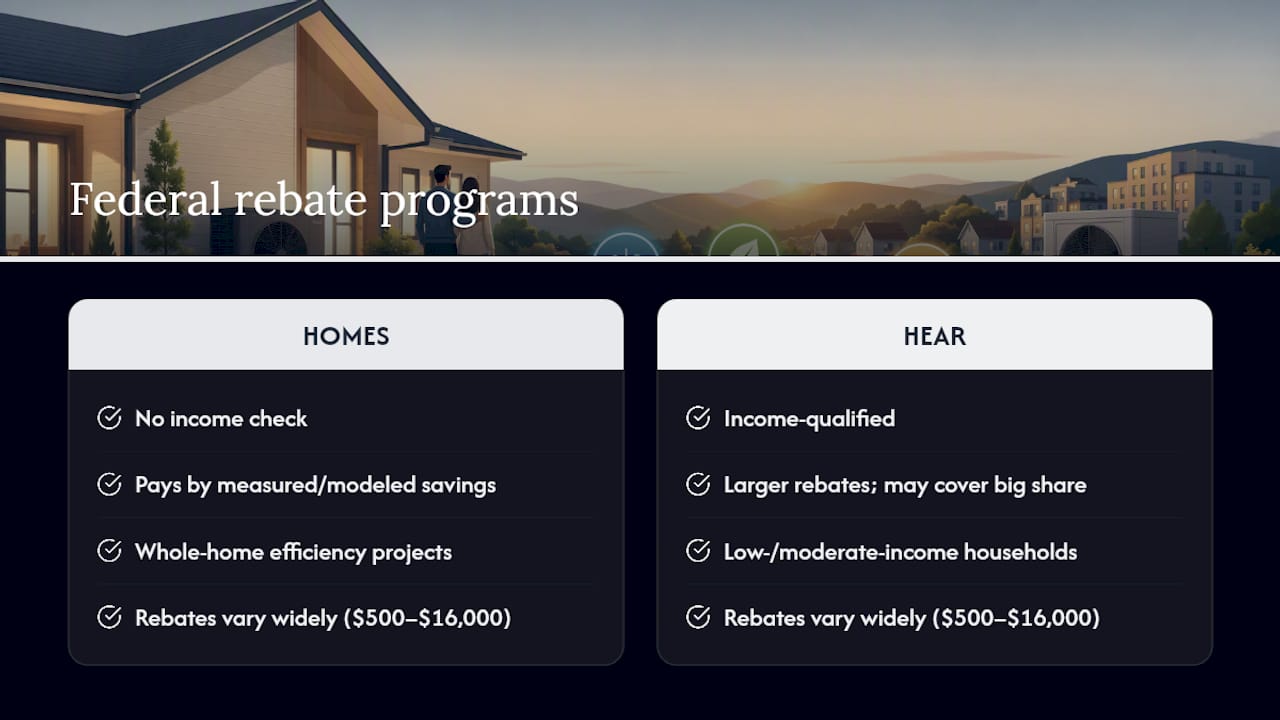
HOMES (Home Efficiency Rebates) doesn’t check your income. It pays out based on measured or modeled energy savings from a whole-home efficiency project, which can include a heat pump upgrade as part of a broader package. HEAR (Home Electrification and Appliance Rebates, previously known as HEEHRA) is income-qualified and offers substantially larger rebates for low- and moderate-income households, sometimes covering a significant share of equipment and installation costs for an efficient heat pump.
Both programs roll out state by state rather than all at once, so availability depends heavily on where you live. On top of that, state energy offices and local utilities frequently run their own rebate programs that stack with HOMES or HEAR. Reported amounts vary enormously. Industry tracking has documented rebates ranging from around $500 to as much as $16,000 depending on the program’s scope, your income tier, and whether it’s a utility incentive or a state-administered one.
Unlike the old tax credit, most of these rebates arrive as point-of-sale discounts rather than a line item on next year’s tax return, meaning you see the savings the day you pay your contractor, not months later.
Pro Tip: Ask your contractor to check rebate eligibility and reserve funding before you sign a contract. Some state HOMES/HEAR allocations are capped, and popular programs have run out of funds mid-year in the past.
To check what’s live in your area, start with the ENERGY STAR Rebate Finder, your state energy office’s website, and your local utility’s efficiency program page.
Building your documentation checklist before you file or apply
Whether you’re claiming a 2025 federal credit or applying for a 2026 rebate, the paperwork burden lands on you, not your contractor. A little organization upfront saves a lot of frustration later.
- Get a written installer statement listing the exact placed-in-service date, meaning the day the system became operational.
- Collect the final invoice with model numbers, serial numbers, and a clear breakdown of equipment versus labor costs.
- Save any ENERGY STAR certification or CEE tier documentation tied to your specific model, since program eligibility often hinges on that listing.
- Keep rebate reservation confirmations separately from tax paperwork. They follow different rules and different agencies.
- Cross-check your documents against the IRS Form 5695 instructions if you’re filing for a 2025 install, or your state rebate portal if you’re applying for 2026 rebate funding.
Call a tax professional if your situation involves an amended return, a multi-year project split across 2025 and 2026, or a rebate that might count as taxable income depending on the program structure.
Planning a 2026 install without the federal credit
Homeowners who scheduled a 2026 installation expecting a tax credit now need a different math. The good news is that rebates often deliver more real value upfront than the old credit did, since they reduce the price you pay immediately instead of waiting for a refund the following spring.
Point-of-sale rebates through HOMES, HEAR, or a utility program typically knock money off the invoice before you even pay it. A tax credit, by contrast, required you to float the full cost for months and only recovered value when you filed. For a household managing cash flow around a major purchase, that difference is the whole ballgame.
If rebates alone don’t close the gap, financing fills in the rest:
- Contractor financing, often through a manufacturer-backed program, can spread payments over several years with promotional rates.
- A home equity line of credit works well for homeowners with equity to tap and who want the lowest possible interest rate.
- Home improvement loans through a bank or credit union suit those who’d rather not touch home equity.
- Utility on-bill financing lets some customers repay the cost directly through their monthly utility bill, tied to the efficiency savings the upgrade generates.
Before scheduling anything, get written confirmation from your contractor that a specific rebate program is currently funded and that your equipment qualifies. Programs pause when state allocations run dry, and a contractor’s verbal assurance isn’t the same as a funded reservation. A detailed breakdown of how HVAC rebates get administered is worth a read if you want to understand how these programs move money before you commit to a purchase.
Eligibility and income rules for 2026 heat pump incentives
Since no federal tax credit exists for 2026 installs, “eligibility” now refers almost entirely to the rebate programs that replaced it, and those rules vary sharply depending on which program you’re applying to. HOMES rebates don’t check your income at all. They’re based on how much energy your project is projected or measured to save, which means a well-designed heat pump upgrade can qualify regardless of your tax bracket.
HEAR works differently. It’s structured around income tiers relative to your area’s median income, with the largest rebate amounts reserved for lower-income households and no rebate at all for households above a certain threshold in some states. Because HEAR is administered state by state, the exact income cutoffs and rebate percentages differ depending on where you live, so the only reliable way to know your specific number is to check your state energy office’s rebate portal directly.
Utility rebates add another layer entirely, and most don’t ask about income at all. Instead, they’re often tied to specific equipment efficiency ratings or enrollment in a utility’s demand-response program. A homeowner could easily qualify for a utility rebate while sitting above the income threshold for HEAR, and vice versa. That’s why stacking multiple programs, rather than assuming only one applies, is usually the smarter strategy for 2026 installs.
How 2026 provisions differ from what was available in 2025
The gap between 2025 and 2026 isn’t a matter of smaller caps or new restrictions layered onto the old credit. The federal tax credit simply doesn’t exist anymore for new installs, which makes 2026 fundamentally different from every year since the credit launched under the Inflation Reduction Act.
For 2025 installs, the rules were generous by comparison: a 30% credit, a $2,000 annual cap for heat pumps, a separate $1,200 cap for envelope improvements, and equipment eligibility tied to CEE efficiency tiers. None of that framework carries into 2026 for federal tax purposes. There’s no reduced credit, no phased-down rate, no smaller cap. It’s a hard stop.
What did expand, relatively speaking, is the importance of rebate programs. With the tax credit gone, HOMES and HEAR funding, along with state and utility rebates, now carry the entire weight of federal and state support for heat pump upgrades. Some states have responded by increasing their own rebate allocations or fast-tracking HOMES rollout to fill part of the gap left by the expired credit, though availability still depends heavily on your specific state’s program status.
The practical upshot: 2025 was about maximizing a known federal credit alongside whatever rebates existed. 2026 is entirely about rebate stacking, financing, and timing your install around fund availability rather than a tax season deadline.
Do efficiency standards affect which heat pumps still qualify for rebates?
Efficiency requirements haven’t loosened just because the tax credit disappeared. If anything, they matter more now, since every remaining incentive, whether it’s HOMES, HEAR, or a utility program, ties eligibility to specific performance benchmarks rather than a blanket equipment category.
Under the old 25C credit, qualification depended on meeting the Consortium for Energy Efficiency’s highest efficiency tier in effect at the start of the calendar year, cross-referenced against ENERGY STAR product listings. That same CEE-and-ENERGY STAR framework carries over into most current rebate programs, since states and utilities largely adopted the existing product databases rather than building new ones from scratch.
Practically, this means a heat pump that would have qualified for the old federal credit is very likely to qualify for HOMES, HEAR, or a utility rebate, since the underlying efficiency benchmarks didn’t change. The bigger risk is buying a lower-tier unit assuming any heat pump automatically qualifies for rebate money. It doesn’t. Confirm the specific model against your state’s approved equipment list or the ENERGY STAR Rebate Finder before you sign a contract, not after.
For homeowners in Central Florida weighing efficiency tiers against upfront cost, understanding how heat pump efficiency ratings actually affect performance helps clarify whether a higher-tier unit is worth the price difference even without a federal credit backing it.
Does the heat pump credit expiration affect other federal incentives?
The expiration of Section 25C is narrower than a lot of homeowners assume. It doesn’t touch other federal programs that might apply to the same project, and it doesn’t retroactively change anything you already claimed on a prior tax return.
Section 25D, the Residential Clean Energy Credit, expired on the same December 31, 2025 cutoff and under the same legislation, so solar panels, battery storage, and geothermal heat pumps installed after that date lose their federal credit too. If your 2026 project bundles a heat pump with solar, don’t expect either piece to qualify federally.
HOMES and HEAR, by contrast, sit outside the tax code entirely. They’re funded through separate appropriations under the Inflation Reduction Act and were untouched by the legislation that killed 25C and 25D, according to industry tracking of the legislative changes. That separation is why they survived while the tax credits didn’t.
One nuance worth flagging for anyone stacking incentives: some rebate amounts may count as taxable income depending on how the program is structured and whether it’s classified as a rebate versus a subsidy. This is genuinely a case-by-case question, and it’s worth a quick conversation with a tax professional before you assume a $5,000 rebate is entirely tax-free money.
What real out-of-pocket savings look like without the tax credit
Numbers make this concrete. Say a homeowner in 2025 installed a qualifying heat pump for $9,000 in total project cost. Under the old rules, they’d claim 30% up to the $2,000 cap, dropping their effective tax-adjusted cost to $7,000, assuming they had enough tax liability to use the full credit.
Now run the same $9,000 project in 2026. There’s no federal credit to apply. If that same homeowner lives somewhere with an active HOMES rebate offering, say, $2,000 for a comparable measured-savings project, and their utility kicks in another $500 for choosing a high-efficiency model, the out-of-pocket cost lands at $6,500, paid at the point of sale rather than recovered months later at tax time.
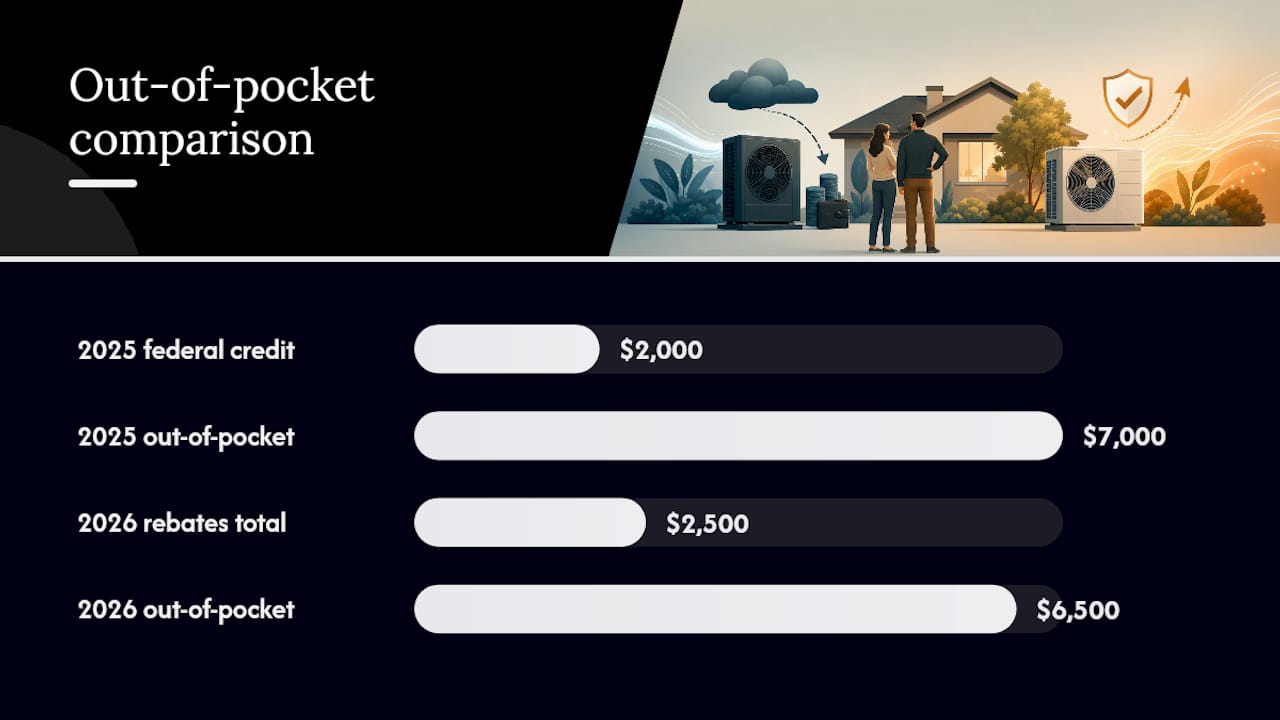
The comparison isn’t perfectly apples to apples since rebate amounts vary so widely by state and utility, but the structural difference matters more than the exact dollar figure. The 2025 homeowner floated the full $9,000 for months and got money back eventually. The 2026 homeowner potentially pays less upfront and never has to wait. Whether that nets out better depends entirely on which rebates are funded in your specific area, which is exactly why checking program status before signing a contract, rather than after, protects your budget either way.
Could Congress bring back a federal heat pump credit after 2026?
Nothing currently in front of Congress guarantees a replacement for the expired 25C and 25D credits. Tax credits tied to energy efficiency have swung back and forth across multiple administrations, appearing, lapsing, and returning in different forms since the early 2000s, so a future reinstatement isn’t out of the question on a multi-year horizon.
What seems more durable, at least for now, is the rebate infrastructure built through HOMES and HEAR. Because those programs are funded through direct appropriations rather than annual tax provisions, they’re less exposed to the kind of single-bill termination that ended the 25C credit. That doesn’t make them permanent, but it does mean their funding timeline runs differently than a tax credit’s.
For homeowners planning further out than this year, the safest approach is to treat any future federal credit as speculative and plan around what’s confirmed today: state and utility rebates, HOMES and HEAR where available, and financing to cover the rest. If a new credit does pass, it will likely apply going forward from its enactment date, not retroactively, so waiting on the chance of a future credit rarely makes financial sense if your system is failing now.
Lucas Air’s perspective: what we’re seeing on job sites in 2026
We’ve had more than one homeowner call us confused about why their neighbor got a tax credit last year and they can’t get one now. It comes down entirely to that placed-in-service date, and we’ve started building it into every install timeline we quote, because a two-week scheduling delay in late December used to mean the difference between qualifying and not.
What we spend most of our time on now is rebate paperwork. HOMES and HEAR applications require documentation most homeowners don’t know to keep, so we provide model numbers, efficiency certifications, and completion dates as a standard part of every install. If you’re planning a 2026 heat pump upgrade and want help sorting out what rebates you actually qualify for, scheduling an inspection is the fastest way to get real numbers instead of guesses.
— Results
How Lucas Air helps you navigate the post-credit landscape
Lucas Air is the local alternative to figuring this out alone. With the federal tax credit gone, the real savings now come from rebate eligibility and getting the paperwork right the first time, and that’s exactly where a Central Florida installer who tracks state and utility programs earns its keep.

We handle the documentation piece directly: placed-in-service certification, model and efficiency records, and rebate reservation support, so you’re not scrambling to reconstruct paperwork months after the install. Our team also walks homeowners through financing options when rebates alone don’t cover the full project cost, and we’ll tell you upfront whether a specific unit qualifies for HOMES, HEAR, or your local utility’s program before you commit to anything.
If you’re ready to move forward on a heat pump installation, start with a step-by-step estimate built around your home’s actual needs and whatever rebate funding is currently available in your county. We serve homeowners and businesses across Central Florida, and every quote includes a plain-language breakdown of what you’ll actually pay after rebates, not just the sticker price.
Where to verify the rules yourself
Don’t take any of this secondhand, including from us. The programs and figures here change, and the safest habit is checking the primary source before you file or sign a contract.
- The IRS Energy Efficient Home Improvement Credit page covers the official expiration date, placed-in-service rules, and FAQ guidance for 2025 filers.
- Form 5695 and its instructions walk through exactly how to calculate and file your credit or amend a prior return.
- ENERGY STAR’s federal tax credit page lists qualifying product tiers and historical credit structure for reference.
- The Department of Energy’s home upgrades and rebates page tracks HOMES and HEAR rollout status by state.
- Your state energy office and local utility websites are the fastest way to confirm rebate amounts and funding availability in your specific area.
Sources
- Energy Efficient Home Improvement Credit
- Federal Tax Credits for Energy Efficiency
- Energy
- Heat Pump Tax Credits & Rebates 2026: What Changed After Section 25C Expired | HVAC Base
