

Your air conditioner controls humidity by cooling air below its dew point, wringing moisture out on the coil as it runs. Most humidity complaints trace back to airflow that’s too fast, a thermostat cycling the system off too soon, or a dirty coil that can’t hold condensation. Try dropping fan speed and extending run time first. If indoor relative humidity stays above 60% or you see condensation on ducts and windows, that’s your signal to call a technician about a whole-house dehumidifier.
TL;DR:
- Oversized systems tend to short-cycle, resulting in minimal dehumidification despite reaching temperature setpoints quickly.
- Running the fan continuously or at high speeds can prevent proper moisture removal by pushing air past the coil too fast.
- Dirt on coils, low refrigerant, or duct leaks reduce the system’s ability to dehumidify, often requiring professional inspection and maintenance.
- Adjusting fan speed, using dehumidify modes, and limiting outdoor air intake can improve moisture control without hardware upgrades.
- Persistent humidity above 60 percent or visible condensation warrants a professional assessment for potential upgrades like whole-house dehumidifiers or system replacement.
Table of Contents
- How does an HVAC system actually remove humidity?
- Why isn’t my AC removing humidity from the house?
- What settings actually lower indoor humidity?
- When should you add a dehumidifier or upgrade your system?
- What maintenance actually restores lost dehumidification capacity?
- How does a professional HVAC inspection diagnose humidity problems?
- Get a professional humidity diagnosis for your home
- Sources
How does an HVAC system actually remove humidity?
Air conditioners handle two separate jobs at once: sensible cooling (dropping the temperature you feel) and latent cooling (pulling water vapor out of the air). Only the second one lowers humidity, and it only happens when the evaporator coil runs cold enough to drop below the air’s dew point. Once that happens, water vapor condenses on the coil fins and drains away through the condensate line. If the coil never gets cold enough, or if air moves across it too fast to condense properly, you get cooled air with the moisture still in it.
This is why CFM per ton matters. Standard design targets roughly moderate airflow per ton of cooling capacity. Push airflow higher than that and the coil doesn’t have enough contact time with the air to pull moisture out. Push it too low and you risk icing the coil. Runtime plays a similar role. A short, five-minute cooling cycle chills the air fast but barely wets the coil, so the room feels cool and still muggy.
Here’s the part most people miss: a properly sized single-stage AC set only to a temperature target has no way to prioritize moisture removal over temperature. It shuts off the second the thermostat hits its number, regardless of how humid the room still is. That’s the mechanical reason a house can read 72 degrees on the thermostat and still feel damp, and it’s also why dew point matters more than relative humidity for how “clammy” a room actually feels.
Why isn’t my AC removing humidity from the house?
Oversized equipment is the most common culprit. A system sized for peak summer heat cools a room to setpoint in a few minutes on a mild day, then shuts off, having barely dehumidified anything. That short-cycling pattern repeats all day, and the house never spends enough continuous runtime pulling moisture out.
A handful of other issues compound the problem:
- High fan speed pushes air past the coil too fast for adequate condensation, especially on systems where a technician set airflow for maximum sensible cooling.
- A dirty coil loses surface contact with the air stream, cutting both cooling capacity and moisture removal, even when filters look fine.
- Low refrigerant charge raises coil temperature above the dew point, so the system cools air without dehumidifying it, while overcharge can cause its own inefficiencies.
- Excess outdoor air intake or bathroom and laundry exhaust fans that don’t run (or run too much) shift the moisture balance, especially in humid climates.
- Tight modern envelopes trap the moisture generated by cooking, showers, and occupants, since there’s less natural leakage to flush it out, a tradeoff DOE research on hot-humid climates has flagged as a growing issue in newer construction.
Any one of these can leave you with a house that hits its temperature target and still feels wet.
What settings actually lower indoor humidity?
Before buying new equipment, most homes can improve dehumidification with adjustments a homeowner or facilities manager can make in an afternoon.
Set your thermostat fan to “auto,” not “on.” Running the blower continuously reevaporates the water sitting on the coil back into your air stream between cooling cycles, undoing the dehumidification you just paid for. If your system offers a dedicated “dry” or dehumidify mode, use it during humid stretches. It typically slows the blower and extends compressor runtime specifically to maximize latent removal, even at the cost of a little extra cooling.
Dropping fan speed by a notch (many variable systems allow this through the thermostat or air handler settings) gives air more time on the coil. DOE testing on hot-humid climate systems found that lowering system airflow and adjusting controls improved dehumidification meaningfully on standard equipment, without any hardware changes. A humidistat-based control strategy can automate this by letting the system run on humidity, not just temperature.
A few more practical moves:
- Avoid running whole-house ventilation heavily during the most humid hours of the day.
- Skip the temptation to crank the thermostat lower to “dry out” a room. It often just short-cycles the system faster.
- Use a portable dehumidifier as a stopgap for one damp room (a basement, a laundry area) rather than a whole-house fix.
Pro Tip: If your thermostat has a humidity readout, watch it for 48 hours instead of adjusting blind. A room that drifts from 45% at night to 62% by afternoon is telling you the problem is airflow and runtime, not a broken system.
When should you add a dehumidifier or upgrade your system?
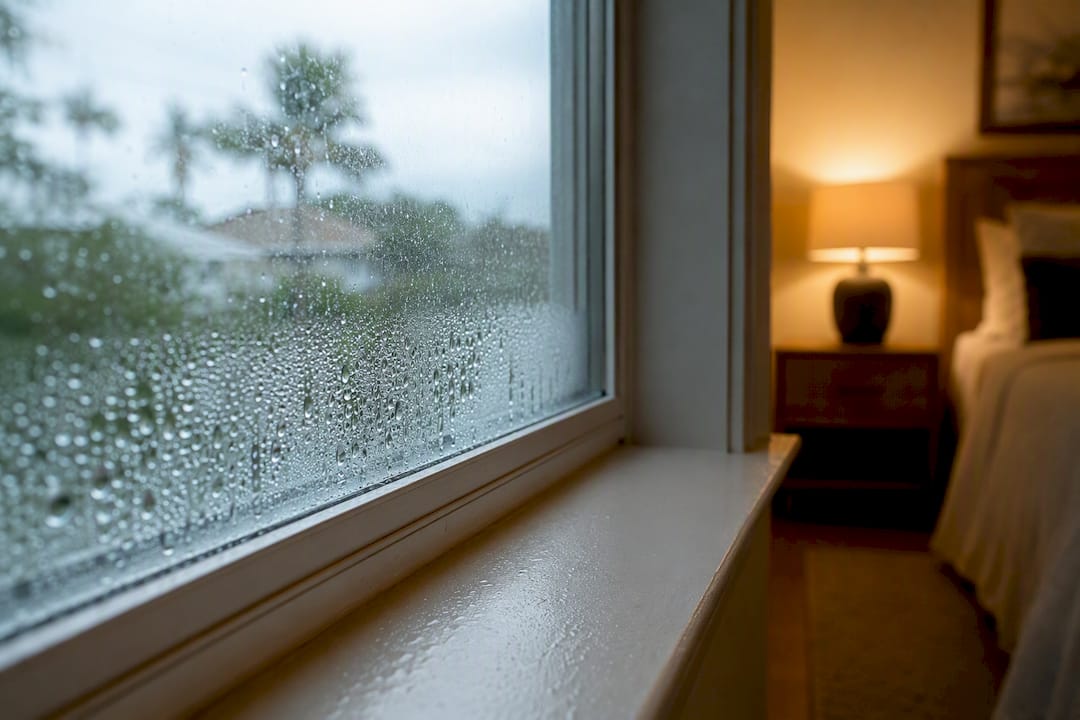
If relative humidity sits above 60% consistently, or you’re seeing condensation on windows, ductwork, or cold surfaces, that’s past the point where thermostat tweaks fix it. Chronic musty smells or visible mold growth are the clearest signal of all. Sustained humidity above roughly 60% creates conditions where mold and dust mites thrive, and that threshold is worth taking seriously rather than living with.
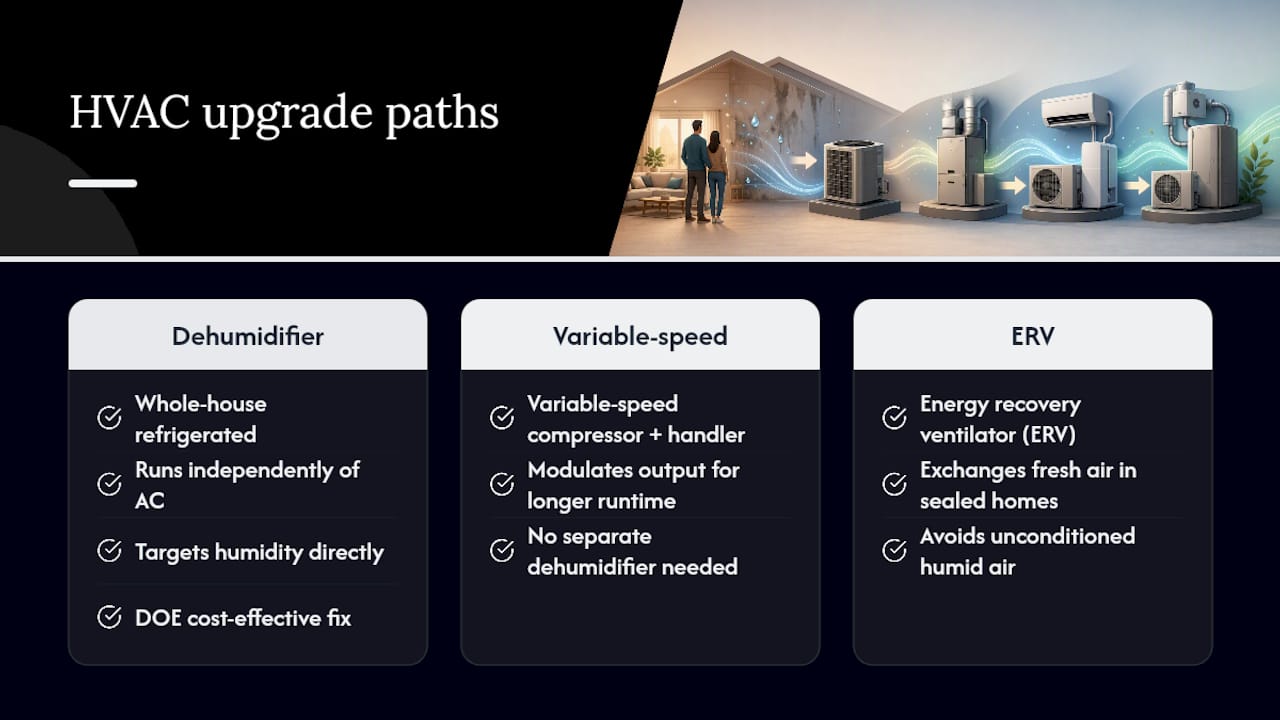
Three upgrade paths cover most situations. A whole-house refrigerated dehumidifier ties into your ductwork and runs independently of the AC’s cooling cycle, targeting humidity directly regardless of temperature demand. This tends to be the most cost-effective fix for persistent latent load, according to DOE’s hot-humid climate research. A variable-speed compressor and air handler can modulate output to run longer at lower capacity, which naturally improves dehumidification without a separate unit. Energy recovery ventilators (ERVs) help tightly sealed homes get fresh air exchange without dumping in unconditioned humid air, addressing the envelope-related latent load problem directly. Before committing to any of these, a proper Manual J load calculation confirms which approach actually matches your home’s real moisture load, not just its square footage.
What maintenance actually restores lost dehumidification capacity?
Most performance loss comes from things a technician can inspect and fix in a single visit. Run through this cadence:
- Replace filters every 1 to 3 months. A clogged filter restricts airflow and forces the coil colder than intended, throwing off the whole balance.
- Clean the evaporator coil annually. Dust and grime on the fins act as insulation, cutting both cooling and dehumidification.
- Clear the condensate drain and inspect the pan. A clogged drain can back up and, in worse cases, shut the system down entirely.
- Verify refrigerant charge and airflow (CFM/ton). This is a technician-only check, but it’s often the single biggest factor separating a system that dehumidifies well from one that doesn’t.
- Seal and insulate ducts where leaks or condensation (“sweating ducts”) show up, since leaky ductwork both wastes conditioned air and adds unwanted moisture.
A full commissioning check goes further: measuring delta-T across the coil, timing cycle lengths, and calibrating the humidistat sensor placement, something ASHRAE’s technical guidance treats as standard practice for reliable control in any building type.
Pro Tip: Before a technician visit, note your thermostat’s humidity reading at three different times of day and snap a photo of any condensation or musty spots. That handful of data points often cuts diagnostic time in half.
How does a professional HVAC inspection diagnose humidity problems?
A DIY fan-speed adjustment can only go so far. When Lucasair inspects a home for humidity complaints, the process starts with a straightforward interview: when the problem shows up, which rooms it hits hardest, and what’s already been tried. From there, a technician measures actual relative humidity at multiple points in the house rather than trusting a single thermostat reading, then checks airflow and coil condition directly.
If the numbers point to a load mismatch rather than a maintenance issue, that’s when a Manual J calculation comes in, confirming whether the equipment is sized correctly for the space before recommending a fix. Depending on what turns up, the outcome might be as simple as a tune-up, or as involved as recommending a whole-house dehumidifier. Since 2018, Lucasair has built its Central Florida service around that kind of direct diagnostic work, with veteran ownership, financing options, and online scheduling built to make that first inspection easy to book.
— Results
Get a professional humidity diagnosis for your home
If your thermostat hits its setpoint and the house still feels damp, that’s a job for a technician, not another round of fan-speed guessing. Lucasair is the direct alternative to living with a guessing game: a Central Florida HVAC provider that measures your actual humidity levels, inspects your coil and airflow, and tells you plainly whether you need a tune-up or a bigger fix.

Persistent RH above 60%, visible condensation, or a musty smell are all reasons to stop troubleshooting alone. A tune-up restores lost dehumidification capacity in systems suffering from dirty coils or refrigerant issues, while a full installation makes sense when your equipment is undersized, oversized, or simply worn out. Lucasair also offers financing for larger upgrades like whole-house dehumidifiers, so cost doesn’t have to delay a fix that’s overdue. Schedule an inspection through Lucasair’s services page and get a straight answer on what your specific home actually needs.
Sources
This article draws on EPA mold and moisture guidance, ASHRAE humidity control standards, DOE hot-humid climate research, and a peer-reviewed indoor RH study.
