
Budget a qualitative range per square foot annually for commercial HVAC maintenance, with higher costs for older or complex buildings. Per-unit, expect typical annual maintenance costs for rooftop units, split systems, and chillers that vary significantly by equipment type and context. Those ranges are a starting point, not a budget. Build your actual number from a bottom-up inventory count next.
TL;DR:
- Smaller buildings often have higher per-square-foot HVAC maintenance costs due to fixed truck-roll expenses, reaching up to $0.90 or more.
- Equipment age, complexity, and access significantly influence maintenance costs, with older or complex systems requiring more frequent service and higher rates.
- Building a precise budget requires an inventory of equipment, adjusted per-unit costs, service frequency, and a contingency of 15% to 20%.
- Vendor bids should clearly itemize parts, response times, and reporting requirements; vague line items and missing markup details are red flags.
- Preventive maintenance tends to be 20% to 50% cheaper over its lifecycle than reactive repairs, with documented energy savings and system life extension benefits.
Table of Contents
- What Does Commercial HVAC Maintenance Cost Per Square Foot?
- What Actually Drives Your HVAC Maintenance Number Up or Down?
- How Much Should a Small, Medium, or Large Facility Budget?
- How Do You Build a Bottom-Up HVAC Maintenance Budget?
- What Service Contract Tiers Should You Compare?
- Does Preventive Maintenance Actually Save Money?
- What Red Flags Should You Watch for in Vendor Bids?
- Why Most Facility Budgets Underestimate Real HVAC Costs
- Get a Commercial HVAC Maintenance Audit From Lucas Air
- Sources
What Does Commercial HVAC Maintenance Cost Per Square Foot?
The most commonly cited benchmark for commercial HVAC maintenance costs in the U.S. runs $0.15 to $0.30 per square foot per year for straightforward buildings with newer equipment. That’s the floor, not the average. Buildings with aging rooftop units, tight mechanical rooms, or 24/7 operating schedules routinely land between $0.50 and $0.85 per square foot once you factor in repair frequency and after-hours labor.
Building type greatly influences HVAC maintenance costs per square foot, with office, retail, hotel, healthcare, and light industrial facilities each requiring different levels of service intensity due to varying equipment and usage patterns.
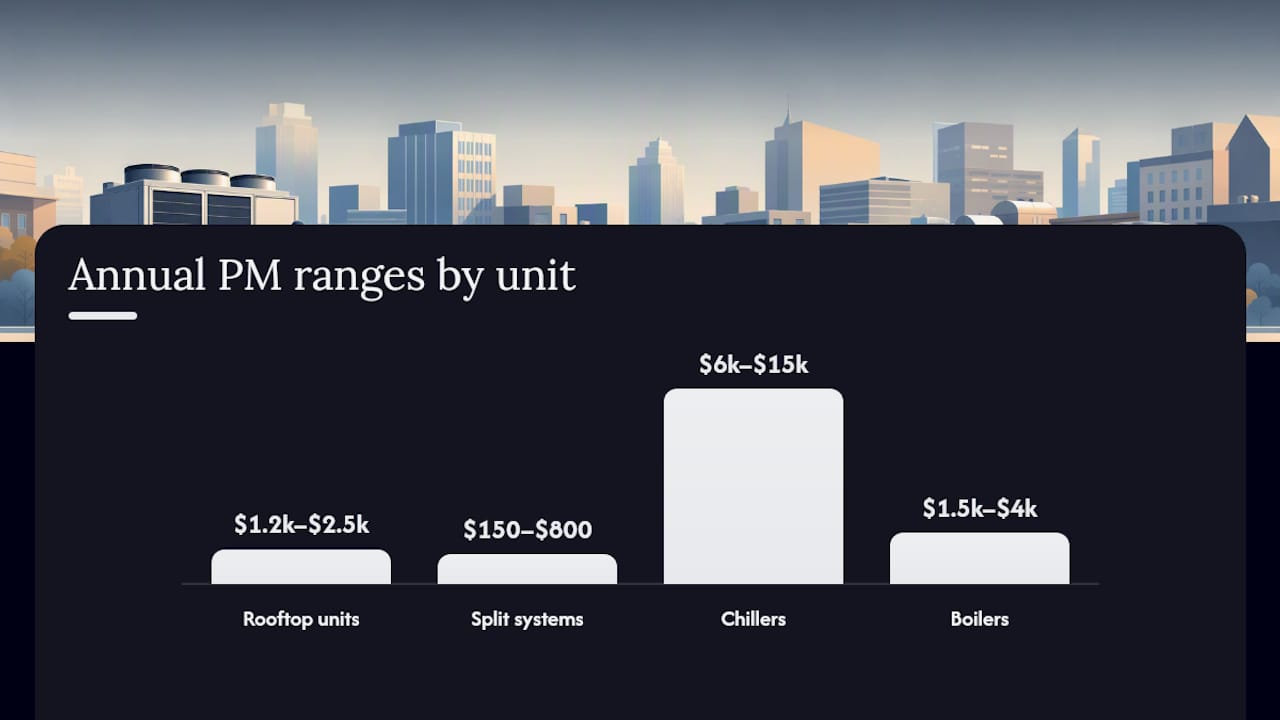
On a per-unit basis, annual preventive maintenance for rooftop units and split systems runs $1,200 to $2,500 for RTUs, $150 to $800 for smaller split systems, $6,000 to $15,000 for chillers, and $1,500 to $4,000 for boilers. A building in South Florida with high run hours will sit at the top of every range. A mild-climate facility with light seasonal load will sit near the bottom.
What Actually Drives Your HVAC Maintenance Number Up or Down?
Four variables explain most of the swing between a $0.20 and a $0.70 per-square-foot budget: system complexity, equipment age, service frequency, and labor market.
Older equipment needs more visits and more parts. A rooftop unit past year twelve typically needs quarterly service instead of semiannual, and it fails between visits more often, which pushes you into reactive repair territory. Complexity compounds this: a single-zone package unit is cheap to maintain; a VRF system with dozens of indoor heads, or a chiller plant with variable-frequency drives, requires specialized technicians who bill at a premium.
Access matters more than people expect. A rooftop unit reachable by a standard ladder costs less to service than one requiring a lift or crane, and that access cost repeats every single visit.
Labor rates and after-hours needs stack on top of the equipment itself. Emergency truck rolls commonly run $450 to $1,000 in labor alone, before parts, and that’s for a daytime call. Push it to nights or weekends and the rate climbs further.
How Much Should a Small, Medium, or Large Facility Budget?
Here’s how the math plays out across three real facility profiles.
- Small retail strip, 8,000 square feet, four rooftop units. Four RTUs at $1,800 average PM cost equals $7,200 annually, or roughly $0.90 per square foot. That’s high per-square-foot because fixed truck-roll costs don’t shrink with building size.
- Mid-size office building, 60,000 square feet, twelve RTUs plus one small chiller. Twelve RTUs at $2,000 each ($24,000) plus one chiller at $9,000 totals $33,000, or $0.55 per square foot.
- Large hotel, 180,000 square feet, 220 PTAC units plus two chillers and one boiler. PTAC units at $250 each ($55,000), two chillers at $10,000 each ($20,000), and one boiler at $2,500 brings the total to $77,500, or $0.43 per square foot.
Notice the pattern: smaller buildings often carry a higher per-square-foot rate, not a lower one.
How Do You Build a Bottom-Up HVAC Maintenance Budget?
Skip the industry average and build your number from your actual equipment. Here’s the process:
- Inventory every unit. Capture unit type, tonnage, manufacture year, warranty status, refrigerant type, and access notes (roof, ground, mechanical room, lift required) for each piece of equipment.
- Assign a per-unit rate. Use the benchmark ranges above as a starting point, then adjust for age and access using the multipliers from the cost-drivers section.
- Apply service frequency. Most commercial equipment needs two visits a year for PM-only coverage; complex or high-criticality equipment often needs four.
- Sum it and add contingency. Total your per-unit costs, then layer on a reserve for unplanned repairs.
Contingency sizing depends on how mature your maintenance program already is. Facilities with a consistent preventive program can budget 15% to 20% on top of routine costs.
An alternative validation method: budget 1% to 3% of total equipment replacement value for PM-only coverage, or 3% to 8% for a full operations-and-maintenance contract that includes repairs. Run both methods and see if they land in the same neighborhood; a big gap between them usually means your equipment inventory or condition assumptions need a second look.
When you request vendor pricing, ask for:
- Line-item pricing broken out by unit, not a single lump sum
- Parts markup percentage, stated explicitly
- SLA response tiers with pricing attached to each tier
What Service Contract Tiers Should You Compare?
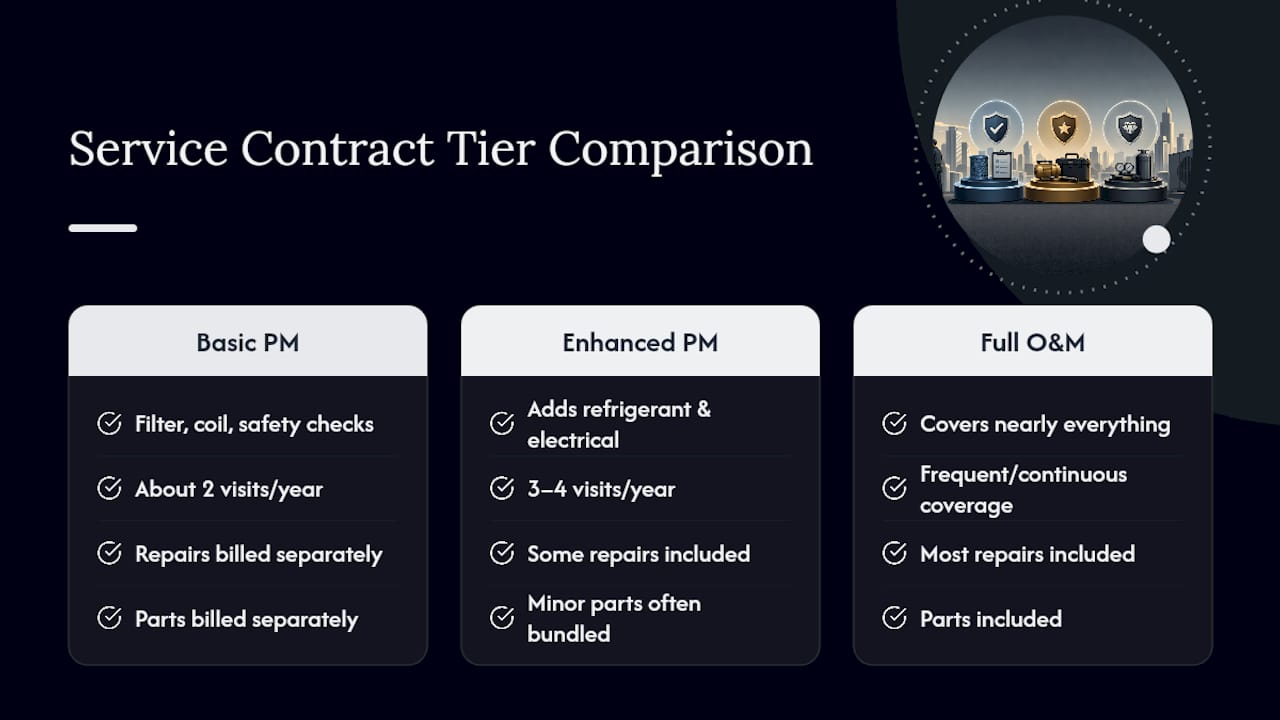
Commercial HVAC service agreements generally fall into three tiers. Basic PM covers filter changes, coil cleaning, and safety checks, usually twice a year, with repairs billed separately. Enhanced PM adds refrigerant checks, electrical testing, and often one or two extra visits, sometimes bundling minor parts. Full operations and maintenance (O&M) covers nearly everything, including most repairs and parts, for a flat annual or monthly fee.
The single biggest price lever inside any tier is the SLA response window. A 4-hour emergency response commitment costs meaningfully more than next-business-day, and many facility managers pay for the faster tier without ever confirming the vendor can actually hit it.
Pro Tip: Ask any vendor to show you their price floor: loaded labor rate times hours, plus travel, plus materials, plus admin overhead, before their target margin gets applied. A vendor who can’t break this down is pricing off a competitor’s rate card, not their own costs.
Price the agreement by building risk, not unit count. A hospital wing and a warehouse with the same number of rooftop units should not carry the same rate; one has far less tolerance for downtime.
Does Preventive Maintenance Actually Save Money?
Reactive maintenance typically runs 20% to 50% more expensive than a preventive program across the equipment’s lifecycle, once you count emergency labor rates, expedited parts shipping, and the energy penalty of equipment running out of tune. Federal building research backs the same conclusion from a different angle: the GSA’s published findings on HVAC performance point to preventive maintenance as one of the more reliable levers for both energy efficiency and equipment reliability in commercial buildings.
The contingency math follows directly from this.
What Red Flags Should You Watch for in Vendor Bids?
Before signing or renewing, check for these issues:
- Vague line items like “miscellaneous materials” with no cap or itemization
- No stated parts markup percentage anywhere in the contract
- An SLA response window with no penalty clause if it’s missed
- No reporting or asset-level documentation after each visit
Then confirm the contract itself covers the basics:
- Defined scope, listing every covered unit by asset tag
- Stated response-time commitment tied to a real remedy, not just a promise
- Reporting requirements: what you get after every visit and how often
Ask vendors directly how they calculate parts markup, what their average response time actually was last quarter (not just their stated SLA), and whether diagnostic time is billed on top of the flat rate. A structured bid-review process built for commercial subcontractors offers a useful model for comparing multiple HVAC quotes on equal footing rather than by sticker price alone.
Why Most Facility Budgets Underestimate Real HVAC Costs
That approach breaks the moment a chiller hits year fifteen or a rooftop unit starts needing quarterly compressor work instead of annual coil cleaning. The equipment doesn’t care what last year’s number was.
What tends to get missed isn’t the maintenance line item itself. It’s the gap between what a contract promises and what it delivers, particularly around response time. Lucas Air Conditioning and Heating, founded in 2018 by Army veteran Cameron Lucas, has built its commercial maintenance approach around closing exactly that gap: documented preventive maintenance programs that extend system life by roughly 30% compared to reactive-only upkeep, and hospitality clients who’ve seen energy costs drop close to 20% after tightening their PM schedule.
A proper commercial agreement should start with a full asset audit, not a generic price sheet. That audit produces a defined maintenance workflow with line-item pricing and a real SLA option, not a vague promise of “priority service.”
The gap between a good HVAC budget and a bad one usually isn’t the benchmark number. It’s whether anyone actually checked the equipment before writing the number down.
— Results
Get a Commercial HVAC Maintenance Audit From Lucas Air
Every budget in this article starts with the same first step: knowing exactly what equipment you have and what shape it’s in. Lucas Air Conditioning and Heating handles that audit directly for commercial properties across Central Florida, walking every unit on your roof and in your mechanical rooms before quoting a single number.
A typical engagement starts with a site walkthrough, moves into a full asset inventory (tonnage, age, warranty status, access notes), and ends with a line-item proposal that shows you exactly what you’re paying for and why, instead of one flat number pulled from a generic rate card. From there, you choose the SLA tier that actually fits your risk profile, not the one a sales rep upsold you into. If your last renewal felt like a guess, request a preventative maintenance agreement quote and get an inventory-based number instead.
Sources
- HVAC maintenance budget planning (OxMaint)
- HVAC maintenance costs: the ultimate guide (GridPoint)
- HVAC service agreement pricing (TradeSworn)
