
Most homeowners pay a few thousand dollars for AC compressor replacement, with the typical job landing near the mid-thousand-dollar range. That range already includes labor, but it can climb past $4,000 once refrigerant retrofits, permits, and difficult access get factored in. The three biggest swing factors are system tonnage, the type of compressor you’re replacing (single-stage versus variable-speed), and how much refrigerant the job requires.
Here’s the decision rule that saves people money: if your system is under 8 to 10 years old, the rest of the unit is in good shape, and the compressor is still under manufacturer warranty, a standalone compressor replacement usually makes sense. If your system runs on R-22, uses an aging or mismatched condenser, or the compressor failure is the second major repair in two years, a full system swap almost always costs less over time.
- Typical total range: from around a thousand to several thousand dollars, potentially higher with retrofits or permits
- Biggest cost drivers: tonnage, refrigerant type/quantity, labor hours
- Rule of thumb: repair under warranty and under 10 years old; replace the system if it’s on R-22 or has repeated failures
Key Takeaways
Getting an accurate AC compressor replacement cost depends on tonnage, refrigerant type, and whether the technician runs a proper diagnostic before condemning the part.
| Point | Details |
|---|---|
| Typical price range | Most jobs run around $1,300 total, with complex retrofits reaching $4,350. |
| Warranty gaps | Manufacturer warranties usually cover only the part; budget $600 to $1,600 for labor and materials. |
| Diagnostic first | Insist on amperage and capacitor testing before approving any compressor replacement quote. |
| Age and refrigerant rule | Repair under 8 to 10 years old with healthy components; replace the system on R-22 or after repeat failures. |
| Trusted local option | Lucasair runs a $70 diagnostic system check and full evacuation/filter-drier protocol on every compressor job. |
Table of Contents
- How Much Does AC Compressor Replacement Cost by System Size?
- What Factors Push AC Compressor Prices Higher or Lower?
- Does a Manufacturer Warranty Cover the Full Repair Cost?
- Should You Replace Just the Compressor or the Whole System?
- What Are the Warning Signs of a Failing Compressor?
- What Should You Ask Before Approving a Compressor Quote?
- How Lucasair Handles Compressor Replacement Jobs
- How Long Does an AC Compressor Replacement Take?
- How Much Does Location Change Compressor Replacement Cost?
- Does the Brand or Model of Your AC Unit Affect the Price?
- The Honest Take on Compressor Pricing
- Get a Straight Diagnosis Before You Pay for a Compressor
- Sources
How Much Does AC Compressor Replacement Cost by System Size?
Compressor price scales with tonnage because bigger systems need bigger, more expensive compressors and more refrigerant to recharge the line set. Smaller systems common in smaller homes and condos typically run lower total costs. Mid-size single-family home units generally cost more, with larger or commercial-grade systems commanding still higher total costs once labor and refrigerant are factored in.
Compressor type matters as much as tonnage. A single-stage compressor, the simplest and most common type in older systems, is the least expensive part to source. Two-stage compressors cost more, while variable-speed (inverter) compressors, now standard in higher-efficiency systems, are the most expensive and often require specialized diagnostic tools.
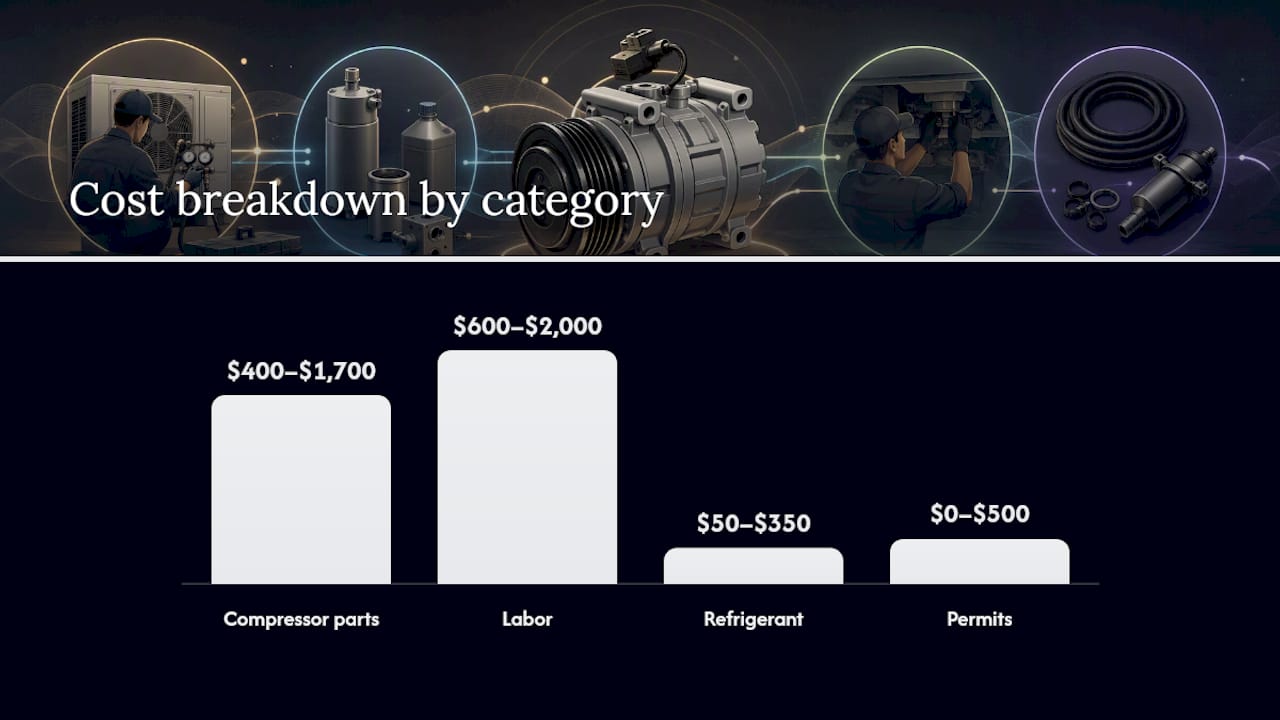
Parts and labor split the cost roughly down the middle, but not always evenly. According to a component-level cost breakdown, compressors themselves typically run $400 to $1,700, labor adds $600 to $2,000, refrigerant contributes another $50 to $350, and permits range from $0 to $500 depending on your municipality. Stack those together and you get the wider $1,125 to $4,350 range that shows up on bigger or more complicated jobs.
Labor hours run 4 to 12 depending on access and complexity, with technicians typically billing $75 to $175 per hour. A straightforward ground-level swap on an accessible pad might take half a day. A rooftop commercial unit with tight clearances, or a job requiring a full refrigerant retrofit, can stretch into a two-day project.
A few scenarios that push costs toward the high end:
- Retrofitting an older R-22 system to accept R-410A or a newer refrigerant, which adds parts and labor
- Rooftop or attic installations that require extra rigging, lift equipment, or confined-space work
- Variable-speed compressors that need matched electronic controls, not just a drop-in part
- Systems requiring a full filter-drier and evacuation cycle rather than a quick swap
What Factors Push AC Compressor Prices Higher or Lower?
Labor rate is the single biggest lever contractors have, and it varies by region and technician tier. A licensed lead tech in a high cost-of-living market can bill closer to $175 an hour, while a rural technician might charge $75. Multiply that difference across 8 hours of labor and you’ve got an $800 swing before a single part gets ordered.
Access adds hours fast. A compressor tucked behind a fence, on a second-story roof, or wedged into a tight mechanical closet takes longer to remove and reinstall than one sitting on an open concrete pad. Techs often quote an access surcharge separately, and it’s worth asking about upfront rather than discovering it on the invoice.
Refrigerant costs have become their own line item to watch. The ongoing HFC phasedown has tightened supply on older refrigerants and pushed newer A2L refrigerants into wider use, and per-pound pricing reflects that shift. A system that needs a full recharge, not just a top-off, can add $50 to $350 depending on refrigerant type and how many pounds your line set holds.
Beyond the compressor itself, a proper job usually replaces a handful of small parts:
- Filter-drier: $30 to $80, and skipping this step is one of the most common shortcuts that shortens a new compressor’s life
- Contactor: $15 to $40
- Capacitor: $20 to $60
- Permits and disposal fees: $0 to $500 depending on your city or county
Pro Tip: Ask your contractor to itemize the filter-drier replacement separately on your invoice. If it’s not listed, ask why. A reused drier is one of the fastest ways a brand-new compressor fails within its first year.
Does a Manufacturer Warranty Cover the Full Repair Cost?
No, and this catches more homeowners off guard than any other line item on the invoice. Manufacturer warranties typically cover only the compressor part itself, not the labor, refrigerant, or ancillary materials needed to install it. Even with a fully covered part, you should budget several hundred to over a thousand dollars out of pocket for labor, refrigerant recharge, and any small parts the technician replaces along the way.
Home warranty plans complicate things further. Providers often cap compressor reimbursements at a fixed dollar amount, charge a separate service call fee regardless of outcome, and require you to use a technician from their network, which can mean longer wait times or aftermarket parts instead of OEM components.
Before any technician touches your unit, take these steps:
- Locate your system’s model and serial number, usually on a metal plate on the outdoor unit.
- Call the manufacturer directly, or check their website, to confirm warranty status and remaining term.
- Ask whether the warranty is transferable if you bought the home from a previous owner.
- Get the labor and materials estimate in writing separately from any warranty claim, so you know your real out-of-pocket number.
Should You Replace Just the Compressor or the Whole System?
Age is the first filter. Under 8 to 10 years old, with a healthy coil and a compressor that’s under warranty, standalone replacement is usually the smarter financial call. Past that window, you’re often better off treating a compressor failure as a signal the whole system is aging out together.
Refrigerant type changes the math entirely. If your system still runs on R-22, replacement parts are scarce and expensive because production stopped years ago, and a compressor swap alone doesn’t solve the underlying obsolescence problem. Even R-410A systems face tightening supply under the ongoing phasedown, which is worth weighing against DOE efficiency guidance on newer equipment’s operating-cost savings.
Watch for these signals that point toward full replacement instead of a single-part fix:
- The compressor has failed once already, or other major components (coil, condenser fan motor) are also showing wear
- Your system uses R-22 or another refrigerant no longer in production
- The outdoor unit and indoor coil are mismatched in tonnage or SEER rating, which strains any new compressor you install
- You’re looking at a variable-speed compressor replacement that costs more than 40 to 50% of a new system’s price
What Are the Warning Signs of a Failing Compressor?
A humming outdoor unit that won’t kick on, warm air blowing indoors, a tripped breaker that keeps tripping, or an unusually hot discharge line near the compressor are the four classic symptoms. None of them, on their own, confirms compressor failure, and that’s exactly where a lot of homeowners get overcharged.
The most common misdiagnosis in the industry is blaming the compressor when the real problem is a failed capacitor or a worn contactor, both of which cost far less to replace. A capacitor swap typically runs $150 to $300 total. A contactor replacement lands in a similar range. Compare that to $1,300 or more for an actual compressor job, and you can see why a proper diagnostic matters before you approve any estimate.
A certified technician should run through these steps before recommending compressor replacement:
- Amperage testing on the compressor to check for a locked rotor or overheating condition.
- A capacitor test, since a failing capacitor often mimics compressor failure symptoms.
- A refrigerant pressure test to rule out low charge or a leak as the root cause.
- A vacuum and evacuation check if contamination or moisture is suspected in the line set.
Pro Tip: If a technician quotes compressor replacement without running an amperage or capacitor test first, ask them to run it before you sign anything. A five-minute test can save you over $1,000.
What Should You Ask Before Approving a Compressor Quote?
A vague estimate is the number one way homeowners overpay. Every legitimate quote should include specific line items you can compare across contractors, not just a single lump-sum number.
Ask for these details in writing:
- Compressor make and model number, not just “compressor replacement”
- Labor hours and hourly rate, broken out separately from parts
- Refrigerant type, pounds needed, and price per pound
- Filter-drier replacement, brazing work, and evacuation steps included in the price
- Permit fees, if your municipality requires one for refrigerant work
Confirm the technician holds current EPA Section 608 certification, which is legally required to handle refrigerant, and ask to see the diagnostic results in writing before agreeing to any part replacement. If contamination or a burnout is suspected, a triple evacuation with nitrogen pressure testing should be standard practice, not an upsell.
Red flags worth walking away from:
- No mention of evacuation or vacuum testing anywhere in the estimate.
- A refrigerant charge priced suspiciously low compared to current market rates.
- No permit line item in a jurisdiction that requires one for HVAC work.
- Reluctance to provide certification numbers or diagnostic readings on request.
How Lucasair Handles Compressor Replacement Jobs
Lucasair was founded in 2018 by Army veteran Cameron Lucas, and that veteran-owned foundation shows up in how the company approaches diagnostics: test first, replace second. A $70 system check gives homeowners a real diagnostic, amperage readings, capacitor test, pressure check, before any compressor gets condemned.
When a compressor replacement is genuinely needed, the job includes proper evacuation, filter-drier replacement, and a nitrogen pressure test, following the same diagnostic workflow outlined earlier in this guide. Financing options are available for homeowners facing a larger repair or considering a full system upgrade instead.
Before scheduling a visit, have this ready:
- Your outdoor unit’s model and serial number
- A description of symptoms (humming, warm air, tripped breaker, timing of failure)
- Any known warranty documentation or purchase date
How Long Does an AC Compressor Replacement Take?
A standard ground-level compressor swap on a residential system typically takes 4 to 8 hours, meaning most homeowners are back to cooling by the same evening if the job starts in the morning. That window assumes the replacement part is in stock and no refrigerant retrofit is needed.
Jobs stretch into a full day or spill into a second day under a few common conditions. Rooftop commercial units need rigging and extra safety setup. Retrofitting an older R-22 system to a newer refrigerant adds evacuation and flushing time. And if the technician discovers contamination in the line set during the pressure test, a triple evacuation cycle alone can add several hours before the new compressor ever gets installed.
Expect some downtime regardless of how fast the crew works. Most compressor replacements require the system to sit in vacuum for at least an hour, sometimes longer, before refrigerant can be recharged safely. In Florida heat, that means planning for a warm afternoon even on a same-day job. If a part needs to be special-ordered, which happens more often with variable-speed compressors, the timeline can stretch to 2 to 5 business days while parts ship.
How Much Does Location Change Compressor Replacement Cost?
Where you live shifts your final number more than most homeowners expect, mainly through labor rates and permit requirements. Urban markets with a higher cost of living tend to bill closer to the $150 to $175 per hour range, while smaller markets and rural areas often land near $75 to $100.
Permit costs vary by county and municipality, sometimes running $0 in areas with no HVAC permit requirement for like-for-like part replacement, and up to $500 in jurisdictions that require inspection for any refrigerant work. Climate plays a role too. In hot, humid regions like Central Florida, compressors run longer hours across more months of the year, which shortens their lifespan and keeps local HVAC labor markets busier, sometimes extending scheduling windows during peak summer demand. A regional cost comparison from Los Angeles shows a similar pattern: higher regional labor costs and stricter local permitting both push totals upward compared to lower cost-of-living markets.
Does the Brand or Model of Your AC Unit Affect the Price?
Yes, and it’s one of the least discussed cost factors. Compressor parts for mainstream residential brands are widely stocked and generally cheaper to source, keeping parts costs on the lower end of the $400 to $1,700 range. Less common brands, older discontinued product lines, or commercial-grade units sometimes require special-order compressors, which adds both cost and lead time.
Variable-speed and inverter-driven systems, increasingly common across most major manufacturers’ higher-efficiency lineups, use compressors matched to proprietary electronic control boards. That means you generally can’t substitute a generic compressor even if one is cheaper and in stock. This is one of the biggest hidden cost drivers in the “why did my quote come in higher than my neighbor’s” conversation. Two homes with the same tonnage can see quotes that differ by several hundred dollars purely because one unit uses proprietary electronics and the other doesn’t.
The Honest Take on Compressor Pricing
Most pricing guides treat compressor replacement like a fixed menu item, but the real cost hinges on decisions made before a wrench ever comes out: whether the tech actually tests before condemning the part, whether refrigerant type gets flagged early, and whether warranty coverage gets checked before or after the invoice is written.
The conventional advice, “get three quotes and pick the middle one,” misses the point. A cheap quote that skips evacuation or reuses a filter-drier isn’t a deal. It’s a second failure waiting to happen within a year. The number that actually matters isn’t the total price, it’s whether that price includes the diagnostic steps that prevent a repeat visit.
If you take one thing from this guide, make it this: insist on amperage and capacitor testing before anyone tells you the compressor is dead. That single step, more than any warranty or price comparison, determines whether you’re paying for a real fix or a guess.
Get a Straight Diagnosis Before You Pay for a Compressor
You don’t need to gamble on a quote that skips testing or guesses at the problem. Lucasair runs the diagnostic first, amperage, capacitor, and pressure checks, before recommending compressor replacement, so you’re not paying $1,300 or more for a part that might not have been the real issue.
If your system is showing the symptoms covered in this guide, a warm discharge line, a tripped breaker, or a compressor that hums but won’t start, schedule a diagnostic repair visit and get a written estimate that breaks out parts, labor, and refrigerant separately. If your system is older or already on a discontinued refrigerant, Lucasair can also walk you through what a full system installation would look like, including financing options, so you can compare both paths side by side before committing to either one.
Sources
- U.S. Department of Energy — Consumer central air conditioners and heat pumps
- HVAC compressor replacement cost: 2026 pricing guide — Practicetestgeeks
- Cost and price guide for HVAC compressor replacements in the U.S. — Well Built Florida
Recommended
- AC Blower Motor Cost: What Homeowners Should Budget in 2026 – Lucas Air Conditioning and Heating
- Duct Replacement Cost in 2026: What You’ll Actually Pay – Lucas Air Conditioning and Heating
- Rates – Lucas Air Conditioning and Heating
- Upgrade your HVAC in 2026 for efficiency & cost savings – Lucas Air Conditioning and Heating
