
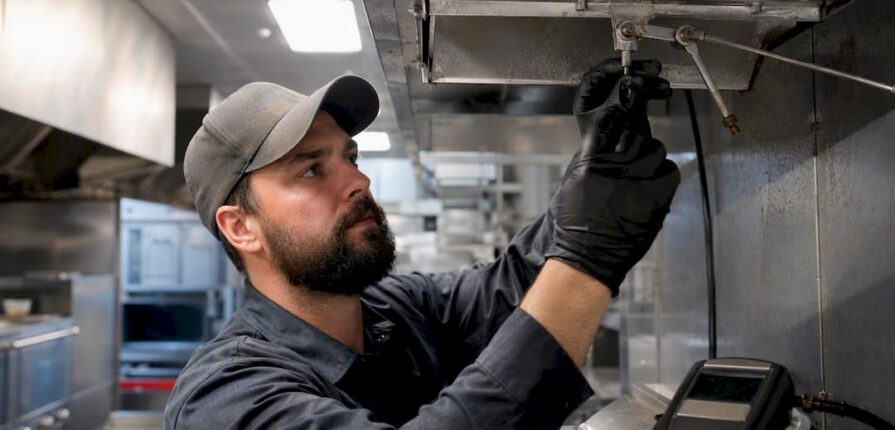
Every item needs a pass or fail. Hood capture either holds smoke at the filter face or it doesn’t. Suppression is either inspected within the last six months or it isn’t. There’s no partial credit here.
- Smoke test at the hood: no visible escape past the filter bank
- MAU airflow: measured CFM within 10% of the design specification
- Dining pressure: slightly positive relative to the kitchen (a door swing test confirms it)
- Filters: correct MERV rating installed, not just “a filter”
- Suppression tag: dated within the last 6 months, technician name legible
- Thermostat zoning: kitchen and dining controlled independently
- MAU discharge temp: near 75°F, not blasting cold or hot air across the hood
Pro Tip: Grab a manometer and a smoke pencil before you sign anything. Hold the smoke pencil at the hood filter face during peak-load simulation, then check the pressure differential between kitchen and dining with the manometer. If smoke escapes or the kitchen isn’t reading negative, stop and call the contractor back before you open the doors to guests.
Key Takeaways
A restaurant HVAC system is only ready for guests when hood capture, makeup air balance, and NFPA-mandated documentation are all verified on-site, not assumed from the equipment spec sheet.
| Point | Details |
|---|---|
| Run the startup BLUF first | Confirm hood capture, MAU airflow, and dining pressure before signing off on any new system. |
| Design around kitchen loads separately | Use Manual N calculations and zoning so kitchen heat spikes don’t dictate dining comfort. |
| Watch makeup air velocity | Keep local MUA discharge under roughly 75 fpm so it doesn’t defeat hood capture. |
| Follow NFPA intervals by volume | Hood cleaning frequency and 6-month suppression inspections are code, not optional maintenance. |
| Document every service visit | Certificates need technician credentials and before/after photos to hold up for insurance. |
| Work with a documented contractor | Lucasair builds air-balance reports and NFPA-aligned records into every restaurant HVAC service. |
Table of Contents
- Design and Pre-Installation Checklist for Restaurant HVAC Systems
- Installation and Commissioning Checklist for New Systems
- Kitchen Ventilation and NFPA Compliance Checklist
- How Often Should You Service Restaurant HVAC and Ventilation Systems?
- What Air Quality Standards Apply to Restaurant HVAC Systems?
- What Are the Warning Signs of Restaurant HVAC Failure?
- What Does a Professional HVAC Contractor Check During Commissioning?
- A Contractor’s Take on What Actually Gets Prioritized First
- Get Restaurant HVAC Commissioning and Maintenance Done Right
- Frequently Asked Questions
- Sources
Design and Pre-Installation Checklist for Restaurant HVAC Systems
A restaurant HVAC system that’s undersized for the kitchen but oversized for the dining room fails on day one, no matter how well it’s installed. Before construction, verify the design against the plans and equipment schedule.
- Manual N load calculations for the kitchen, separate from Manual J calculations for dining
- Hood exhaust rate matched to a properly sized MAU (not “close enough”)
- Zoning plan that splits kitchen and dining into independently controlled areas
- Written control sequences for hood/MAU interlock, not just a verbal promise
- MERV targets specified by zone: MERV 13 typically recommended for dining areas, per Trane’s operational guidance, with grease-rated pre-filters ahead of hood exhaust
- Variable-speed equipment specified over a single oversized fixed-speed unit
Cooking equipment creates heat spikes that a static system can’t track, which is why designers favor zoning and variable-speed equipment rather than one large unit trying to average out extremes. Ask your contractor directly about the commissioning schedule, the scope of the air balance report, manufacturer warranty terms, and who’s responsible for NFPA-compliant hood and suppression paperwork. Get the answers in writing before installation starts, not after.
Pro Tip: Require an integrated airflow schedule from the contractor showing exhaust CFM against makeup air CFM side by side, along with the intended pressure relationship (dining positive, kitchen negative). If they can’t produce that document before startup, they haven’t finished the design.
Installation and Commissioning Checklist for New Systems
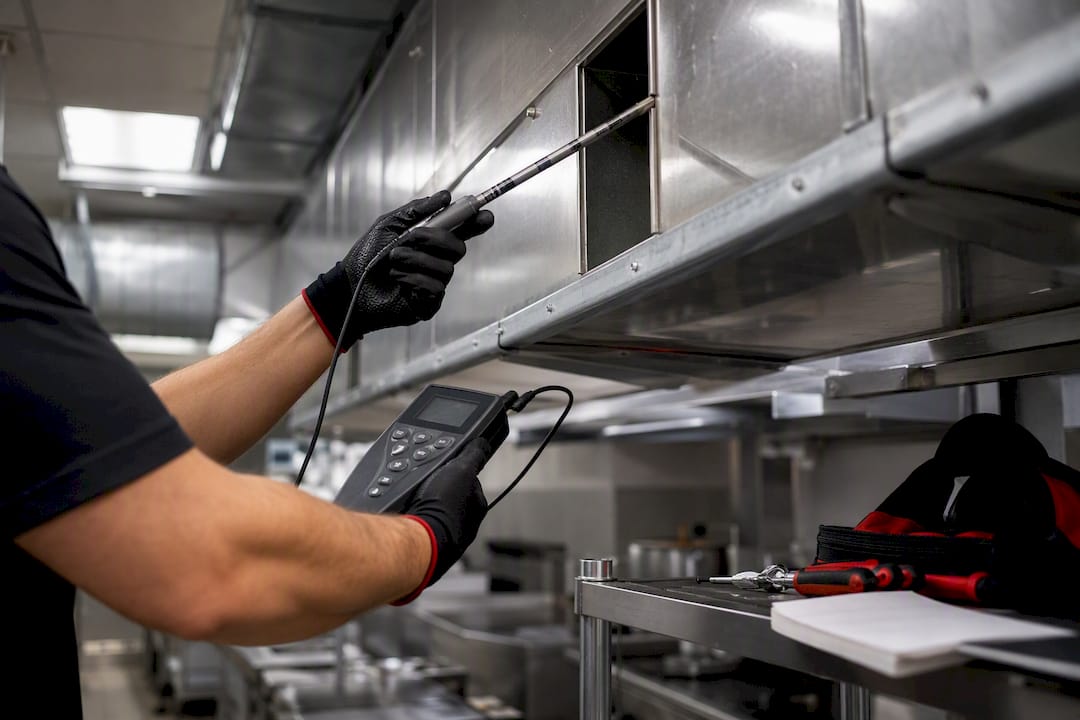
Startup day is where design promises meet reality. Work through checks in this order, because each one depends on the last being right.
- Visual inspection of all connections, ductwork seams, and electrical terminations
- Power-up and control verification, confirming thermostats and BMS points respond correctly
- Belt tension and motor amperage checks on all fans
- Refrigerant pressures, superheat, and subcooling within manufacturer spec
- Condensate drainage confirmed, float switches tested to trip correctly
- Airflow verification zone by zone, matching Manual J/N outputs to installed equipment
- Control interlocks tested: hood exhaust fan, MAU, and any DWV (demand ventilation) sequencing
A licensed commissioning partner typically documents every reading during this process rather than eyeballing it, and you should expect the same.
Before the contractor leaves, collect the air-balance report, startup readings, wiring diagrams, control sequence documentation, and warranty paperwork. A verbal “it’s all good” is not a deliverable.
Kitchen Ventilation and NFPA Compliance Checklist
Hood capture and makeup air are where most restaurant HVAC systems quietly fail, because the two systems fight each other if they’re not tuned together.
- Verify hood capture with tracer smoke at full operating exhaust rate, not idle
- Inspect grease filters and confirm access panels seal properly
- Confirm the current suppression inspection date meets NFPA 17A and NFPA 96 requirements
- Confirm MAU is interlocked with hood exhaust, so one can’t run without the other
- Measure MUA discharge velocity and keep it low near the hood
Makeup air introduced too close to the hood, or at too high a velocity, can defeat hood capture entirely.
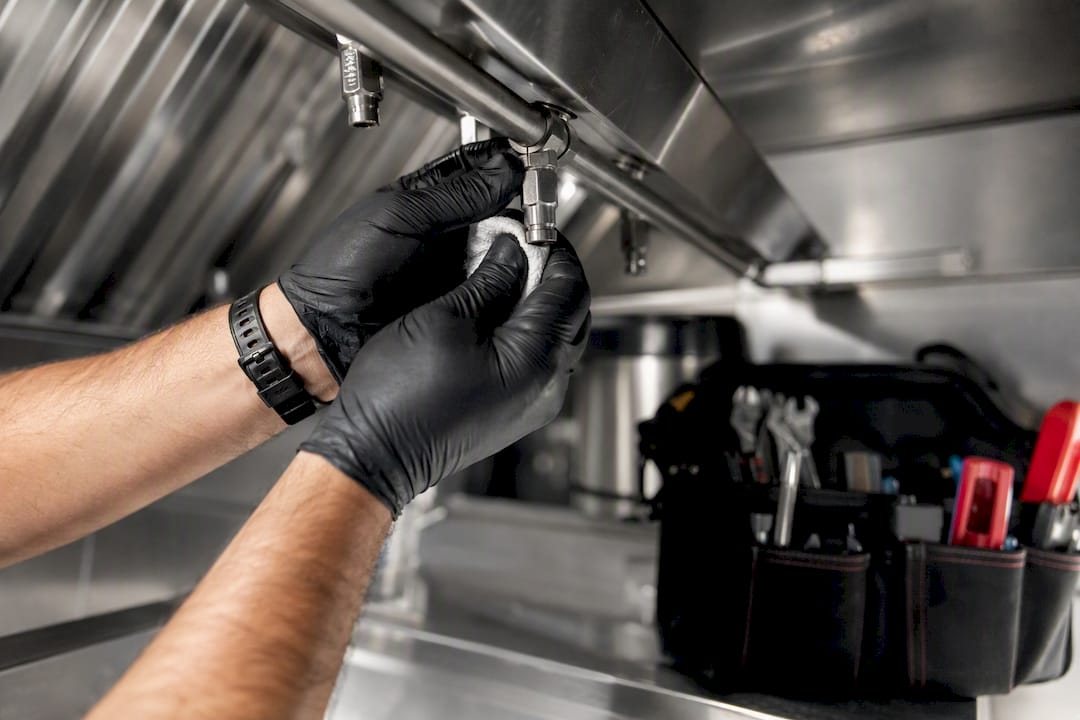
NFPA 96 sets cleaning intervals by cooking volume: monthly for high-volume charbroiling, quarterly for moderate-to-high volume, and semi-annual or annual for lower-volume kitchens. NFPA 17A requires the hood suppression system to be inspected every six months regardless of cooking volume. Certificates need the technician’s name and credentials, the specific equipment serviced, and before-and-after photos. Missing that documentation is a common inspection failure that can void insurance coverage after a grease fire.
How Often Should You Service Restaurant HVAC and Ventilation Systems?
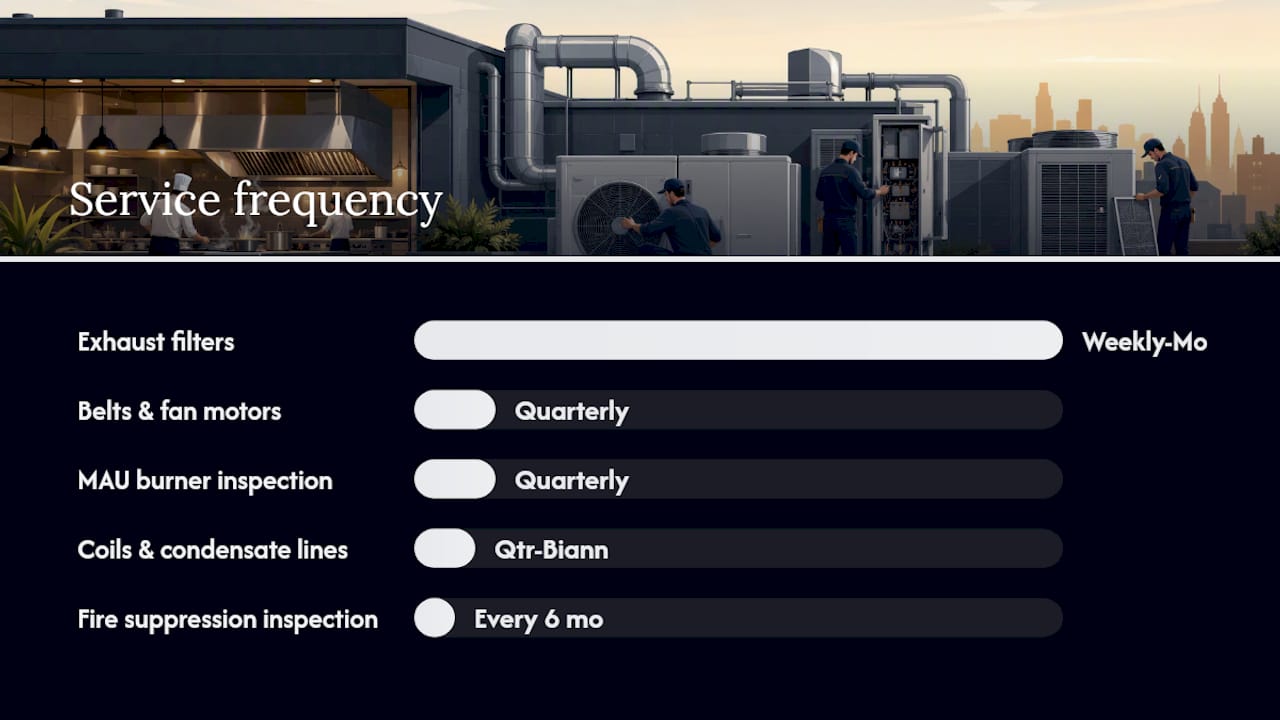
Preventive maintenance intervals aren’t guesswork. They’re tied to how hard the kitchen runs and what code requires.
| Component | Recommended interval | Why it matters |
|---|---|---|
| Exhaust filters | Weekly to monthly | Grease buildup reduces capture and raises fire risk |
| Grease duct cleaning | Per NFPA 96 schedule by cooking type | Code-mandated; insurance often requires proof |
| Fire suppression inspection | Every 6 months | NFPA 17A requirement; lapses can void coverage |
| Belts and fan motors | Quarterly | Prevents unexpected exhaust or MAU failure |
| MAU burner inspection | Quarterly | Catches pilot instability before it causes negative pressure |
| Coils and condensate lines | Quarterly to biannual | Grease-laden air fouls coils faster in kitchens |
Every visit should generate a service certificate: technician credentials, date, work performed, and photos showing before and after the work. Reviewing your restaurant HVAC maintenance workflow against this table is a quick way to spot gaps before an inspector finds them.
- Align suppression and hood cleaning visits on the same trip when possible, since both require code documentation
- Set automated reminders 30 days ahead of each NFPA-mandated interval
- Keep a digital and physical copy of every certificate on-site
What Air Quality Standards Apply to Restaurant HVAC Systems?
Air quality in a restaurant isn’t just about comfort. It’s what customers smell, and what an inspector measures.
- Maintain relative humidity between 40% and 60% year-round
- Use MERV 13 filtration in dining areas where the system can handle the added static pressure
- Use grease-rated filtration specific to kitchen exhaust, never a standard residential-grade filter
- Target at least 3 air changes per hour of outdoor air in dining spaces where feasible
- Replace dining filters on a fixed schedule, not “when they look dirty”
ASHRAE-based operational guidance recommends running exhaust fans at full capacity throughout occupied hours and verifying hood/MAU interlocks regularly, not just at installation. If odors linger or humidity swings widely, dehumidification or added filtration may be worth evaluating before assuming the whole system needs replacing.
Pro Tip: Track dew point, not just temperature, in high-steam kitchens. A room can read a comfortable 72°F and still be sitting at a dew point that condenses on ductwork and seeds mold. Dew point tells you what’s actually happening inside the walls.
What Are the Warning Signs of Restaurant HVAC Failure?
Certain symptoms point to specific, predictable failures. Learn to read them before they become a closed kitchen.
- Doors hard to open or slamming shut: kitchen pressure has gone too negative, often from a failing MAU
- Smoke or cooking odor reaching the dining room: hood capture has failed, or makeup air is disrupting it
- Unstable pilot lights or rising energy bills: MAU burner or control failure
- Visible grease buildup past the filter line: overdue duct cleaning and a real fire hazard
- Refrigeration struggling during dinner rush: charge or airflow issue under peak load
Run a smoke test at the hood and a door-swing pressure check monthly. If suppression is out of date or hood capture fails outright, pause service until a licensed contractor resolves it.
Pro Tip: Anything touching hood capture or suppression certification jumps to the top of the list. These aren’t comfort issues. They’re the two failures that shut down a kititchen or void an insurance claim.
What Does a Professional HVAC Contractor Check During Commissioning?
A contractor working a restaurant job moves through a defined sequence: review submittals and plans, take baseline field measurements, run air-balance and hood capture testing, verify control interlocks, then hand over documentation.
- Signed air-balance report with measured CFM by zone
- Startup readings for refrigerant charge, static pressure, and temperature splits
- Warranty registration completed, not just mentioned
- Photographic proof of hood cleaning and duct access points
Commissioning and NFPA compliance overlap more than most owners realize, and tracking hood service, suppression inspection, and HVAC maintenance in one workflow avoids the gaps that show up when three separate vendors each assume someone else is handling documentation.
Pro Tip: Require digital delivery of every certificate and photo, uploaded to a shared asset log. When the fire marshal or your insurance carrier asks for proof, you want it in one folder, not scattered across three inboxes.
A Contractor’s Take on What Actually Gets Prioritized First
On day one, priorities are safety items first: hood capture, suppression currency, and MAU operation. Everything else waits.
When budget is tight, a temporary fix, like tightening a filter schedule or adjusting a damper, can buy time before a permanent repair. It’s a bridge, not a solution.
Documentation isn’t optional. A contractor who skips certificates and photos is setting you up for an insurance denial the day something goes wrong.
*— Results.
Get Restaurant HVAC Commissioning and Maintenance Done Right
Working through this checklist yourself tells you where the gaps are. Closing them is where Lucasair comes in, with restaurant HVAC commissioning, hood and MAU servicing, and preventive maintenance agreements built around NFPA and ASHRAE documentation requirements, not guesswork.
When you request a quote, ask for exactly what this checklist covers: a signed air-balance report, suppression verification tied to your NFPA 17A schedule, and a documented PM plan with technician credentials and before/after photos on every visit. Lucasair’s preventative maintenance agreements build that documentation in from the first visit, so you’re never scrambling before an inspection. If your kitchen is still in the design or installation phase, our residential and commercial installation team can commission the system correctly the first time. Ready to get a site visit scheduled? Reach out to Lucasair today and get a documented, code-ready HVAC system before your grand opening.
Frequently Asked Questions
What’s the single most important item on a restaurant HVAC startup checklist?
Hood capture. If smoke escapes past the filter face during a tracer smoke test, nothing else on the checklist matters until that’s fixed.
How often does NFPA require restaurant hood suppression inspections?
Every six months, per NFPA 17A, regardless of cooking volume or kitchen size.
What MERV rating is recommended for restaurant dining areas?
MERV 13 is a common target for dining zones, based on operational guidance from Trane’s restaurant startup documentation, though the HVAC system needs enough static pressure capacity to handle it.
Why does makeup air placement matter so much in restaurant HVAC design?
Makeup air introduced too close to the hood, or at too high a velocity, can defeat hood capture entirely, letting grease-laden air escape into the dining room instead of up the exhaust stack.
What documentation should a restaurant keep on file for HVAC and hood service?
Every service visit should generate a certificate listing the technician’s name and credentials, the date, the specific work performed, and before-and-after photos, kept both physically and digitally for insurance and fire marshal review.
Sources
Every item on this checklist traces back to a real code or design standard, not an internal preference.
- Restaurant HVAC design: loads, costs & checklist
- CKV Design Guide 2: Optimizing Makeup Air
- Restaurant and Commercial Kitchen HVAC maintenance: Kitchen exhaust and make-up air
- Trane Restaurants Startup Guide
Ask your contractor to cite these standards directly in their air-balance and commissioning documentation rather than a generic pass/fail summary.
Recommended
- 7 Essentials for a Thorough Commercial HVAC Checklist
- How to maintain restaurant HVAC for efficiency and compliance – Lucas Air Conditioning and Heating
- 7 Must-Check Items for Your HVAC Inspection Checklist – Lucas Air Conditioning and Heating
- Top HVAC Upgrades for Restaurants: Boost Efficiency – Lucas Air Conditioning and Heating
