
TL;DR:
- Commercial duct cleaning removes dust, mold, and debris to improve indoor air quality and system efficiency. It should be scheduled every 1–3 years with full system coverage and proper documentation to ensure compliance and verify results. Skipping proper procedures risks spreading contaminants and losing legal protection during inspections or liability claims.
Commercial duct cleaning is the process of removing dust, debris, mold, and biological contaminants from HVAC ductwork to protect indoor air quality and system efficiency in commercial buildings. This guide to commercial duct cleaning covers when to schedule service, how the process works, which standards apply, and what mistakes cost property managers the most. Routine cleaning reduces HVAC energy consumption by up to 30% by clearing obstructions that force systems to work harder. That single figure makes duct cleaning one of the highest-return maintenance decisions you can make for a commercial facility.
What does a guide to commercial duct cleaning cover?
Commercial duct cleaning, known in the industry as air duct system cleaning, addresses the entire air distribution network: supply and return ducts, air handling units (AHUs), trunk lines, diffusers, and grilles. The industry standard governing this work is the NADCA ACR (Assessment, Cleaning, and Restoration) Standard. ASHRAE Standard 62.1 sets the ventilation quality benchmarks that cleaning helps maintain. Together, these two standards define what a compliant, effective cleaning looks like for any commercial property.
When is commercial duct cleaning necessary?
The short answer: inspect annually and clean every 1–3 years for most commercial properties. High-use facilities like restaurants and commercial kitchens need cleaning every 6–12 months due to grease accumulation and elevated particulate loads. That interval is not a suggestion. Grease buildup in kitchen exhaust ducts is a documented fire hazard, and health codes in most jurisdictions treat it as a compliance matter.
Beyond scheduled intervals, specific conditions require immediate attention. EPA guidelines identify five primary triggers for unscheduled cleaning:
- Confirmed mold growth inside ducts or on system components
- Vermin infestation, including rodents or insects
- Visible debris blocking airflow at registers or diffusers
- Dust discharging visibly from supply vents during operation
- Major renovation or construction that introduced particulates into the system
The legal dimension matters here. The OSHA General Duty Clause requires employers to maintain a hazard-free workplace. Ducts circulating mold spores or fine particulates can expose employees to health risks. Without documented cleaning records, a property manager has limited defense in an OSHA inspection or a tenant liability claim. Cleaning is not just maintenance. It is a compliance record.
Pro Tip: Keep a duct cleaning log with dates, scope of work, and technician certifications. That file protects you legally and simplifies future inspections.
How to clean commercial ducts: the step-by-step process
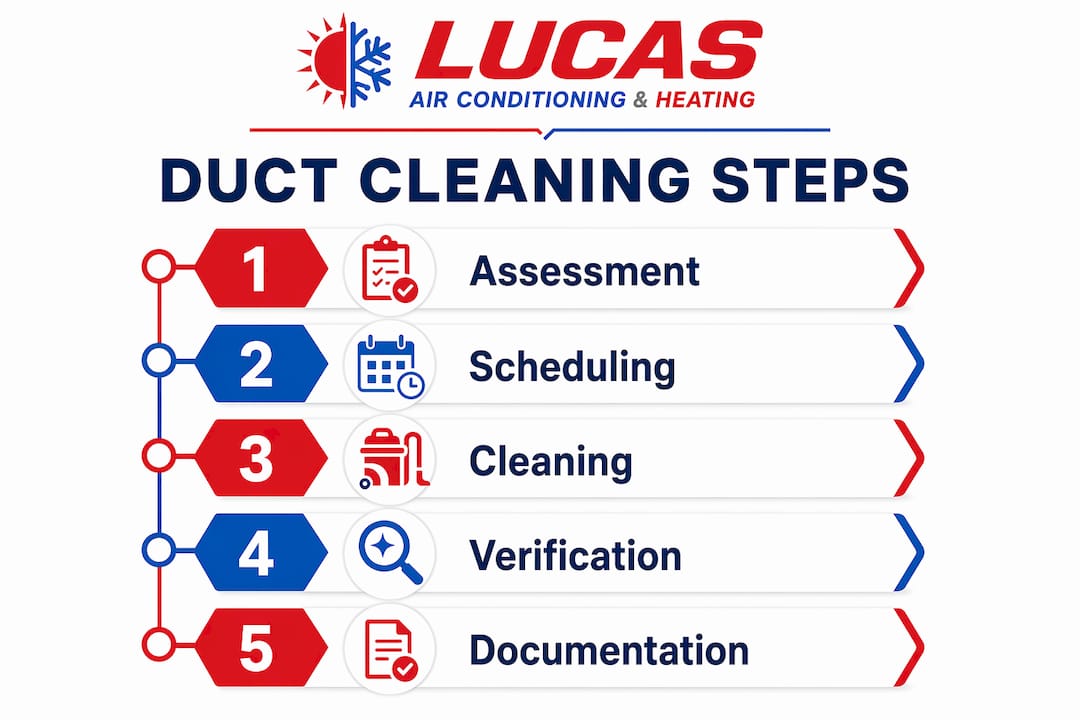
Effective commercial air duct maintenance follows a defined sequence. Skipping any phase risks spreading contaminants rather than removing them.
- Initial assessment. A certified technician inspects the full system, including the AHU, trunk lines, and branch ducts. This confirms the cleaning scope and identifies any damaged sections requiring repair before cleaning begins.
- Negative air pressure setup. The crew connects a high-powered vacuum collection unit to the duct system and creates negative pressure. Negative pressure containment prevents loosened debris from escaping into occupied spaces during agitation.
- Mechanical agitation. Technicians use pneumatic brushes, air whips, and compressed air tools to dislodge debris from duct walls. This is the phase most often skipped by low-quality providers, who rely on suction alone.
- Debris extraction. The vacuum collection unit captures all dislodged material. Filters on the unit prevent fine particles from re-entering the building.
- Biological decontamination. Where mold or bacterial contamination is confirmed, technicians apply EPA-registered antimicrobial treatments to duct surfaces after mechanical cleaning.
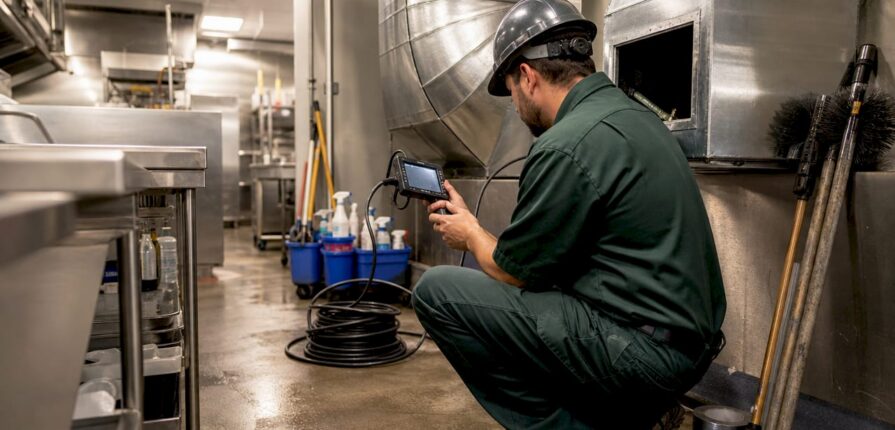
- Verification and documentation. Post-cleaning inspection, often using a video camera or calibrated manometer readings, confirms that airflow has been restored and surfaces are clean. A written report documents before-and-after conditions.
Scheduling cleaning outside business hours with a phased zone approach minimizes tenant disruption. Large buildings are divided into zones, with each zone cleaned during off-peak hours or overnight. Failing to plan around occupancy patterns is the most common reason commercial duct cleaning projects run over time and generate complaints.
Pro Tip: Ask your contractor to provide a zone-by-zone schedule before work begins. A written schedule lets you notify tenants in advance and prevents last-minute conflicts.

| Phase | Primary tool | Purpose |
|---|---|---|
| Assessment | Video inspection camera | Confirm scope and identify damage |
| Containment | Negative pressure vacuum unit | Prevent contaminant spread |
| Agitation | Pneumatic brushes, air whips | Dislodge debris from duct walls |
| Extraction | HEPA-filtered vacuum collection | Remove all loosened material |
| Decontamination | EPA-registered antimicrobial | Eliminate mold and bacteria |
| Verification | Manometer, post-cleaning camera | Document restored airflow and cleanliness |
What tools and standards guide professional duct cleaning?
The NADCA ACR Standard is the definitive benchmark for commercial duct cleaning. It requires that the entire air distribution system, including the AHU, coils, drain pans, and all duct sections, be cleaned as a single connected system. Only NADCA ACR-compliant cleanings covering the full distribution system deliver reliable efficiency and air quality improvements. Partial cleanings that address only accessible duct runs do not meet this standard and rarely produce measurable results.
ASHRAE Standard 62.1 sets minimum ventilation rates for acceptable indoor air quality in commercial buildings. Clean ducts are necessary to maintain those rates. Restricted or contaminated ductwork reduces effective airflow below ASHRAE thresholds, which can affect occupant health and building certification status.
Key tools used in professional commercial duct cleaning include:
- Pneumatic rotary brushes: Mechanically scrub duct walls to break up compacted debris
- Air whips and skipper balls: Use compressed air to agitate and propel debris toward the vacuum
- HEPA-filtered vacuum collection units: Capture fine particulates without releasing them back into the building
- Calibrated manometers: Measure static pressure differentials to verify airflow before and after cleaning
- Video inspection cameras: Provide visual documentation of duct conditions at each phase
EPA’s 2025 guidance on source removal confirmed that physically extracting contaminants from duct surfaces, rather than simply filtering recirculated air, is the most effective approach for improving indoor air quality. This aligns directly with the NADCA ACR method and validates the mechanical agitation step that separates thorough cleanings from superficial ones.
Pro Tip: Before hiring any contractor, ask for their NADCA certification number. Verify it on the NADCA website. Uncertified providers frequently skip the AHU and trunk lines, which are the highest-impact components.
What are the most common commercial duct cleaning mistakes?
The most damaging mistake is treating a filter change as a substitute for duct cleaning. Filter changes are far more impactful for day-to-day air quality than a single duct cleaning event. That does not make duct cleaning optional. It means both practices serve different functions and neither replaces the other. Duct cleaning removes accumulated contamination from system surfaces. Filter changes manage ongoing particulate loads. A property with clean filters and contaminated ducts still has an IAQ problem.
Other frequent errors include:
- Hiring uncertified contractors. Providers without NADCA certification often clean only accessible duct sections, leaving AHUs and trunk lines untouched.
- Skipping negative pressure setup. Without proper containment, agitation spreads debris into occupied areas instead of capturing it.
- No post-cleaning documentation. A cleaning without a written verification report provides no legal protection and no baseline for future inspections.
- Poor scheduling. Cleaning during business hours in occupied spaces causes disruption and often forces work stoppages. Phased, after-hours cleaning schedules prevent this.
A duct cleaning that lacks documented verification is not a completed job. It is an unverified claim. Property managers who accept verbal assurances instead of written reports carry the full liability if air quality issues arise afterward.
When evaluating service providers, ask these three questions directly: Are you NADCA-certified? Does your scope include the AHU, coils, and all trunk lines? Will you provide a written post-cleaning report with before-and-after documentation? A qualified contractor answers yes to all three without hesitation.
Key takeaways
Commercial duct cleaning requires annual inspections, NADCA ACR-compliant scope covering the full air handling system, and documented verification to deliver measurable air quality and efficiency gains.
| Point | Details |
|---|---|
| Inspect annually, clean every 1–3 years | Restaurants and kitchens need cleaning every 6–12 months due to grease and particulate loads. |
| Use NADCA ACR-compliant scope | Cleaning must cover AHUs, trunk lines, and all system components, not just accessible duct runs. |
| Maintain negative pressure throughout | Proper containment prevents loosened debris from spreading into occupied building spaces. |
| Document every cleaning | Written before-and-after reports protect against OSHA liability and support future inspections. |
| Separate filter changes from duct cleaning | Both practices serve different functions; neither replaces the other in a complete maintenance program. |
Why documentation is the part most property managers skip
Property managers often treat duct cleaning as a box to check rather than a technical event with measurable outcomes. That mindset is expensive. I have seen facilities spend money on cleaning services that produced no verifiable improvement because the contractor never established proper negative pressure and never documented results. The building owner had no recourse and no record.
The OSHA General Duty Clause makes this a legal issue, not just an operational one. Circulating mold or fine particulates through an occupied building creates employer liability. A cleaning log with certified contractor credentials, scope of work, and post-cleaning airflow measurements is your primary defense. Without it, you are relying on memory and goodwill.
The energy savings argument is equally concrete. Removing obstructions from ductwork and AHU components lets the system move air with less resistance. That directly reduces runtime and energy draw. For a large commercial facility, the savings over a 12-month period can offset the cost of cleaning several times over. Viewing commercial air duct maintenance as a cost center misses the return it generates.
My practical advice: schedule your next inspection before a problem forces your hand. Reactive cleaning after a mold discovery or an OSHA inquiry costs far more than planned maintenance. Build cleaning intervals into your annual facility budget alongside filter replacements and HVAC tune-ups. Treat the written report as a required deliverable, not an optional add-on.
— Results
Lucasair’s commercial duct cleaning services in Central Florida
Lucasair serves business owners and property managers across Central Florida with commercial HVAC and duct cleaning services aligned with current NADCA ACR standards and ASHRAE 62.1 requirements. Every cleaning includes full system scope: AHUs, trunk lines, branch ducts, and all air-handling components.
Lucasair schedules work around your occupancy patterns to avoid disrupting tenants or daily operations. Every job includes written documentation of scope, methods, and post-cleaning verification. Whether you manage an office building, a restaurant, or an industrial facility, Lucasair’s certified technicians deliver cleaning that meets compliance standards and produces documented results. Contact Lucasair to schedule an inspection or request a cleaning quote for your property.
FAQ
What is commercial duct cleaning?
Commercial duct cleaning is the professional removal of dust, debris, mold, and contaminants from HVAC ductwork and air handling components in commercial buildings. It follows the NADCA ACR Standard, which requires cleaning the full air distribution system, including AHUs and trunk lines.
How often should commercial ducts be cleaned?
Most commercial properties need duct cleaning every 1–3 years, with annual inspections. Restaurants and commercial kitchens require cleaning every 6–12 months due to grease accumulation and higher contamination risk.
Does duct cleaning actually save energy?
Yes. Removing obstructions from ductwork and AHU components reduces system resistance, which lowers energy consumption. Routine cleaning can reduce HVAC energy use by up to 30%.
What standards apply to commercial duct cleaning?
The NADCA ACR Standard governs the cleaning process and scope. ASHRAE Standard 62.1 sets the ventilation quality benchmarks that clean ducts help maintain. EPA guidance supports source removal as the most effective IAQ approach.
How do I verify a duct cleaning was done correctly?
Require a written post-cleaning report that includes before-and-after documentation, airflow measurements, and the contractor’s NADCA certification number. A cleaning without written verification provides no compliance protection.
Recommended
- The Role of Duct Cleaning in Manufacturing Facilities – Lucas Air Conditioning and Heating
- Why Regular Duct Cleaning Boosts Air Quality and Efficiency – Lucas Air Conditioning and Heating
- Restaurant duct cleaning: Keep compliant and customers happy – Lucas Air Conditioning and Heating
- Why Commercial HVAC Matters for Florida Property Managers – Lucas Air Conditioning and Heating
