

TL;DR:
- Systematic AC troubleshooting resolves most cooling issues by checking power, thermostat, airflow, and drainage before seeking professional help. Proper safety precautions, the correct tools, and regular maintenance, such as replacing filters and flushing drains, are essential for effective DIY diagnostics. Complex problems like refrigerant leaks or repeated breaker trips require licensed HVAC technicians to ensure safety and proper repair.
Step by step AC troubleshooting is a systematic diagnostic process that lets you identify and fix the most common air conditioner problems without waiting for a service call. Most AC failures trace back to a short list of culprits: a misconfigured thermostat, a tripped circuit breaker, a clogged air filter, or a blocked condensate drain. The Department of Energy and HVAC professionals agree that simple checks resolve the majority of residential cooling complaints. This guide walks you through each diagnostic step in order, tells you what to look for, and tells you exactly when to stop and call a licensed technician.
What tools and safety precautions do you need before troubleshooting?
Before you touch anything on your AC system, gather the right tools and understand the safety boundaries. Working on an air conditioner without preparation is how small problems become expensive ones.
Tools to have on hand:
- A flathead and Phillips screwdriver for accessing panels and filter housings
- Fresh AA or AAA batteries for your thermostat
- A replacement air filter sized to your unit (check the existing filter frame for dimensions)
- A multimeter for checking voltage at outlets or disconnect boxes (only if you are comfortable with electrical testing)
- A wet/dry vacuum or a small funnel and white vinegar for condensate drain maintenance
- A flashlight for inspecting dark cabinet interiors and drain pans
Safety rules that are non-negotiable:
- Turn off power at the thermostat AND at the disconnect box near the outdoor unit before opening any access panel
- Never attempt to handle or recharge refrigerant yourself. Federal EPA regulations require a certified technician for any refrigerant work
- Do not probe internal electrical components with a multimeter unless you have confirmed the power is off and you understand what you are testing
- If you smell burning, see scorch marks, or hear loud grinding, stop immediately and call a professional
Pro Tip: Before you change any setting or remove any component, take a photo with your phone. Documenting your thermostat settings, wiring positions, and filter orientation takes 30 seconds and saves significant confusion during reassembly.
A quick pre-troubleshooting checklist also helps you track what you have already ruled out. Write down each step as you complete it. This record is useful if you do end up calling Lucasair or another technician, because it tells them exactly what has already been checked.
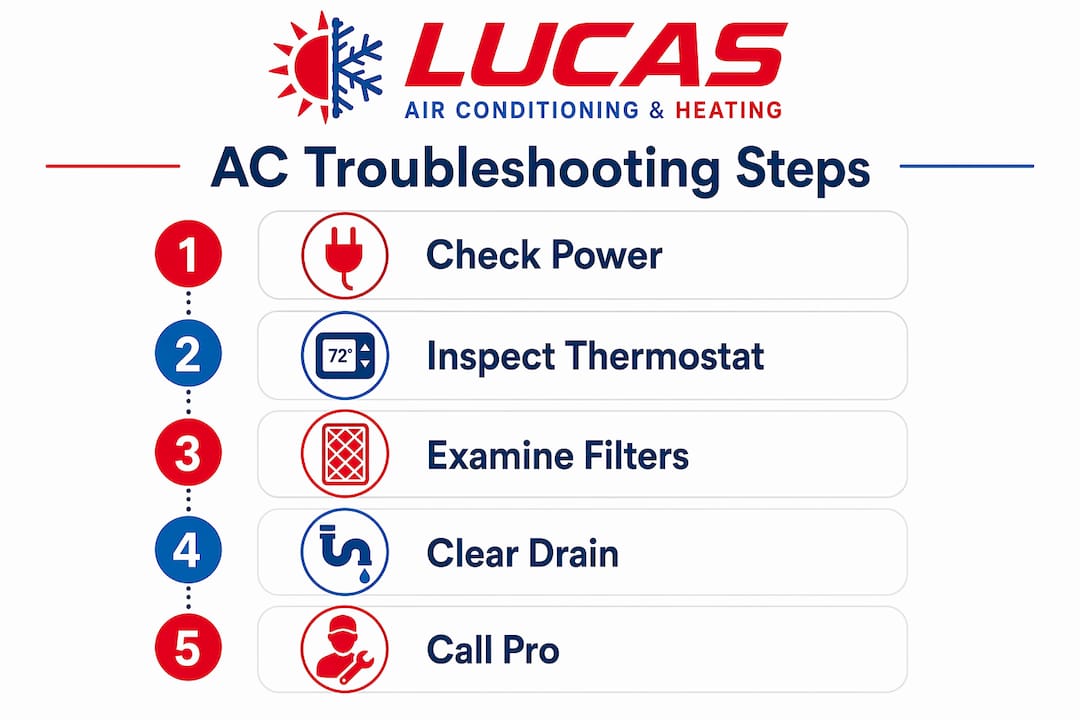
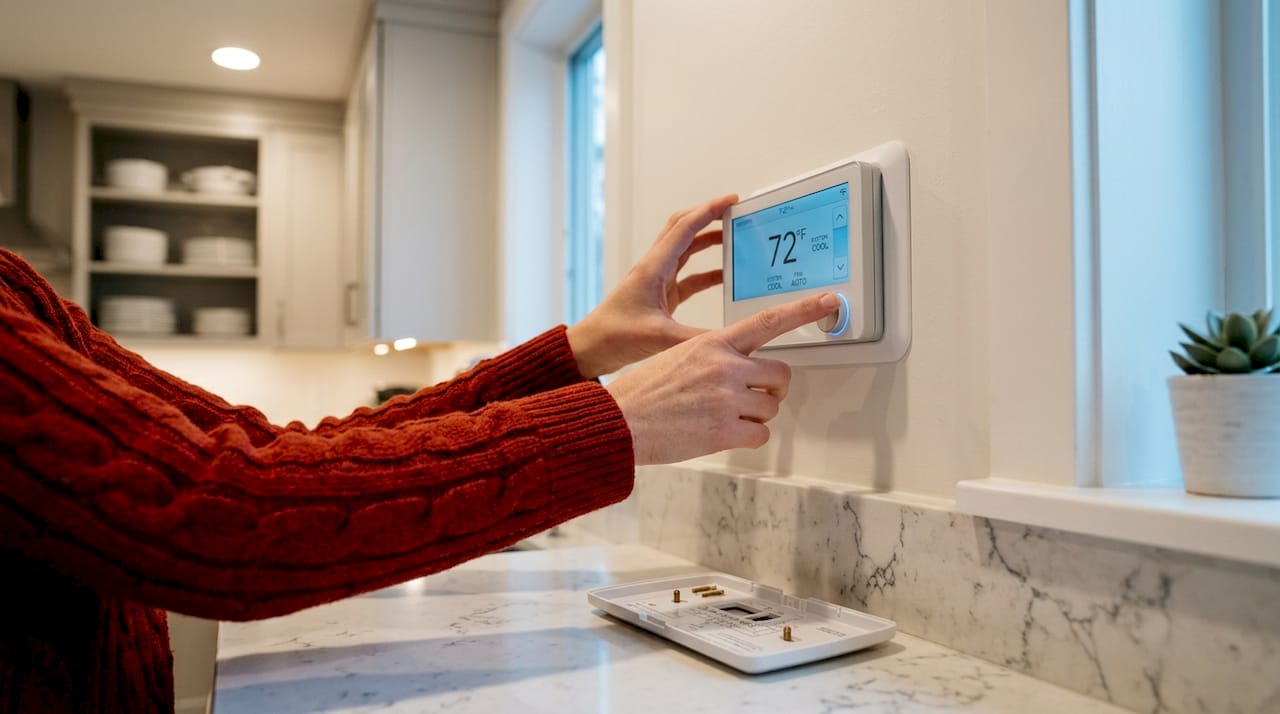
How to troubleshoot AC power and thermostat issues step by step
Power and thermostat problems are the most common reason an AC unit appears dead or fails to cool. Work through these steps in order before assuming anything is broken.
-
Check the thermostat mode. Confirm the thermostat is set to COOL, not HEAT or FAN ONLY. Set the target temperature at least 5 degrees below the current room temperature. Thermostat misconfiguration and dead batteries are among the most frequent causes of AC failures, and they are the easiest to fix.
-
Replace the thermostat batteries. If your thermostat display is dim or blank, swap in fresh batteries before doing anything else. A low battery causes erratic behavior that mimics serious system faults.
-
Inspect the circuit breaker panel. Go to your home’s main electrical panel and look for any breaker in the tripped position (usually centered between ON and OFF). Reset it by pushing it fully to OFF, then back to ON. Repeated breaker trips signal an underlying electrical fault that requires professional diagnosis. Do not keep resetting a breaker that keeps tripping.
-
Check the disconnect switch at the outdoor unit. There is a metal box mounted on the wall near your condenser. Open it and confirm the disconnect block or fuse is seated properly. A loose disconnect is a surprisingly common cause of a non-responsive outdoor unit.
-
Verify the indoor air handler switch. Many air handlers have a standard light-switch style power switch on the side of the unit. It is easy to bump off accidentally. Confirm it is in the ON position.
-
Look for thermostat wiring issues. If the display is on and settings are correct but the system still does not respond, remove the thermostat cover and check that all wires are firmly seated in their terminals. A wire that has slipped out of the R or C terminal will prevent the system from communicating.
Pro Tip: Your thermostat’s model number is printed inside the cover. Search that number plus “wiring diagram” to pull up the manufacturer’s exact terminal layout. This removes all guesswork when checking connections.
How to inspect air filters, vents, and the condensate drain
Restricted airflow is the second most common cause of poor cooling performance, and it is almost entirely preventable with regular maintenance. This section covers the three main airflow chokepoints in any residential system.
-
Locate and remove your air filter. The filter sits in the return air grille (usually a large louvered vent in a hallway ceiling or wall) or in a slot on the air handler itself. Slide it out carefully.
-
Inspect the filter. Hold it up to a light source. If you cannot see light through it, the filter is clogged. Dirty air filters reduce airflow and efficiency and can cause the evaporator coil to freeze solid, which shuts down cooling entirely.
-
Replace the filter. Install a new filter with the airflow arrow pointing toward the air handler. Replacing filters monthly during the cooling season is the single most impactful DIY step you can take to protect your system.
-
Check every supply and return vent in the home. Walk room to room and confirm all vents are open and unobstructed. Furniture, rugs, and drapes pushed against vents create the same restriction as a clogged filter. Closing too many supply vents also increases duct pressure and stresses the blower motor.
-
Inspect the condensate drain line. Find the white PVC pipe that exits the air handler and drains outside or into a floor drain. Pour one cup of white vinegar into the access port (a capped T-fitting near the air handler). Flushing with vinegar monthly prevents algae and mold buildup that causes clogs, water backup, and automatic system shutdowns triggered by the float switch.
-
Check the drain pan. If the pan under the air handler has standing water, the drain is already clogged. Use a wet/dry vacuum on the exterior end of the drain line to pull the blockage out before flushing with vinegar.
-
Look for ice on the evaporator coil. Open the air handler access panel and inspect the coil. Ice buildup confirms restricted airflow or a refrigerant issue. Turn the system to FAN ONLY for two hours to thaw the coil, then recheck after replacing the filter.
Pro Tip: Set a recurring monthly phone reminder labeled “AC filter check.” In Central Florida’s long cooling season, a filter that looks fine in week two can be fully clogged by week five.
When does AC troubleshooting require a professional?
Some AC problems sit beyond the reach of DIY diagnosis. Recognizing these limits protects both your safety and your equipment.
Signs that require a licensed HVAC technician:
- Frost or ice forming on the refrigerant lines or outdoor unit when the filter is clean and airflow is unobstructed. This points to a low refrigerant charge or a leak.
- Warm air blowing from supply vents despite correct thermostat settings, clean filters, and clear drains. This often indicates a failed compressor or a refrigerant issue.
- A grinding, banging, or squealing noise from the outdoor condenser or indoor air handler. These sounds indicate failing fan motors, a loose blower wheel, or compressor damage.
- A capacitor that will not hold a charge. Capacitors start the compressor and fan motors. A swollen or leaking capacitor is visible on inspection, but replacing it involves stored electrical charge that can cause serious injury.
- Any situation where the circuit breaker trips repeatedly after reset.
Refrigerant handling requires a licensed technician by federal law. Attempting a DIY recharge with off-the-shelf refrigerant cans can mask a leak, damage the compressor, and void your equipment warranty. When a technician arrives, they will check refrigerant charge, measure airflow and electric controls, and verify thermostat accuracy using calibrated instruments that are not available to homeowners.
Step-by-step homeowner troubleshooting empowers early problem identification but should transition to professional help if problems persist after basic checks.
Common mistakes to avoid and tips for ongoing AC maintenance
Good air conditioner troubleshooting is as much about what you do not do as what you do. These are the mistakes that turn a $0 fix into a $1,500 repair.
- Do not ignore a tripped breaker. A single trip can be a fluke. Two trips in one week means something is drawing excess current. Call a technician before the third trip causes component damage.
- Do not run the system with a frozen coil. Ice on the evaporator coil blocks airflow completely. Running the compressor against a frozen coil strains it and shortens its life. Always thaw first, then diagnose.
- Do not skip the outdoor condenser. Condenser coil dirt and foliage block airflow and reduce efficiency measurably. Keep two feet of clearance around the unit and rinse the fins with a garden hose from the inside out once per season.
- Do not ignore odors. A musty smell means mold in the drain pan or ductwork. A burning smell means an electrical component is overheating. Neither resolves on its own.
- Schedule a professional tune-up annually. The best time in Central Florida is March or April, before peak cooling demand hits. A tune-up from a qualified technician covers refrigerant levels, electrical connections, coil cleaning, and blower performance. Pairing that with your own monthly filter checks and quarterly drain flushes gives your system the best chance of running through summer without a breakdown.
Pro Tip: Keep a simple maintenance log on your phone or a sticky note on the air handler. Record the date of each filter change, drain flush, and any unusual behavior. This log is the first thing a good technician will ask for.
For a deeper look at keeping your system healthy year-round, the HVAC preventative maintenance guide from Lucasair covers seasonal care in detail.
Key takeaways
Systematic AC troubleshooting resolves most residential cooling failures by working through power, thermostat, airflow, and drainage checks before escalating to professional service.
| Point | Details |
|---|---|
| Start with thermostat and power | Check mode, temperature setting, batteries, and circuit breakers before assuming mechanical failure. |
| Replace filters monthly | A clogged filter causes coil icing, compressor stress, and complete system shutdown. |
| Flush the condensate drain | Monthly vinegar flushes prevent algae clogs that trigger automatic shutdowns and water damage. |
| Know when to stop DIY | Refrigerant issues, repeated breaker trips, and component failures require a licensed technician. |
| Schedule annual tune-ups | Professional service in spring catches problems that homeowner checks cannot detect. |
What I’ve learned from watching homeowners troubleshoot their own AC
Most homeowners either do too little or too much. The ones who do too little call a technician for a dead thermostat battery. The ones who do too much pull refrigerant lines apart and create a $2,000 problem from a $15 filter issue.
The sweet spot is knowing your system’s anatomy well enough to rule out the simple stuff fast. In my experience, roughly seven out of ten “my AC stopped working” calls trace back to a dirty filter, a tripped breaker, or a thermostat set to the wrong mode. That is not a knock on homeowners. Those things are genuinely easy to miss, especially when you are hot and frustrated at 9 PM in July.
Where I see people get into trouble is the moment they decide that because the easy fixes did not work, they should start probing electrical components or adding refrigerant from a hardware store can. That logic costs money and occasionally causes injury. The line between DIY and professional territory is not about skill. It is about tools, certifications, and liability. Refrigerant work without an EPA 608 certification is illegal, full stop.
My honest recommendation: spend 20 minutes on the checklist in this guide. If the system is still not working after you have confirmed the thermostat, breaker, filter, and drain, pick up the phone. You have already done the diagnostic work that saves the technician time, which often saves you money on the service call.
For homeowners who want to go deeper before calling anyone, the HVAC troubleshooting guide covers additional diagnostic scenarios specific to Central Florida systems.
— Lucasair
When DIY checks are done, Lucasair is ready to help

If you have worked through every step in this guide and your AC is still not cooling, Lucasair has you covered. Lucas Air Conditioning and Heating serves homeowners across Central Florida, including Eustis, The Villages, and surrounding communities, with expert AC diagnostics and repairs that go beyond what any checklist can address. As a veteran-owned business founded by Army Veteran Cameron Lucas, Lucasair brings the same discipline and precision to every service call that you just applied to your own troubleshooting. Whether you need a refrigerant check, a capacitor replacement, or a full seasonal tune-up, scheduling is fast and financing options are available. Contact Lucasair today to get your system running right before the next heat wave hits.
For homeowners in Lake County and Marion County, Lucasair also provides trusted HVAC contractor services in The Villages, FL with same-area technicians who know local system demands.
FAQ
Why is my AC running but not cooling the house?
The most common causes are a clogged air filter, a frozen evaporator coil, or low refrigerant. Start by replacing the filter and checking for ice on the indoor coil before calling a technician.
How often should I replace my AC air filter?
Replace your filter every 30 days during the active cooling season. A clean filter is the single most impactful step for maintaining efficiency and preventing compressor damage.
What does it mean when my AC breaker keeps tripping?
A breaker that trips repeatedly signals excess electrical draw from a failing component such as a capacitor, compressor, or fan motor. Reset it once, and if it trips again, call a licensed HVAC technician rather than resetting it a third time.
Can I recharge my AC refrigerant myself?
No. Refrigerant handling requires an EPA 608 certification and specialized equipment. DIY refrigerant work is illegal, can damage the compressor, and will void most equipment warranties.
How do I clear a clogged AC condensate drain?
Pour one cup of white vinegar into the drain access port near the air handler, wait 30 minutes, then flush with water. If the drain pan already has standing water, use a wet/dry vacuum on the exterior drain outlet first to pull the clog out.
Recommended
- Step by Step HVAC Repair Guide for Homeowners – Lucas Air Conditioning and Heating
- Step by step HVAC troubleshooting guide homeowners – Lucas Air Conditioning and Heating
- Step-by-step air conditioner assessment guide for homeowners – Lucas Air Conditioning and Heating
- HVAC Repair Workflow Residential: Step-by-Step Guide
