
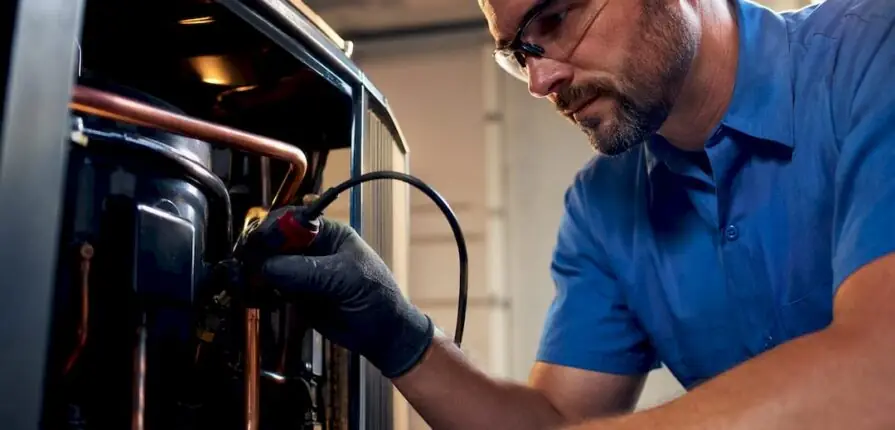
Replacing an AC compressor typically runs $800 to $2,300 installed, with most homeowners landing near a $1,550 midpoint. That figure covers the compressor itself, technician labor, refrigerant recovery and recharge, and small parts like a filter drier. Costs push past that range fast on older R-22 systems or units buried in tight attic or rooftop spots where access alone adds hours to the job.
TL;DR:
- Compressor replacement costs generally range from $800 to $2,300, with labor and refrigerant fees significantly affecting the final bill, especially on older or hard-to-access units.
- The type and size of the compressor, along with refrigerant type, strongly influence prices, with inverter-driven models and larger tonnage units costing more to repair or replace.
- Repair costs usually just cover the compressor and refrigerant recharge; additional charges may include line flushing, filter driers, or after-hours service, which should be itemized upfront.
- In high-cost regions or humid climates like Florida, labor rates and system wear from salt air and humidity increase overall repair expenses and frequency of failures.
- HVAC technician diagnostics before replacement are crucial to avoid unnecessary costs, as many “dead compressor” calls turn out to be simple electrical issues or faulty parts that cost far less to fix.
Table of Contents
- AC Compressor Cost Breakdown: Part, Labor, and Refrigerant
- How Much Does Tonnage and Compressor Type Affect Price?
- How Long Does an AC Compressor Replacement Take?
- Why Refrigerant Type Drives the Real Cost Difference
- Repair or Replace: The Math That Settles It
- Signs Your Compressor Is Actually the Problem
- What Should Be Written on Your Compressor Quote
- Hidden Fees That Sneak Into Compressor Repair Bills
- Should You Attempt a DIY AC Compressor Repair?
- Why Compressor Costs Vary So Much by Region and State
- Financing a Compressor Repair or Replacement
- What We See on Central Florida Service Calls
- How Lucas Air Handles Compressor Diagnostics and Repairs
- Where These Numbers Come From
- Sources
AC Compressor Cost Breakdown: Part, Labor, and Refrigerant
The total bill on your invoice is really four smaller bills stacked together, and understanding each one is the fastest way to tell a fair quote from an inflated one.
The compressor itself is usually the biggest single line item, and its price swings hard depending on type. A standard scroll compressor runs $500 to $1,500 for the part alone, since scroll models dominate residential central air and cost less to manufacture at volume. Reciprocating compressors, common in older systems, land in a similar range but get harder to source as those platforms age out. Rotary compressors, found mostly in smaller window and mini-split units, tend to price lower. Variable-speed and inverter-driven compressors sit at the top of the range, often $1,600 to $2,400 for the part, because they include electronics that modulate speed for efficiency.
Labor is where quotes diverge the most. Compressor swaps take 4 to 8 hours depending on unit accessibility and whether the old compressor has to be cut out of brazed refrigerant lines. Hourly rates vary by market, generally $75 to $200 per hour, though many shops quote a flat labor fee of $300 to $900 instead of billing by the hour. Flat-fee pricing protects you from a tech who works slowly, but it can also mean you’re overpaying if the job turns out to be simple.
Refrigerant recovery and recharge is its own line item, separate from labor, because EPA rules require the old refrigerant to be captured and weighed before any new charge goes in. For common R-410A systems, recovery and recharge fees typically add $100 to $350 to the bill. That number climbs sharply on older R-22 units, a point worth remembering before you sign anything.
Small parts round out the invoice. A new filter drier is standard practice after any compressor failure since the old one absorbs contaminants from the burned-out unit, and skipping it risks killing the new compressor within months. Expect $50 to $150 for the drier alone, plus incidentals like Schrader valve cores or line insulation.
Here’s what a sample itemized quote looks like for a mid-size residential job:
- Scroll compressor (3-ton system): $900
- Labor (6 hours at $120/hr): $720
- Refrigerant recovery and R-410A recharge: $200
- Filter drier and small parts: $90
- Total: $1,910, comfortably inside the national range
That math is exactly why reviewing typical rate structures before you call for quotes helps you spot a bid that’s padded versus one that’s just thorough.
How Much Does Tonnage and Compressor Type Affect Price?
System size drives cost about as much as compressor type does, since larger tonnage means a bigger, more expensive compressor and more refrigerant to recharge.
- 1.5 to 2 ton systems: roughly $700 to $1,400 installed, common in smaller homes and condos
- 2.5 to 3 ton systems: roughly $900 to $2,100 installed, the most common residential band
- 3.5 to 4 ton systems: often $1,600 to $2,500+ installed, typical for larger single-family homes
Mini-split and heat pump compressors follow slightly different math. Ductless mini-splits often use smaller, sealed rotary or scroll units that cost less as a part, but labor can run higher if refrigerant lines need extending or the outdoor unit sits somewhere awkward. Heat pump compressors work harder year-round, running in both cooling and heating mode, which means they tend toward the higher end of their tonnage band even when the part itself isn’t unusual.
There’s a threshold worth watching for. Once a compressor swap on an aging condenser starts pricing close to a full condenser replacement, usually within a few hundred dollars, most technicians will tell you straight that swapping the whole outdoor unit makes more sense. You get a new warranty on every component instead of one aging part propped up by new refrigerant. If you’re already flirting with that line, it’s worth pulling up what full AC replacement runs in Florida before committing to the repair.
How Long Does an AC Compressor Replacement Take?
Most compressor jobs take a single day, but the labor hours inside that day vary more than homeowners expect.
- Standard swap: 4 to 6 hours for an accessible ground-level condenser with straightforward line connections
- Complex swap: 6 to 8 hours when brazing, extensive flushing, or tight access adds time
- Hourly labor rates: $75 to $200/hr depending on market and technician certification level
- Flat-fee labor: $300 to $900, common for standardized residential jobs
Accessibility is the hidden variable in every quote. A rooftop commercial unit or a condenser wedged into a crawl space adds real time, sometimes requiring two technicians instead of one, which shows up as a labor surcharge rather than a separate fee. Multi-story homes with attic-mounted air handlers face similar markups.
Permits aren’t typically required for a like-for-like compressor swap, but full system replacements often do need one, and inspection scheduling can add a day or two to the timeline. After-hours or emergency service, meaning nights, weekends, or a same-day callout during a heat wave, commonly adds a premium on top of standard labor rates. If your compressor dies on a Friday night in July, expect that surcharge to show up on the invoice.
Why Refrigerant Type Drives the Real Cost Difference
Refrigerant type is often the single factor that separates an affordable repair from a replacement decision, and it has nothing to do with the compressor itself.
Any technician who handles refrigerant must hold EPA Section 608 certification, a federal requirement that exists because refrigerants are regulated substances with environmental and safety consequences. This isn’t paperwork you can wave off. It’s the reason a licensed HVAC company, not a handyman, has to be the one opening your refrigerant lines.
The refrigerant math that changes everything: R-22 has been phased out under EPA’s HFC phasedown rules, and the remaining reclaimed supply pushes per-pound prices well above what R-410A or the newer R-454B costs. A system that needs several pounds of R-22 recharge can rack up refrigerant costs alone that rival the price of the compressor part.
If your outdoor unit runs R-22 (common in older systems), compressor failure is often the point to consider full replacement. R-22 recharge costs can be high due to scarcity, making repairs less economically viable. Compatibility matters too: you can’t just drop R-410A into an R-22 system’s existing lines and call it fixed, since the oils, pressures, and hardware differ. Old refrigerant in an aging system is usually the real story behind a repair bill that looks reasonable on paper but isn’t worth paying.
Repair or Replace: The Math That Settles It
Three heuristics, used together, take most of the guesswork out of this decision.
- Check the age threshold first. A compressor failing under 8 to 10 years, especially if it’s still under a manufacturer parts warranty, usually points to repair. Past 12 years, with the compressor and other major components aging in parallel, replacement starts making more sense even if this particular repair looks affordable in isolation.
- Run the percent-of-new rule. If the repair quote exceeds roughly 40 to 50 percent of a new system’s installed cost, most contractors recommend replacing rather than repairing. A $1,800 compressor repair on a system that would cost $4,000 to replace sits right at that line, worth a second quote before deciding either way.
- Apply the $5,000 rule. Multiply the system’s age by the repair cost; a high resulting number favors replacement over repair. A 9-year-old system with a $700 repair quote scores 6,300, over the threshold, while a 4-year-old system with the same repair scores 2,800, comfortably under it.
Warranty status can override all three rules at once. If the compressor is under a manufacturer’s parts warranty and you only pay labor, repair is generally preferred regardless of system age. The same logic applies if you had a major repair done in the last year or two. Paying for a second failure on top of a recent one changes the math, since you’re not starting from zero condition, you’re compounding an already-troubled system.
Signs Your Compressor Is Actually the Problem
Not every “the AC stopped cooling” call is a dead compressor, and a good diagnostic saves you from paying for a part you didn’t need.
- No cold air despite the outdoor unit running
- Loud clanking, grinding, or humming from the outdoor unit
- The system trips the breaker repeatedly
- A burning smell near the outdoor unit, often a sign of electrical failure inside the compressor
- Higher-than-normal amp draw on startup
Before authorizing a compressor swap, ask your technician to rule out cheaper culprits: a failed capacitor, a worn contactor, a miscalibrated thermostat, or simply low refrigerant from a slow leak elsewhere in the system. These parts cost a fraction of a compressor and get blamed on the compressor more often than homeowners realize.
Pro Tip: Ask for the actual diagnostic readings, not just a verdict. A legitimate quote should list the amp draw measured, a megohm (insulation resistance) reading on the compressor windings, and the exact model number pulled from the unit’s nameplate. If a tech tells you “it’s the compressor” without showing you numbers, get a second opinion before you spend money.
What Should Be Written on Your Compressor Quote
A vague quote is the single biggest reason homeowners overpay or get surprised by add-on charges mid-job. Insist on these line items before signing:
- Compressor model number and manufacturer, plus whether it’s OEM or an aftermarket equivalent
- Labor hours and whether they’re billed hourly or as a flat fee
- Refrigerant type and exact pounds needed for recharge, not just “refrigerant fee”
- Filter drier replacement, listed separately
- Refrigerant recovery and disposal fees
- Written warranty terms for both the part and the labor
Ask directly whether the quote includes an electrical load check on the new compressor’s startup circuit. Some failures that killed the original compressor, like a bad capacitor sending it dirty power for months, will kill the replacement too if nobody checks. Also ask about OEM versus aftermarket parts specifically. Aftermarket compressors cost less upfront but sometimes carry shorter or no manufacturer warranty, which matters if it fails again in year three.
If a contractor won’t break the quote into these pieces and just gives you one bundled number, that’s worth pushing back on. Reputable residential HVAC repair services should be able to itemize every part of the job without hesitation.
Hidden Fees That Sneak Into Compressor Repair Bills
A handful of smaller charges routinely surprise homeowners who only budgeted for “the compressor.”
- Filter drier and evacuation chemicals: $50 to $150, standard after any compressor burnout
- Line flush (removing acid and debris from a burned-out compressor): often bundled with labor but sometimes billed separately, $75 to $200
- Hard-start kit (helps an aging or high-load compressor start smoothly): $100 to $250
- Emergency or after-hours service premium: commonly adds 1.5x to 2x standard labor rates
- Permits, when required for larger system work, vary by county but typically run $50 to $200
None of these are scams. They’re legitimate parts of a proper repair. The issue is when they show up as a surprise on the final invoice instead of the original quote.
Should You Attempt a DIY AC Compressor Repair?
Handling refrigerant without EPA Section 608 certification is against federal law, not just a warranty technicality. Anyone who recovers, recharges, or otherwise touches refrigerant on a compressor swap has to hold that certification, which is exactly why this isn’t a weekend DIY project for most homeowners.
Beyond the legal issue, the practical risks are real. Improper evacuation leaves moisture and air in the system that destroys a new compressor within weeks. Miswired electrical connections on a 240-volt circuit can injure you or start a fire. And manufacturers routinely void parts warranties when they find evidence of non-professional refrigerant work.
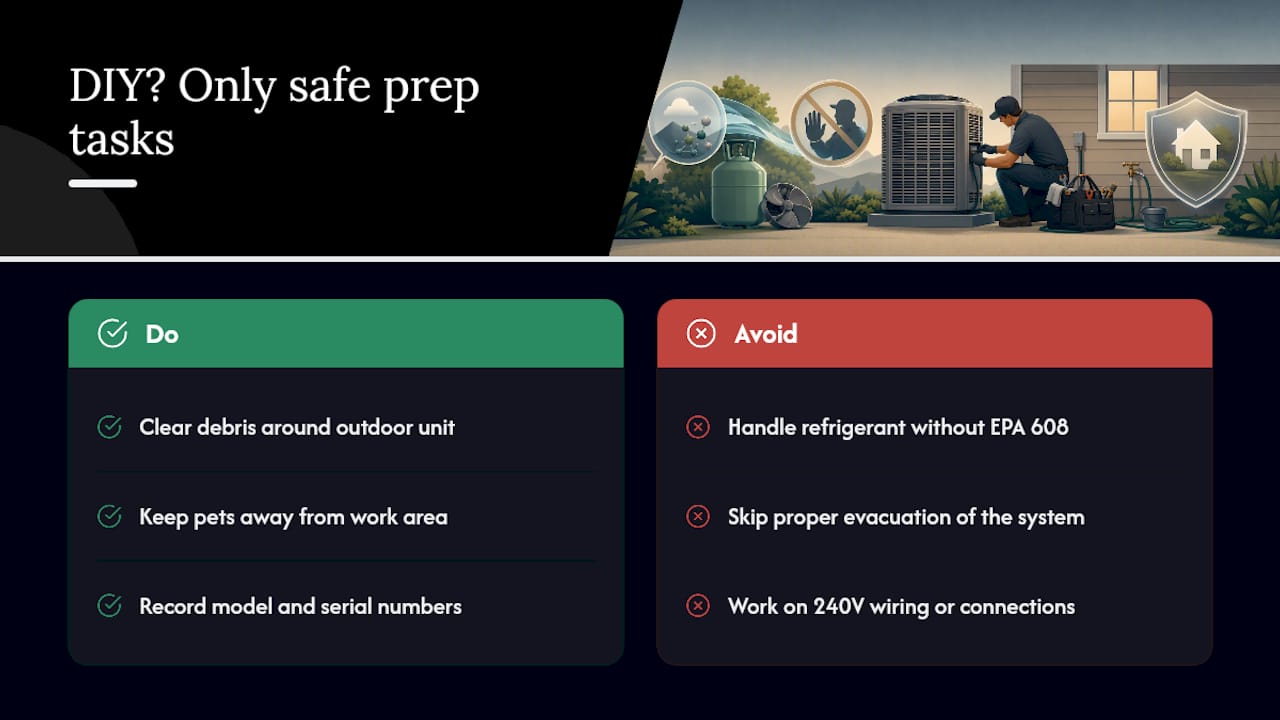
What you can safely do yourself: clear brush and debris around the outdoor unit, secure pets away from the work area, and pull the model and serial numbers off the nameplate before you call for quotes so you’re not scrambling during the diagnostic visit. Leave the refrigerant lines, electrical connections, and compressor mounting to a licensed repair technician.
Why Compressor Costs Vary So Much by Region and State
Where you live changes the price of a compressor swap more than most homeowners expect, and it’s not just about labor rates.
Local labor markets set the floor. Metro areas with a higher cost of living generally see technician rates at the top of the $75 to $200 per hour range, while smaller markets often land closer to the bottom. Climate matters just as much. In Central Florida, air conditioning runs nearly year-round, which means compressors log more operating hours annually than they would in a milder climate, and that shortens their working life while also creating a busier service market with more competition among contractors.
Building codes and permit requirements differ by county, adding administrative cost in some areas that simply doesn’t exist elsewhere. Coastal regions face an added factor: salt air accelerates corrosion on outdoor condenser components, which can mean more frequent compressor failures and a shorter interval between major repairs compared to inland homes. Humidity levels also affect how hard a compressor works to pull moisture out of the air, another reason Florida systems tend to see more wear than the national average suggests.
Availability of parts plays a role too. Rural areas sometimes face longer wait times for specific compressor models, which can add days to a repair timeline even when the diagnosis and quote are settled quickly.
Financing a Compressor Repair or Replacement
A $1,550 midpoint repair, or a full system replacement running several thousand dollars more, isn’t a bill most households want to pay in cash on short notice, especially when it hits during peak summer heat.
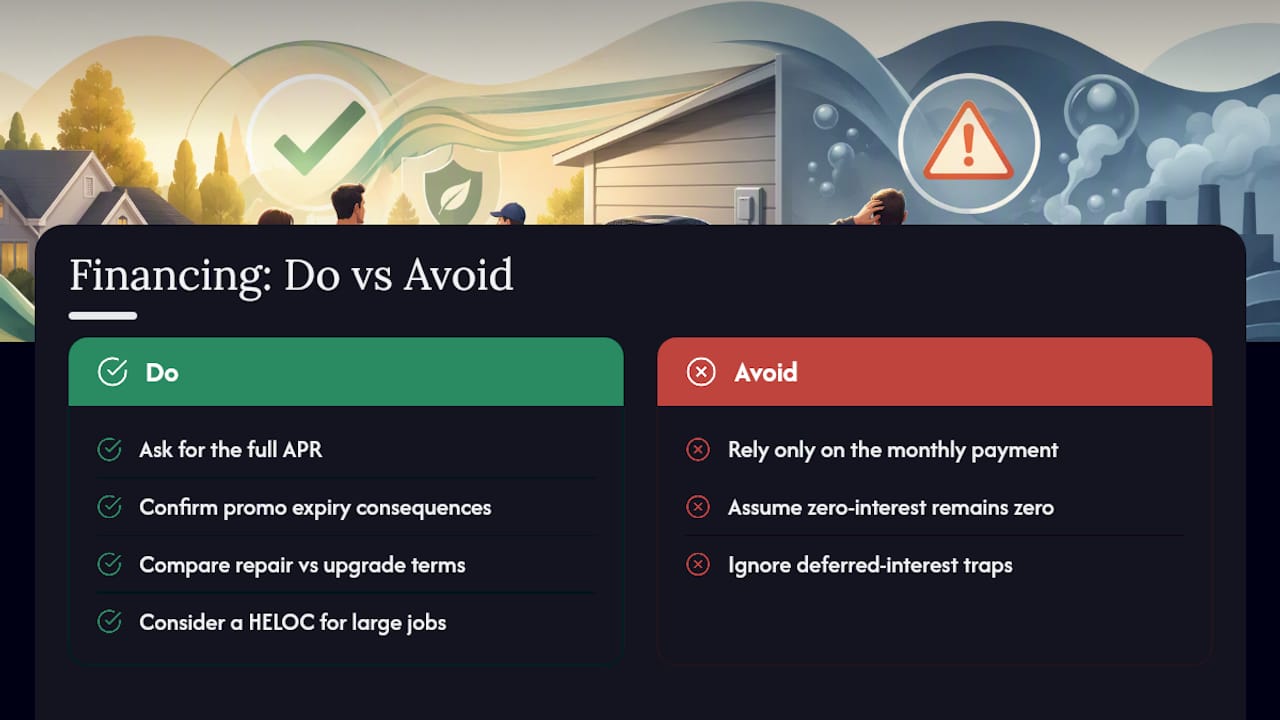
Many HVAC contractors offer financing options that break a repair or replacement into monthly payments rather than one lump sum. Terms vary by lender and credit approval, but common structures include promotional periods with deferred interest, fixed monthly payment plans over 12 to 60 months, and same-as-cash offers for shorter terms. Some homeowners also use a home equity line of credit for larger replacement jobs, since the interest rate is often lower than a retail financing plan, though that route takes longer to set up than an in-house HVAC financing application.
Before signing any financing agreement, ask for the full annual percentage rate, not just the monthly payment number, and confirm what happens if a promotional zero-interest period expires before the balance is paid off. That’s where deferred-interest plans quietly cost homeowners the most. If your compressor failed on an older system that’s already a replacement candidate under the age and percent-of-new rules covered earlier, it’s worth asking your contractor whether financing terms differ between a straight compressor repair and a full system upgrade. Sometimes the payment difference per month is smaller than the total cost difference makes it look.
What We See on Central Florida Service Calls
Compressor failures in Central Florida cluster around two causes we run into constantly: units that ran on low refrigerant for months before anyone noticed, and electrical failures from age-related capacitor and contactor wear that eventually took the compressor down with them. Salt air and heavy humidity accelerate both problems compared to drier climates.
Our approach starts with diagnostics, not a compressor sales pitch. We test capacitors, contactors, and amp draw before recommending a swap, because a lot of “dead compressor” calls turn out to be a $40 part instead of an $1,800 one. When a compressor swap really is the right call, we itemize the quote, model number, labor hours, refrigerant pounds, warranty terms, so you’re not guessing what you’re paying for.
If your system is acting up, get the itemized diagnostic first and ask about financing before you assume you can’t afford the fix.
— Results
How Lucas Air Handles Compressor Diagnostics and Repairs
Lucas Air is the local alternative to guessing your way through a compressor problem: instead of a phone quote based on symptoms alone, we run an actual system check before recommending a repair or replacement. That diagnostic-first approach is exactly what keeps homeowners from paying for a new compressor when the real issue is a $40 capacitor.
Lucas Air handles residential and commercial repairs, tune-ups, and full system installations, with financing options available for repairs and replacements. They offer system checks that provide amp draw and refrigerant readings to inform decisions before committing to any repair. If your outdoor unit is making noise, tripping breakers, or just not cooling like it used to, request an itemized repair quote and get the actual numbers before you decide what to fix.
Where These Numbers Come From
Cost ranges and labor figures in this article draw from This Old House’s compressor pricing data and industry labor benchmarks. Refrigerant and certification rules come directly from EPA Section 608 and the EPA’s HFC phasedown guidance. Repair-versus-replace heuristics reference ACHR News industry reporting.
Sources
- How Much Does an AC Compressor Cost? (2026 Pricing) — This Old House
- AC Compressor Replacement Cost: When It Makes Sense vs. When to Replace (2026) – Thermostat & HVAC Helpers
- EPA — Section 608
- When does a compressor swap still make sense — ACHR News