

TL;DR:
- Most hospitality managers overlook indoor air quality until complaints arise, ignoring its impact on health and guest satisfaction. Proper ventilation, source control, and advanced filtration are essential for compliance and maintaining optimal IAQ, especially in humid Central Florida climates. Implementing proactive sensor-based monitoring and regular system maintenance helps prevent IAQ issues from affecting guest experience and property reputation.
Most hospitality managers think about air quality the moment a guest complains about a smell. That’s too late, and it’s also the wrong frame entirely. The role of air quality in hospitality goes well beyond odors — poor indoor air quality (IAQ) causes immediate and long-term health effects that guests may not connect to your property until they’ve already left a bad review. In Central Florida’s humid, high-occupancy hotel environment, IAQ isn’t a comfort bonus — it’s a compliance issue, a guest satisfaction driver, and a direct factor in your operating costs.
Table of Contents
- Understanding the role of air quality in hospitality health impacts
- Central Florida ventilation standards and compliance strategies
- Source control: cleaning products, fragrances, and VOCs
- Ventilation and filtration technologies worth investing in
- Building a proactive IAQ management program
- What most properties get wrong about air quality investment
- Protect your property with Lucas Air’s hospitality HVAC services
- Frequently asked questions
Key Takeaways
| Point | Details |
|---|---|
| IAQ impacts guest health | Poor indoor air quality causes both immediate discomfort and long-term health risks for hotel guests. |
| Follow ventilation codes | Hotels in Central Florida must meet specific ASHRAE 62.1 ventilation standards to ensure safe air exchange. |
| Control pollutant sources | Reducing VOCs from cleaning products and odors improves air quality better than masking with fragrances. |
| Use tech for ventilation | Demand-controlled ventilation and high-efficiency filtration optimize air quality and energy use in variable occupancy spaces. |
| Proactive IAQ management | Continuous monitoring linked to maintenance work orders prevents IAQ problems before guests are affected. |
Understanding the role of air quality in hospitality health impacts
The basics first. IAQ refers to the condition of the air inside your building as it affects the people occupying it. In a hotel or restaurant, that means guests, staff, and anyone spending significant time on your property. The risk compounds with longer stays.
Indoor pollution sources push pollutant concentrations higher whenever ventilation falls short, leading to headaches, eye irritation, fatigue, and in chronic situations, respiratory disease. The tricky part? Guests rarely say “the air here made me feel off.” They say the room felt stuffy, or they slept poorly, or they just didn’t feel like themselves. You lose the connection between IAQ and the complaint, so the root cause never gets fixed.
In hospitality, the most common indoor air pollutants you’ll face include:
- Volatile organic compounds (VOCs): Released from cleaning products, paint, carpets, and furniture
- Particulate matter: Dust, pollen, and combustion byproducts that enter through HVAC systems
- Carbon dioxide (CO2): Builds up in poorly ventilated conference rooms, lobbies, and guest rooms
- Mold and biological contaminants: Thrive in Central Florida’s humidity when moisture isn’t controlled
- Carbon monoxide: A serious risk near loading docks, parking garages, or improperly vented kitchen equipment
Understanding indoor air quality fundamentals is the starting point for any manager who wants to go beyond reactive fixes.
Central Florida ventilation standards and compliance strategies
Florida doesn’t let hospitality operators set their own ventilation benchmarks. The Florida Building Code mandates ASHRAE 62.1-2022 ventilation requirements for hotels, specifying minimum outdoor air delivery rates by space type — guest rooms, lobbies, fitness centers, and dining areas each carry distinct requirements.
Here’s a simplified look at what those minimums look like in practice:
| Space type | Outdoor air (cfm/person) | Outdoor air (cfm/sq ft) |
|---|---|---|
| Hotel guest room | 5 | 0.06 |
| Hotel lobby | 7.5 | 0.06 |
| Restaurant dining | 7.5 | 0.18 |
| Fitness center | 20 | 0.06 |
The numbers themselves matter less than this reality: systems failing minimum outdoor-air requirements will fail mechanical plan review regardless of how well the system handles heating and cooling. Thermal comfort and ventilation compliance are evaluated separately.
To stay compliant without guessing, work through these steps:
- Audit your current airflow rates against ASHRAE 62.1-2022 minimums for each occupied space type
- Commission a test and balance report after any system modification or new installation
- Schedule annual verification of outdoor air damper positions and actuator function, since dampers drift over time
- Document everything — inspection records support plan approvals and protect you during any code review
For context on how Florida’s standards apply to commercial properties, reviewing Central Florida HVAC standards and understanding HVAC code considerations for Central Florida will save you headaches when permits or renovations come up.
Pro Tip: Don’t assume a newly installed system is delivering the rated outdoor air. Factory settings, duct leakage, and damper calibration errors are common on day one. Always verify airflow with a third-party test and balance after installation.
Source control: cleaning products, fragrances, and VOCs
Ventilation handles dilution. But if you’re pumping fresh air into a room where the housekeeper just used a VOC-heavy cleaner or sprayed a commercial air freshener, you’re fighting the source with the solution instead of eliminating the source.
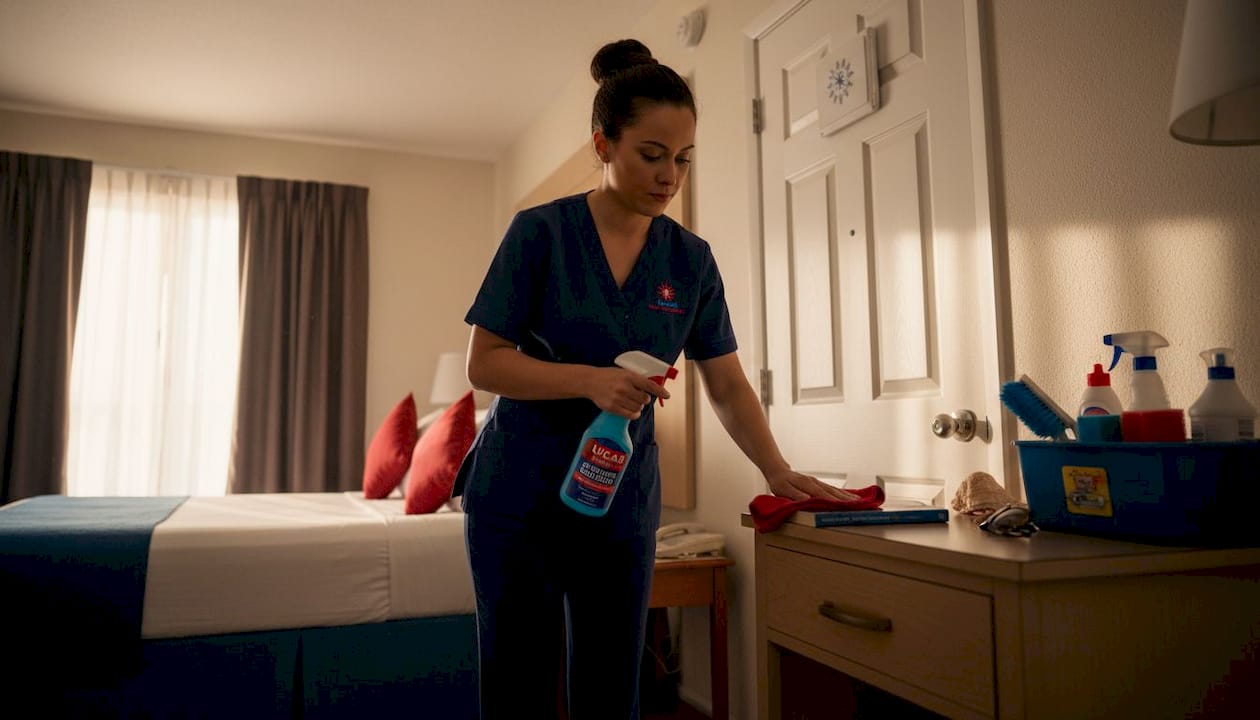
Cleaning products emit VOCs that accumulate indoors and can worsen air quality, especially for guests with asthma or chemical sensitivities. And the fragrance trap is real: many properties layer scented products over existing odors, which may temporarily satisfy a passing guest but makes IAQ worse for anyone staying overnight.
Practical source control steps for your housekeeping operation:
- Switch to low-VOC or VOC-free cleaning products certified by organizations like Green Seal or EPA’s Safer Choice program
- Ventilate aggressively during and after room cleaning, opening windows where possible and running bathroom exhaust fans
- Eliminate plug-in or aerosol air fresheners in favor of addressing moisture and organic odor sources directly
- Train housekeeping staff to recognize and report musty odors, which signal mold rather than just “old building” smells
- Clean HVAC coils and drip pans regularly — these are frequently the actual odor source in hotel rooms
For duct cleaning and IAQ best practices, the evidence is clear that dirty ductwork circulates accumulated particulates and biological material, amplifying the effect of poor source control. Also worth reviewing: environmental cleaning principles for facility managers go deeper into how cleaning protocols interact with indoor air chemistry.
Pro Tip: When guests report a “musty” smell in a room that recently passed housekeeping, check the condensate drain pan under the HVAC air handler first. Standing water there is a mold incubator that no air freshener will fix.
Ventilation and filtration technologies worth investing in
With source control in place, the next layer is making sure your HVAC system is actively removing what gets past you. Two technologies stand out for Central Florida hospitality properties.
Demand-controlled ventilation (DCV) uses CO2 sensors to adjust outdoor air delivery based on actual occupancy. In a hotel ballroom that swings from empty to 200 people and back again, fixed outdoor air rates mean you’re either over-ventilating an empty room or under-ventilating a full one. DCV solves both problems, reducing energy use while keeping CO2 from creeping up in high-occupancy moments.
High-efficiency filtration is the other non-negotiable. EPA recommends MERV 13 or higher HVAC filtration to reduce indoor particulates from cooking and other emission sources. For comparison:
| Filter rating | What it captures | Best for |
|---|---|---|
| MERV 8 | Dust, pollen, mold spores | Minimum residential standard |
| MERV 11 | Fine dust, pet dander, smoke particles | Good for standard hotel rooms |
| MERV 13 | Bacteria, smoke, virus carriers | Recommended for hotel kitchens and high-occupancy spaces |
| HEPA (MERV 17+) | Nearly all particles | Isolation rooms, medical-grade settings |
For hotel kitchens specifically, the EPA is direct: run range hoods vented outdoors during cooking and for at least 10 to 20 minutes after. Recirculating hoods without outdoor venting do not meet this standard regardless of the filter media they use.
Key filtration upgrade steps:
- Confirm your current MERV rating and verify it’s compatible with your air handler’s static pressure limits
- Upgrade to MERV 13 in guest room units and food service areas
- Install only air cleaners that carry no ozone emissions certification, since ozone generators sold as “air purifiers” worsen IAQ
- Pair DCV controls with CO2 sensors in conference rooms, dining spaces, and fitness areas
For detailed guidance on maintaining systems that handle these demands, hotel HVAC maintenance for IAQ and choosing the right HVAC system for Florida are worth reading before your next capital decision.
Building a proactive IAQ management program
Technology means nothing without a program that tells your team when to act and how. The EPA’s three core IAQ strategies — source control, ventilation improvement, and air cleaning — map directly to the operational responsibilities your maintenance and housekeeping teams already own. The missing piece is usually the feedback loop.
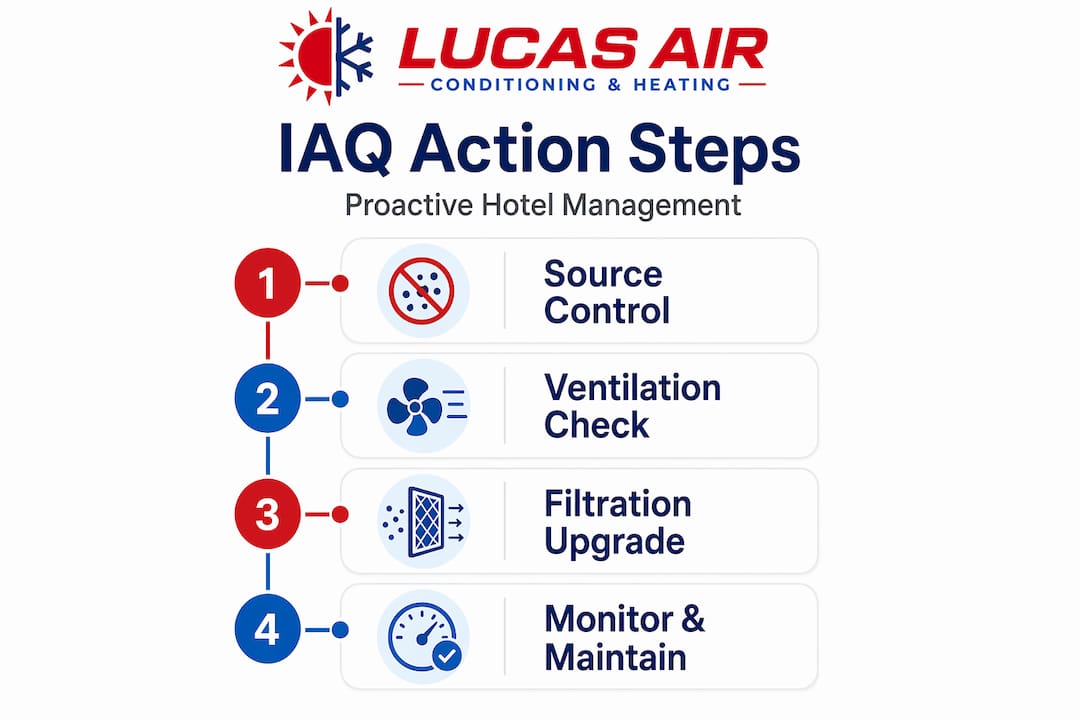
Sensor data tied to maintenance actions is what separates a reactive operation from a proactive one. Without that link, CO2 levels can spike in a conference room for three days before anyone notices.
Here’s what a functional IAQ program looks like in practice:
- Deploy sensors for CO2, relative humidity, and particulate matter in guest rooms, lobbies, kitchens, and meeting spaces
- Set alert thresholds — CO2 above 1,000 ppm triggers a ventilation check; humidity above 60% triggers a moisture inspection
- Replace HVAC filters on pressure differential, not calendar date — a filter in a dusty ballroom foyer may need replacement in six weeks, not six months
- Log maintenance actions against sensor events so you can identify recurring issues by zone
- Schedule quarterly walkthroughs of outdoor air dampers, condensate pans, and coil condition
Key monitoring priorities:
- CO2: Indicates ventilation adequacy relative to occupancy
- Relative humidity: The primary driver of mold risk in Central Florida, especially between 60% and 70%
- PM2.5 (fine particulates): Spikes signal filter failure or an active pollution source
- VOC levels: Useful where cleaning or kitchen activity is high
Connect your hotel HVAC maintenance strategies to these sensor triggers, and you move from fixing complaints to preventing them.
What most properties get wrong about air quality investment
Here’s an opinion grounded in real HVAC work across Central Florida commercial properties: most hospitality operators treat IAQ as a cost center when it’s actually a revenue protection strategy.
The math is straightforward. A guest who sleeps poorly, wakes with a headache, or notices a stale odor doesn’t necessarily connect the dots to your HVAC system. They just leave a three-star review and don’t rebook. You never see the connection in your data. You just watch occupancy numbers drift.
The other mistake is investing in visible comfort features — new furniture, upgraded linens, lobby renovations — while running MERV 8 filters in a 15-year-old air handler that hasn’t had its coils cleaned since the Obama administration. Guests feel air quality before they see anything else in the room.
Central Florida’s climate makes this harder. High humidity and year-round HVAC operation mean filters load faster, coils stay wet, and condensate systems face more biological growth than in dry climates. What works as a once-a-year maintenance schedule in Arizona isn’t adequate here. Quarterly coil inspections, humidity-based filter replacement, and active condensate treatment are baseline practices in this market — not premium upgrades.
The properties that compete well on guest satisfaction in this region treat IAQ management the same way they treat housekeeping: as a daily operational standard, not a periodic project.
Protect your property with Lucas Air’s hospitality HVAC services
If any of this section — the ventilation compliance gaps, the filter ratings, the condensate drain issues — sounds familiar, it’s worth having someone who knows Central Florida commercial systems take a look at yours.
Lucas Air Conditioning and Heating works with hospitality and commercial property owners across the Eustis area and Central Florida region. Founded by Army Veteran Cameron Lucas, the company provides HVAC installation, repairs, preventative maintenance, and duct cleaning tailored to the demands of high-occupancy commercial environments. Whether you need a ventilation audit, a filtration upgrade, or a full system assessment to close the gap between your current setup and ASHRAE compliance, Lucas Air can help. Schedule a service appointment or call directly to discuss your property’s specific needs.
Frequently asked questions
Why is indoor air quality so important in hotels?
Indoor air quality directly affects how guests feel during their stay, with poor IAQ causing immediate and delayed health effects including headaches, fatigue, and respiratory irritation that guests often associate with poor overall comfort rather than identifying the cause.
What are the main ventilation standards hotels must follow in Central Florida?
Hotels in Central Florida must comply with ASHRAE Standard 62.1-2022, adopted through the Florida Building Code for hotels, which sets minimum outdoor air delivery rates by space type including guest rooms, lobbies, and dining areas.
How can cleaning practices impact indoor air quality in hospitality?
Many cleaning and fragrance products emit VOCs that accumulate indoors, worsening air quality and increasing discomfort for guests with asthma or sensitivities, which is why addressing odor sources directly is far more effective than masking them with scented products.
What ventilation strategies improve air quality in hotel kitchens?
Hotels should run range hoods vented outdoors during and after cooking, use exhaust fans for supplemental ventilation, and install MERV 13 or higher HVAC filtration to effectively reduce particulates and pollutants from kitchen emissions.
How can hotels proactively monitor and maintain good indoor air quality?
Hotels should deploy continuous sensors for CO2, humidity, and particulates, set alert thresholds tied to specific maintenance responses, and replace filters based on pressure-differential data rather than schedules to catch IAQ problems before guests experience them.
Recommended
- Apartment air quality: practical solutions for Central Florida – Lucas Air Conditioning and Heating
- Role of HVAC in rental properties: Central Florida guide – Lucas Air Conditioning and Heating
- Hospitality HVAC solutions for Central Florida facilities – Lucas Air Conditioning and Heating
- Indoor air quality: improve comfort and health at home – Lucas Air Conditioning and Heating
