

TL;DR:
- Airborne contaminants such as particulates, spores, and microbes land on food and surfaces, posing serious health risks. Food-grade compressed air must meet strict ISO standards and undergo regular testing to prevent contamination and ensure compliance. Proper ventilation, maintenance, and awareness of urban pollution sources are essential for safeguarding food safety across facilities.
Most food safety programs track temperature, sanitation, and supplier sourcing with precision. Yet the role of air quality in food safety rarely gets the same rigor, even though the air moving through your kitchen, processing facility, or storage space carries pathogens, particulates, and chemical contaminants that land directly on food and surfaces. The consequences range from failed audits and product recalls to serious public health outcomes. This article breaks down the contamination pathways, the 2026 compliance standards you need to know, the technologies that actually work, and the specific risks facing restaurants and urban consumers.
Table of Contents
- Key takeaways
- How air quality affects food safety
- Standards and regulations for food-grade air
- Technologies and best practices for food facilities
- Urban sourcing, restaurants, and consumer risks
- My take on what most programs get wrong
- Keeping your kitchen air safe and compliant
- FAQ
Key takeaways
| Point | Details |
|---|---|
| Air is an invisible contamination vector | Airborne particulates, mold spores, and microbial bioaerosols settle on food and contact surfaces, bypassing standard sanitation protocols. |
| Compressed air is a food ingredient | Any air touching food or packaging must meet ISO 8573-1 Class 1:2:1 limits on oil, particles, and moisture. |
| Regulations require documented testing | SQF, BRCGS, and FSMA all mandate quarterly compressed air testing at minimum, and failures trigger production holds. |
| Ventilation gaps create hidden risks | Leaving range hoods running 10 to 20 minutes after cooking clears residual aerosols that persist long after the flame is off. |
| Urban produce carries ambient pollution risks | Produce grown near traffic or industrial zones accumulates PM2.5 and heavy metals on its surface regardless of organic certification. |
How air quality affects food safety
The contamination pathways are more direct than most operators realize. Airborne particulate matter, microbial bioaerosols, and chemical pollutants do not stay suspended indefinitely. They settle. When they settle on food, equipment, or food-contact surfaces, they introduce contamination that no amount of downstream cooking or sanitizing can fully address if the exposure is continuous.
The specific contaminants that matter in food environments include PM2.5 particles, mold spores, allergen fragments, cooking oil aerosols, and microbial bioaerosols carrying bacteria, fungi, and viruses. Each one carries a distinct risk profile. Mold spores trigger allergic reactions and produce mycotoxins. Oil aerosols coat surfaces and create conditions where bacteria thrive. Microbial bioaerosols can re-contaminate surfaces that were just sanitized, which is the core problem that makes bioaerosol monitoring a critical component of any serious environmental monitoring program.
The scale of the health problem tied to food-related air pollution is staggering. PM2.5 linked to food systems contributed to approximately 840,400 deaths globally in 2017. At the agricultural level, rising CO2 has driven a 3.2% nutrient decrease in major crops since the late 1980s, meaning air quality affects food safety not just through contamination but through nutritional degradation long before the product reaches your facility.
Air quality and food contamination are not separate concerns. Every cubic meter of air inside your kitchen or production space is either part of the hazard or part of the control.
For food safety professionals, understanding the distinction between ambient air pollution and facility-level air quality is critical. Outdoor pollution is a sourcing and procurement concern. Indoor air quality is an operational and engineering control concern. Both require different responses, but neither can be ignored.
Standards and regulations for food-grade air
If you work in food manufacturing and your compressed air system is not already treated as a critical control point, your audit is at risk. The regulatory framework in 2026 is clear across the major food safety standards.
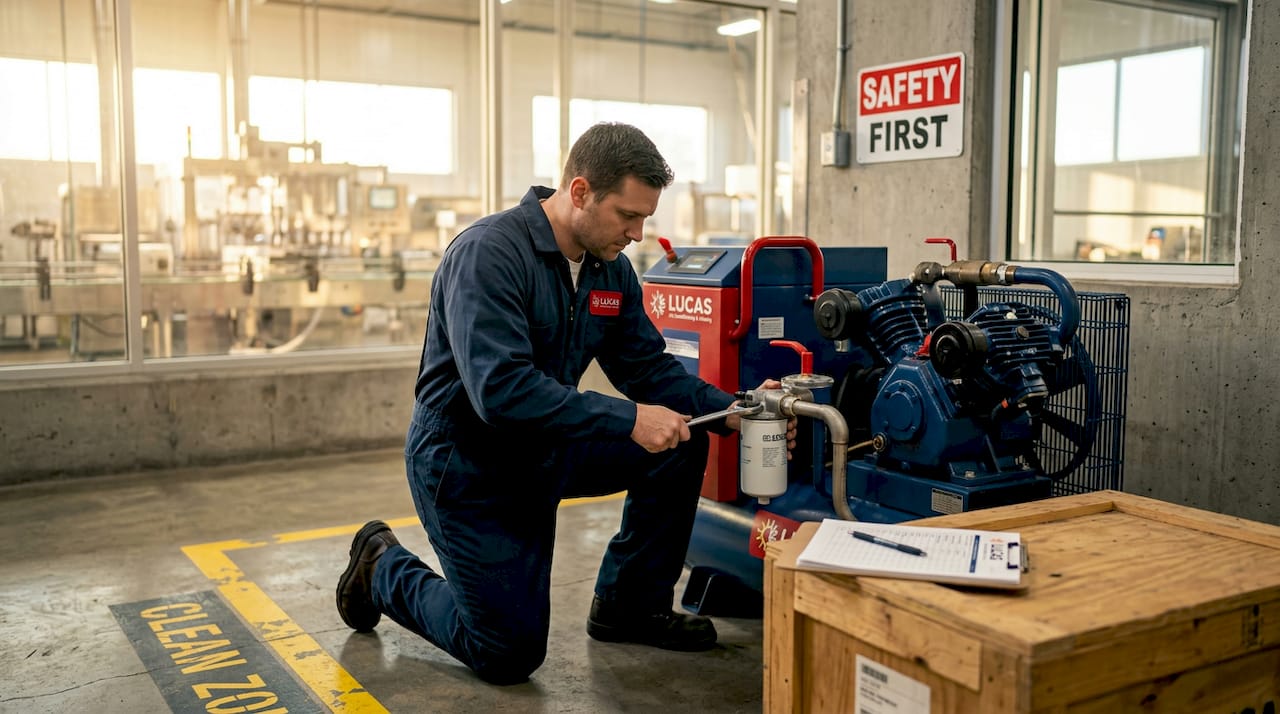
HACCP principles require you to identify every potential contamination pathway, and compressed air that contacts food or packaging qualifies. The Food Safety Modernization Act (FSMA) Preventive Controls rule specifically requires hazard analysis that accounts for environmental contamination, which includes air. SQF Edition 9 and BRCGS Issue 9 both mandate formal air quality controls with documented verification procedures.
For compressed air specifically, the benchmark is ISO 8573-1. Air in direct food contact must meet Class 1:2:1 standards, which means oil content below 0.01 mg/m³, particle counts below 20,000 per cubic meter, and a dew point of -40°C. These are not aspirational targets. They are pass/fail criteria at audit. The entire distribution system, including all piping and fittings, must be validated to those limits, because contamination frequently originates from infrastructure failures that go unnoticed until a recall or a third-party audit surfaces them.
What does documented compliance actually look like? Here is the minimum required framework:
- Designate compressed air contact points as critical control points in your HACCP plan.
- Test at minimum quarterly for particle count, oil content, dew point, and microbial load. SQF, BRCGS, and FSMA all require this testing frequency, and failures trigger production holds.
- Document all test results with date, location, technician, and corrective actions taken.
- Validate your entire compressed air distribution system, not just the compressor output.
- Establish alert limits below your critical limits so you can take corrective action before a compliance failure occurs.
Pro Tip: Set your internal alert threshold for oil content at 0.005 mg/m³ rather than the ISO limit of 0.01 mg/m³. That buffer gives you time to investigate and fix the source before you cross into non-conformance.
On the ventilation side, regulations address aerosol control in cooking environments with specific parameters. Post-cooking exhaust periods matter for compliance, not just comfort. Optimized kitchen ventilation can reduce aerosol velocity by over 97%, and the supporting data recommends running exhaust hoods for 10 to 20 minutes after cooking stops to clear residual pollutants. Many inspectors now ask specifically about ventilation protocols, and “we turn the hood off when we stop cooking” is not an acceptable answer.
Technologies and best practices for food facilities
Getting to and staying at food-grade air quality requires the right equipment, the right maintenance schedule, and a monitoring program that catches problems before they become violations.
Compressed air treatment
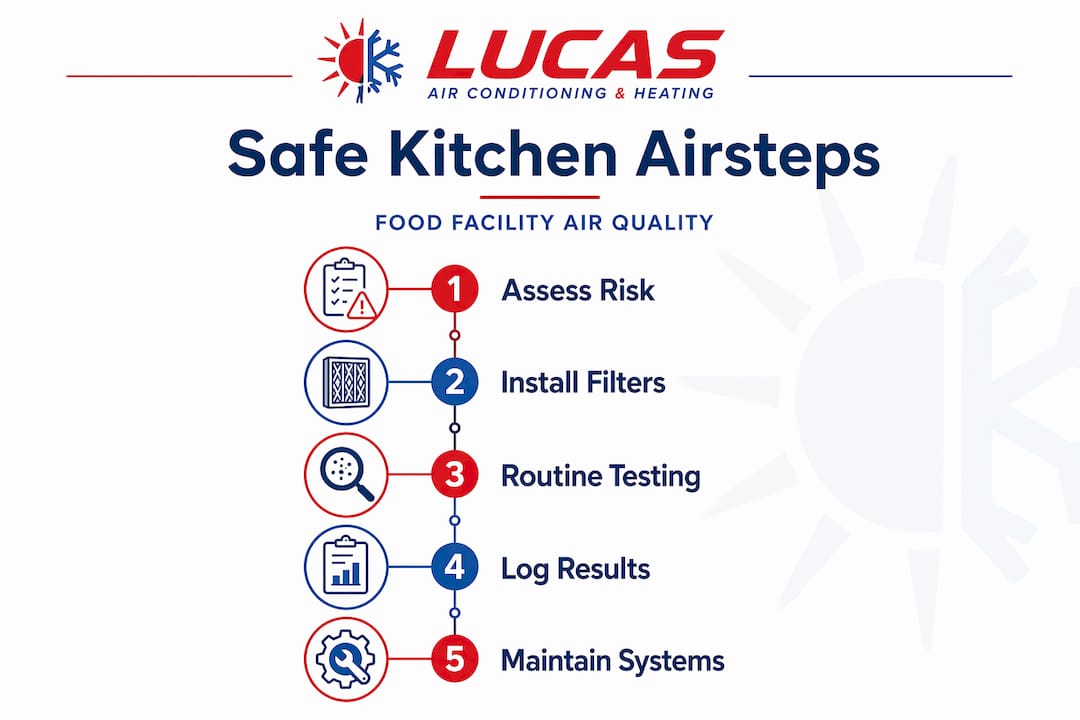
The starting point is compressor selection. Oil-free compressors reduce one contamination source, but they do not solve the problem alone. Oil-free compressors plus filtration and drying are the minimum combination, and regular microbial testing is non-negotiable on top of that. The industry standard is a three-stage filtration system: a coalescing pre-filter removes bulk liquid and large particles, a high-efficiency coalescing filter captures fine oil aerosols and submicron particles, and an activated carbon filter removes residual hydrocarbon vapors.
| Component | Function | Failure Risk if Skipped |
|---|---|---|
| Coalescing pre-filter | Removes bulk liquid and large particles | Downstream filter overload, moisture carryover |
| High-efficiency coalescing filter | Captures fine oil aerosols and submicron particles | Oil contamination of food contact surfaces |
| Activated carbon filter | Removes hydrocarbon vapors and odors | Chemical tainting of product |
| Refrigerant or desiccant dryer | Reduces moisture to required dew point | Microbial growth in distribution lines |
HVAC and kitchen ventilation
For restaurants and commercial kitchens, the importance of air quality in kitchens goes beyond comfort. Grease and condensate accumulation inside exhaust hoods creates the exact conditions where pathogens and pests establish themselves. That grease buildup is not just a fire code problem. It is a hygiene audit failure waiting to happen, and inspectors at both local health departments and third-party certification audits look for it specifically.
Practical controls that work:
- Run exhaust ventilation for at least 10 minutes after cooking ends, every service, without exception.
- Schedule professional hood and duct cleaning on a frequency tied to your cooking volume, not just the calendar.
- Maintain positive air pressure in food prep zones relative to adjacent areas to prevent contaminated air from migrating in.
- Integrate air quality monitoring into your environmental monitoring program, including bioaerosol testing at defined intervals.
- Inspect and replace HVAC air filters on a schedule, not just when they look dirty.
Pro Tip: Add a monthly visual inspection of your exhaust hood interior to your opening or closing checklist. If you can see grease accumulation with the naked eye, your cleaning frequency is too low.
Urban sourcing, restaurants, and consumer risks
The conversation about air quality and food safety does not start at the kitchen door. It starts at the point of production, and for urban and peri-urban agriculture, that means accounting for ambient air pollution as a direct food safety variable.
Urban produce grown near traffic or industrial activity accumulates PM2.5 and heavy metals on its surface. This contamination does not wash off as easily as soil. The assumption that local or organic produce is automatically safer than conventionally sourced produce from a cleaner region is one of the more persistent misconceptions in consumer food safety. A tomato grown in a rooftop garden above a busy urban intersection may carry more surface contamination than a conventionally grown tomato from a rural farm with low ambient pollution.
For restaurant operators, this creates a sourcing responsibility that most purchasing specs do not currently address. Knowing your supplier’s location relative to industrial zones and traffic corridors is a legitimate food safety question, not just a marketing consideration.
Inside the kitchen, the risks compound when ventilation is inadequate:
- Cross-contamination via air movement between raw protein prep areas and ready-to-eat zones is a real pathway, particularly in kitchens with poor airflow design.
- Cooking processes generate chemical byproducts including nitrogen dioxide and volatile organic compounds that accumulate when exhaust systems are undersized or poorly maintained.
- High-volume frying operations without adequate capture velocity on exhaust hoods create persistent aerosol clouds that coat surfaces across the kitchen.
For consumers, the practical guidance is straightforward. Wash all produce rigorously regardless of its label or source. If you source from urban farms or farmers markets in dense metro areas, ask about the farm’s location and surrounding environment. That question is not unreasonable. It is exactly the kind of due diligence that food safety professionals apply at the sourcing level.
My take on what most programs get wrong
I’ve spent enough time around food safety audits and facility reviews to say with confidence that compressed air is the most underestimated contamination risk in most food processing environments. It is invisible, it moves fast, and the assumption that “we use an oil-free compressor so we’re fine” is wrong in a way that fails audits and contaminates product.
What I’ve seen repeatedly is a gap between what the HACCP plan documents and what the facility actually monitors. The plan says compressed air is a CCP. The corrective action procedure exists on paper. But the quarterly test hasn’t been done in 14 months, and nobody flagged it until a third-party auditor pulled the records.
The other gap I’ve observed is the distance between regulatory compliance and actual microbial safety. Passing a particle count test does not mean your air is free of viable pathogens. Bioaerosol monitoring, which samples the air specifically for living microbial load, is still not standard practice in most facilities. It is emerging as the next serious frontier in food safety environmental monitoring, and the facilities that adopt it proactively will be ahead of where regulation is heading.
My practical advice: treat your compressed air system and your ventilation infrastructure the same way you treat your food contact surfaces. Schedule it, document it, test it, and fix it before an auditor or a recall forces the conversation.
— Lucasair
Keeping your kitchen air safe and compliant
Everything covered in this article, from exhaust hood performance to compressed air quality to bioaerosol risk, depends on one underlying variable: the condition of your HVAC and ventilation infrastructure. A system that hasn’t been serviced is a system that is quietly accumulating grease, moisture, and microbial load in places you cannot easily see.
Lucasair works with restaurants and commercial facilities across Central Florida to keep ventilation systems performing at the level food safety requires. Whether you need restaurant duct cleaning to stay compliant and protect your customers, a full HVAC system installation designed for food service environments, or a preventative maintenance program that keeps your air quality audit-ready year-round, Lucasair has the experience to deliver it right. Contact Lucasair today to schedule a consultation and get your facility’s air quality where it needs to be.
FAQ
What is the role of air quality in food safety?
Air quality directly affects food safety by carrying pathogens, particulates, and chemical contaminants that settle on food and food-contact surfaces. Poor air quality is a recognized contamination pathway under HACCP, FSMA, SQF, and BRCGS standards.
Does compressed air need to meet a specific standard for food contact?
Yes. Compressed air in direct food contact must meet ISO 8573-1 Class 1:2:1, limiting oil to 0.01 mg/m³, particles to 20,000 per cubic meter, and dew point to -40°C. Testing must occur at minimum quarterly under SQF, BRCGS, and FSMA requirements.
How does airborne contamination reach food in commercial kitchens?
Cooking aerosols, mold spores, and microbial bioaerosols become airborne and settle on exposed food and surfaces. Inadequate exhaust ventilation allows these contaminants to persist and accumulate, increasing cross-contamination risk between prep zones.
Is urban or organic produce safer from air quality contamination?
Not automatically. Produce grown near traffic or industrial zones accumulates PM2.5 and heavy metals on its surface regardless of organic certification. Location relative to pollution sources is as relevant as farming method when assessing contamination risk.
How often should restaurant HVAC and exhaust systems be cleaned?
Cleaning frequency should be tied to cooking volume and the types of food being prepared, not just a fixed calendar schedule. High-volume frying operations typically require more frequent hood and duct cleaning to prevent grease accumulation, pathogen harboring, and audit non-conformances.
Recommended
- Role of air quality in hospitality: a Central Florida manager’s guide – Lucas Air Conditioning and Heating
- Restaurant duct cleaning: Keep compliant and customers happy – Lucas Air Conditioning and Heating
- Duct Cleaning & Indoor Air Quality: Evidence & Best Practices – Lucas Air Conditioning and Heating
- Indoor air quality: improve comfort and health at home – Lucas Air Conditioning and Heating
