
TL;DR:
- HVAC systems in clinics must meet strict regulatory standards to ensure patient safety and infection control.
- Humidity control is critical in Florida, requiring integrated dehumidification due to high outdoor moisture levels.
- Proper commissioning and choosing the right system type are essential for reliable operation and compliance.
Selecting the right HVAC system for a clinic in Central Florida is one of the highest-stakes decisions a facility manager can make. Patient safety, infection control, regulatory compliance, and Florida’s relentless humidity all collide in a single mechanical system. Get it wrong and you risk failed inspections, compromised air quality, and uncomfortable patients. Healthcare HVAC systems are classified by space types under ASHRAE 170 and FGI guidelines, meaning there is no one-size-fits-all answer. This article walks you through the regulatory framework, system types, critical features, and the edge cases that trip up even experienced facility teams.
Table of Contents
- Understanding HVAC requirements for clinics
- Centralized vs. modular HVAC systems
- High-efficiency and infection control features
- Special-use spaces and edge cases: Imaging, isolation, and energy code conflicts
- Hard-won lessons: What most clinics miss in HVAC selection
- Discover local solutions for clinic HVAC in Central Florida
- Frequently asked questions
Key Takeaways
| Point | Details |
|---|---|
| Regulations dictate design | Clinic HVAC systems must meet strict air change and filtration requirements for safety and compliance. |
| Florida climate demands | Humidity control and energy efficiency are essential for clinics in Central Florida. |
| Modular systems boost flexibility | Split and VRF systems offer efficient, scalable options for medium-sized clinics. |
| Monitoring cuts costs | Continuous BAS or AI monitoring can lower energy costs up to 50% while maintaining safety. |
| Commissioning is crucial | Proper commissioning validates system performance and infection control in real-world clinic settings. |
Understanding HVAC requirements for clinics
Before exploring system types, it is critical to understand what makes a clinic’s HVAC setup unique. Unlike office buildings or retail spaces, clinics operate under strict federal and state guidelines that dictate exactly how air must move, filter, and pressurize each room. Falling short is not just a compliance issue. It is a patient safety issue.
ASHRAE 170 and FGI guidelines are the two primary frameworks governing clinic HVAC design. ASHRAE 170 sets minimum air changes per hour (ACH), temperature ranges, humidity bands, and pressure relationships for each space type. FGI guidelines layer on top with facility-specific requirements. Together, they define what your clinic HVAC systems overview must deliver before a single patient walks through the door.
Clinics are divided into space categories based on the level of clinical activity:
- Class A spaces: Administrative areas, waiting rooms, and low-risk zones with minimal ACH requirements
- Class B spaces: Exam rooms and consultation areas requiring at least 6 ACH and controlled temperature
- Class C spaces: Procedure rooms, minor surgery, and treatment areas requiring higher ACH, HEPA filtration, and precise pressure control
- Airborne Infection Isolation (AII) rooms: Negative pressure rooms with 12 or more ACH and dedicated exhaust
- Protective Environment (PE) rooms: Positive pressure rooms for immunocompromised patients
Filtration requirements scale with room risk. Most exam rooms need a minimum MERV 7 prefilter and a MERV 14 final filter. Surgery suites and isolation rooms require HEPA filtration, which captures 99.97% of particles at 0.3 microns. Proper infection control via HVAC is not optional in these spaces. It is the difference between a safe environment and an outbreak risk.
Florida adds another layer of complexity. The combination of high outdoor humidity, intense heat, and the need for precise indoor humidity control (typically 30-60% relative humidity in clinical spaces) means your system must work harder than in most other states. Redundancy is not a luxury here. It is a clinical necessity.
Humidity that creeps above 60% promotes mold growth and bacterial proliferation. Humidity below 30% dries mucous membranes and increases infection susceptibility. Central Florida’s climate pushes systems toward the upper limit constantly, which is why dehumidification capacity must be built into the design from day one.
Centralized vs. modular HVAC systems
With the regulatory basics covered, let’s review the main system types clinics can choose from. The choice between centralized and modular systems shapes everything from upfront cost to long-term flexibility.
Centralized systems use a single air handling unit (AHU) or a network of AHUs to condition and distribute air across the entire facility. Variable Air Volume (VAV) systems and Energy Recovery Ventilators (ERVs) are common components. These systems work well for larger clinics with multiple departments because they allow centralized control, easier compliance documentation, and stronger redundancy. The downside is higher upfront cost and more complex installation.
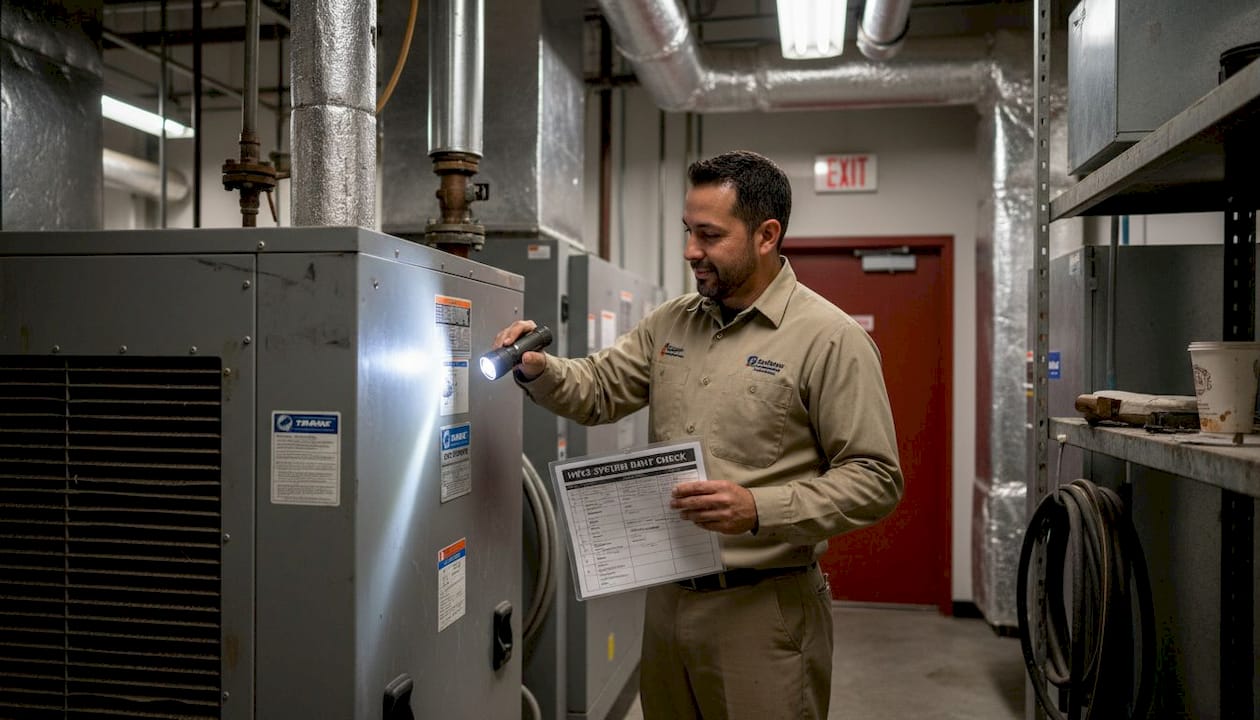
Modular systems include split systems, Variable Refrigerant Flow (VRF) systems, and Dedicated Outdoor Air Systems (DOAS). These are better suited to small and medium clinics. VRF systems allow individual zone control, which is useful when different rooms have very different load profiles. A DOAS handles fresh air ventilation and dehumidification separately from the cooling system, which is exactly what Florida’s climate demands.
ASHRAE 170-compliant AHUs with redundancy and segmentation are the gold standard for larger facilities, while DOAS combined with VRF is the preferred approach for Florida’s humidity challenges in smaller clinics.
| Feature | Centralized (AHU/VAV) | Modular (VRF/DOAS) |
|---|---|---|
| Best for | Large, multi-department clinics | Small to medium clinics |
| Upfront cost | Higher | Lower |
| Redundancy | Strong with backup AHU | Moderate, zone-level |
| Humidity control | Excellent with ERV | Excellent with DOAS |
| Compliance ease | High | Moderate, requires planning |
| Flexibility | Lower | Higher |
Key considerations when choosing between the two:
- How many exam, procedure, and isolation rooms does your clinic have?
- Do you need zone-level control for spaces with very different occupancy patterns?
- What is your budget for installation versus long-term operating costs?
- Does your clinic HVAC repair workflow allow for centralized or distributed maintenance?
Pro Tip: In Florida, never select a system based on cooling capacity alone. Latent load (moisture removal) often exceeds sensible load (temperature reduction) in humid months. A system undersized for dehumidification will struggle to maintain compliance year-round.
High-efficiency and infection control features
Choosing a system is just the first step. Features and integration are where efficiency and safety are actually secured. The best system on paper can still fail if the wrong components are specified or the controls are not set up correctly.
Filtration is the foundation. Dual-stage filtration using a MERV 7 prefilter and a MERV 14 final filter is the baseline for most clinical spaces. Procedure rooms and isolation areas require HEPA filtration. Filters must be checked and replaced on a documented schedule, not just when they look dirty.
Pressure differentials protect both patients and staff. Negative pressure in AII rooms keeps airborne pathogens from migrating to hallways. Positive pressure in PE rooms keeps contaminants out. These pressure relationships must be verified regularly, not just at commissioning.
Humidity control in Florida is non-negotiable. Standalone dehumidifiers or DOAS units with reheat coils are often necessary to keep relative humidity in the 30-60% range during peak summer months. Standard cooling systems alone rarely achieve this.
Smart controls and Building Automation Systems (BAS) are where significant gains are possible. Continuous BAS and AI monitoring can prevent deficiencies and cut energy use by 20-50% by optimizing setpoints, scheduling unoccupied modes, and flagging anomalies before they become failures.
Additional features worth specifying:
- UV-C germicidal irradiation in AHUs to reduce microbial load
- Energy Recovery Ventilators (ERVs) to recapture energy from exhaust air
- Demand-controlled ventilation (DCV) in low-occupancy zones
- Real-time air quality monitoring tied to the BAS
Pro Tip: Review your HVAC energy efficiency upgrades before finalizing specifications. Upgrading to a high-efficiency system with smart controls often pays back in energy savings within three to five years, even in a clinical environment with high ventilation requirements.
Proper commissioning after installation is not optional. A system that is not commissioned correctly may appear to work but fail to meet ACH rates or pressure requirements under real operating conditions. This is one of the most common gaps we see in clinic HVAC projects, and it creates HVAC infection prevention risks that are entirely avoidable.
Special-use spaces and edge cases: Imaging, isolation, and energy code conflicts
Some clinic spaces demand even closer attention to HVAC design and operational protocols. These are the rooms where a generic approach creates real risk.
Imaging suites housing MRI, CT, or X-ray equipment generate significant heat loads and require precise temperature control to protect sensitive electronics. HVAC redundancy is essential here. If the system fails during a scan, equipment damage and patient disruption follow quickly. Dedicated cooling with backup capacity is the standard approach.
AII and PE rooms require continuous pressure monitoring with visual and audible alarms. Door sweeps, anterooms, and dedicated exhaust systems are often required. These are not features you can retrofit cheaply after construction.
Energy code conflicts are a real issue in Florida. State energy codes may push for VAV turndown ratios that conflict with clinical minimum ACH requirements. When the two conflict, clinical minimums always win. But this means you need an engineer who understands both sets of requirements and can document the exception properly.
| Special space | Key HVAC requirement | Florida-specific risk |
|---|---|---|
| Imaging suite | Redundant cooling, precise temp | Equipment failure from heat |
| AII room | Negative pressure, 12+ ACH | Humidity infiltration |
| PE room | Positive pressure, HEPA | Outdoor air moisture load |
| Procedure room | MERV 14/HEPA, pressure control | Mold risk from humidity |
Additional edge cases that demand attention include Legionella risk in stagnant water systems, Florida’s humidity demands for chilled water systems or supplemental dehumidifiers, and the critical importance of commissioning after any construction or renovation.
Legionella prevention requires water management plans for cooling towers and any system with stagnant water. Florida’s warm temperatures accelerate bacterial growth, making this a year-round concern rather than a seasonal one.
Review your HVAC commissioning checklist before any new construction or major renovation. Commissioning is the only way to verify that the system you designed is actually the system you built and that it performs to clinical standards under real conditions. Skipping it is one of the most expensive mistakes a facility manager can make.
For ongoing clinic HVAC infection prevention, establish a documented maintenance schedule that includes filter changes, pressure verification, and BAS review at regular intervals.
Hard-won lessons: What most clinics miss in HVAC selection
Having surveyed system types, features, and special considerations, here is one perspective you will not find in compliance manuals.
Most clinic HVAC failures we encounter are not caused by choosing the wrong system type. They are caused by underestimating Florida’s humidity and skipping real commissioning. A facility manager who selects a technically compliant system but cuts the commissioning budget is setting up their clinic for problems within the first year of operation.
The second most common mistake is treating energy efficiency and infection control as competing priorities. They are not. BAS and AI monitoring can reduce energy use by 20-50% while simultaneously improving infection control by catching pressure failures and filter degradation before they become clinical risks. The tools exist. The barrier is usually awareness and upfront investment.
Dehumidification is consistently underspecified in Florida clinics. Contractors who work primarily in residential or light commercial settings often size systems for sensible cooling without accounting for the latent load in a clinical environment. The result is a system that keeps the temperature comfortable but lets humidity climb into ranges that promote mold and bacterial growth.
Our advice: budget for commissioning, specify dehumidification capacity explicitly, and invest in clinic HVAC expert tips from contractors who understand both Florida’s climate and healthcare compliance requirements. These three decisions will determine whether your HVAC system protects your patients or creates liability.
Discover local solutions for clinic HVAC in Central Florida
For clinics ready to take action, here is where to find expert help and local insight.
Central Florida’s climate and healthcare regulations require a contractor who understands both. Lucas Air Conditioning and Heating has been serving commercial clients across the region since 2018, with hands-on experience in clinic environments where compliance and comfort are equally critical.

Whether you need a full system assessment, targeted upgrades, or an ongoing maintenance agreement that keeps your clinic compliant year-round, our team is ready to help. We work with facility managers on commissioning support, infection control upgrades, and energy efficiency improvements. Connect with your clinic HVAC contractor in The Villages area or explore our full range of clinic HVAC services to schedule a consultation today.
Frequently asked questions
What is the minimum air change rate for clinic exam rooms?
Most clinic exam rooms require at least 6 air changes per hour according to ASHRAE 170 and FGI guidelines. Higher-risk spaces like procedure rooms and isolation rooms require significantly more.
Which HVAC system is best for clinics in humid Florida?
A DOAS combined with VRF is ideal for most Florida clinics because it addresses humidity control and ventilation separately, meeting both infection control standards and energy efficiency goals.
How do clinics reduce HVAC energy costs without compromising safety?
Continuous monitoring with BAS or AI systems combined with energy recovery ventilators can cut energy use 20-50% while maintaining the ventilation rates and pressure relationships required for infection control.
Why is commissioning important for clinic HVAC systems?
Commissioning verifies post-construction compliance by confirming that ACH rates, pressure differentials, and filtration performance actually match design specifications under real operating conditions, not just on paper.
