

What is a preventative maintenance workflow and how does it work?
A preventative maintenance workflow is the structured, repeatable sequence of steps your team follows to service equipment before it fails, not after. The core industry term is preventive maintenance (PM), and the workflow is what separates a PM program that actually runs from a binder collecting dust on a shelf.
The workflow moves through six defined stages every time:
- Asset inventory: Register every maintainable asset with its location, model, installation date, and OEM manual reference
- Task definition: Specify exactly what gets inspected, measured, or replaced, and what acceptable ranges look like
- Scheduling: Assign a trigger type, either time-based (every 90 days), usage-based (every 1,000 runtime hours), or condition-based (when a sensor threshold is crossed)
- Execution: A qualified technician completes the work order with the correct parts and procedures in hand
- Documentation: Record what was found, what was done, parts used, and any follow-up items
- Review: Analyze completion data and failure trends quarterly to adjust intervals and eliminate unnecessary tasks
Scheduling method matters more than most managers realize. Time-based PM suits assets with predictable wear and compliance-mandated intervals. Usage-based PM fits motors, pumps, and vehicles where runtime drives degradation. Condition-based PM works best where sensor data can detect degradation before failure occurs. Mixing all three, matched to the right asset type, is what best-in-class facilities actually do.
The U.S. Department of Energy documents that structured PM programs deliver 5–20% annual energy savings compared to reactive operations. That range is wide because it depends on how well the workflow is designed and followed.
Which types of preventive maintenance should you apply to which assets?
Not every asset deserves the same treatment. Applying the wrong PM type wastes labor on low-risk equipment while leaving critical assets underprotected.
Time-based PM works well for assets with predictable wear patterns and regulatory inspection requirements. HVAC filters, belt drives, and fire suppression systems fall here. The interval comes from the OEM manual first, then gets adjusted based on your actual operating conditions.
Usage-based PM tracks runtime hours, cycles, or mileage rather than the calendar. A chiller scheduled for an oil analysis at 2,000 operating hours gets that service whether 2,000 hours takes six weeks or six months. This prevents both over-maintaining during slow seasons and under-maintaining during peak load.
Condition-based PM triggers a work order when sensor data crosses a threshold: bearing vibration, motor current draw, refrigerant subcooling drift. Condition-based scheduling fits assets where degradation is detectable before failure, extending the service interval and cutting unnecessary visits.
Asset criticality classification drives which PM type you assign:
- Critical assets (roughly 20% of your equipment) drive 80% of PM planning attention and labor. These get condition-based or usage-based PM, tightest compliance windows, and FMEA-driven task definitions
- Important assets get time-based PM with defined intervals and standard checklists
- Standard assets may run on minimal scheduled PM or even run-to-failure if replacement cost is low and failure consequence is minor
Failure Mode and Effects Analysis (FMEA) is the tool that converts criticality classification into specific task definitions. For each critical asset, FMEA identifies every failure mode, its operational and safety effect, and a Risk Priority Number (RPN = Severity × Occurrence × Detection). High-RPN failure modes get PM tasks. Low-RPN modes may not need any scheduled intervention at all.
Pro Tip: If a PM task cannot be linked to a specific failure mode in your FMEA, consider removing it. Many facilities carry legacy PMs added years ago for equipment that no longer exists. Eliminating unjustifiable tasks cuts maintenance cost and technician workload without increasing risk.
Why a structured preventive maintenance program pays for itself
The financial case for a well-run PM program is not subtle. Structured PM programs achieve significantly greater efficiency and reduce unplanned downtime compared to reactive operations. Most FM teams still spend a majority of their maintenance budget reacting to failures, not because they lack knowledge, but because they lack a system.
The benefits stack up across several categories:
- Energy savings: The U.S. DOE documents 5–20% annual energy savings from structured PM versus reactive operations
- Reduced emergency repairs: HVAC contractors who move from reactive to preventive programs consistently report reductions in emergency call-out rates within the first year
- Extended equipment life: Regular servicing catches minor wear before it becomes component failure, pushing replacement timelines out significantly. Lucasair’s preventative maintenance agreements are built on exactly this principle for Central Florida commercial and residential clients
- Better resource planning: When most work is planned rather than reactive, you can schedule labor efficiently, stage parts in advance, and avoid the premium costs of emergency procurement
- Safety and compliance: Documented PM records satisfy regulatory inspections and insurance requirements. A completed work order with measurements and technician sign-off is the evidence an audit actually needs
The planned-versus-unplanned ratio is the clearest indicator of program health. World-class maintenance organizations target 80% planned work. If your team spends most of its time on unplanned repairs, the PM program is not yet doing its job.
Common pitfalls that quietly kill preventive maintenance programs
Most PM programs do not fail at launch. They fail slowly, through neglect of the review stage and a drift back toward reactive habits.
Skipping the review stage is the single most common failure. Without quarterly analysis of completion data and failure trends, PM systems become “zombie” programs: tasks get executed on schedule but intervals never get adjusted, unnecessary work keeps accumulating, and the program stops improving. Closed work orders are a dataset. If nobody looks at it, you are collecting evidence of problems and then ignoring it.
Over-maintaining is a real cost that most managers underestimate. Adjusting PM intervals to actual MTBF data prevents induced failures caused by unnecessary disassembly and reassembly. If your PM visits consistently find nothing wrong, the interval is too short. If assets are failing between visits, it is too long. Start with OEM recommendations, then use 12–18 months of CMMS work order history to calibrate.
Poor work order assignment creates a specific failure mode called “PM breakage,” where tasks get skipped or deferred because parts are missing or the wrong technician shows up. Confirming parts availability and technician access before dispatch prevents this. A job assigned without its parts just bounces back to the queue tomorrow.
Treating PM as a calendar exercise rather than a data exercise is the underlying mindset problem. Site-specific factors like Florida’s heat and humidity, operating hours, and load patterns all affect how fast equipment degrades. OEM manuals were written for lab conditions, not your specific building.
Pro Tip: Document every PM with actual measurements, not just a checkbox. Pressure readings, vibration levels, and temperature data are what enable degradation tracking and predictive interval adjustments. “Checked the boiler” is not a maintenance record. “Verified operating pressure at 12 PSI, inspected flue for corrosion, tested low-water cutoff” is.
How to design and optimize your preventive maintenance workflow step by step
Building a functional PM workflow does not require perfection on day one. It requires a clear starting point and a commitment to improving each quarter.
Step 1: Build your asset inventory. Register every maintainable asset with equipment name, model, serial number, location, installation date, and OEM manual reference. Without this foundation, scheduling is guesswork. Field-verify the register; do not assemble it from memory or outdated drawings.

Step 2: Rank assets by criticality. Score each asset on production impact, safety risk, downtime cost, replacement lead time, and whether redundancy exists. Most facilities find about 20% of assets are critical, 30% are important, and 50% are standard. This ranking drives everything downstream.
Step 3: Define PM tasks with step-by-step procedures. For each critical asset, apply FMEA to identify failure modes and write specific task instructions: not “inspect pump” but “check seal condition, verify coupling alignment, measure bearing temperature.” Procedures should specify what to measure, acceptable ranges, and what action to take when something is out of spec.
Step 4: Set scheduling frequency using OEM specs and MTBF data. Start with manufacturer recommendations, then adjust based on your operating environment and actual failure history. A PM interval set at 80–90% of your measured MTBF gives you a buffer against failure while avoiding unnecessary service visits.
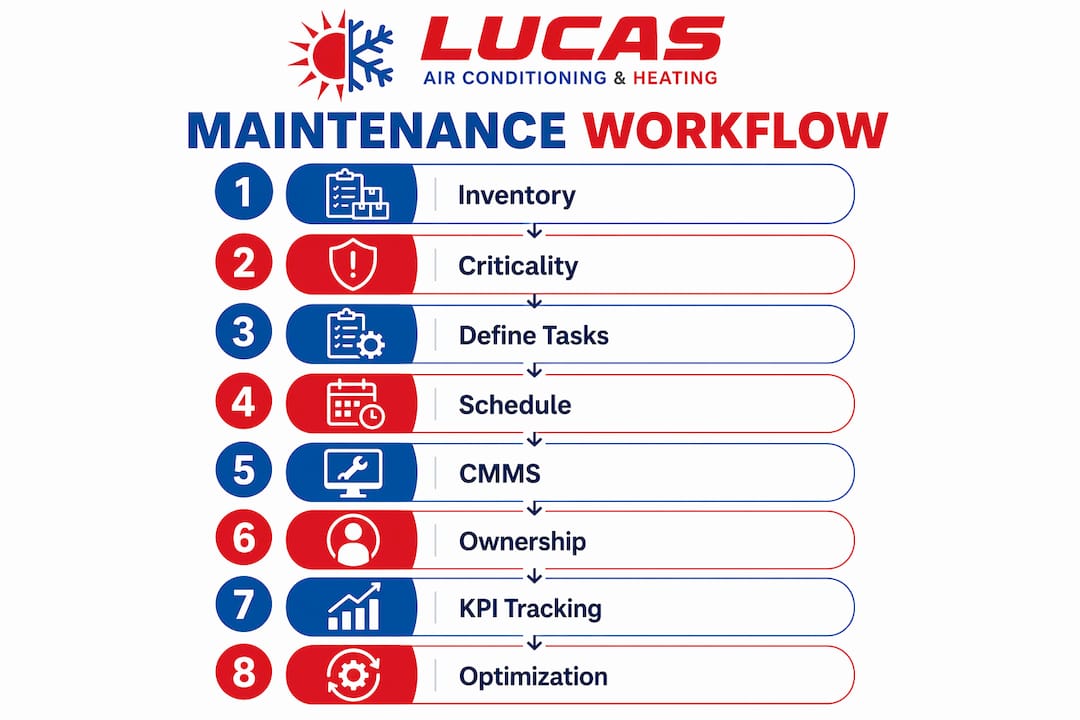
Step 5: Integrate a CMMS for automated work order generation. A Computerized Maintenance Management System (CMMS) is the technology backbone of any mature PM program. Configure PM tasks, intervals, and assignments once, and the system generates work orders automatically before due dates. Technicians receive mobile notifications with full checklists, asset history, and parts requirements. CMMS automation eliminates the manual scheduling burden and ensures nothing gets forgotten because someone was on vacation. Best-in-class facilities target a PM completion rate above 85%; below 70% signals scheduling overload or resource gaps.
Step 6: Assign clear ownership. Every PM task needs a named owner for execution and a supervisor responsible for reviewing completions and flagging overdue items. Ambiguity is the enemy of compliance. When everyone assumes someone else will handle it, nothing gets done.
Step 7: Track KPIs and review quarterly. Three metrics tell you whether your program is working. PM compliance rate measures the percentage of scheduled tasks completed on time. The planned-versus-unplanned ratio shows whether you are shifting away from reactive mode. Mean Time Between Failures (MTBF) tells you whether PM is actually preventing breakdowns. A rising MTBF on a specific asset confirms the program is working. A flat or declining MTBF tells you the tasks or frequency need adjusting.

Step 8: Continuously optimize. Review PM data every quarter. Identify assets still failing despite regular maintenance and shorten their intervals. Identify tasks that consistently find nothing wrong and extend or eliminate them. Delete legacy PM tasks that cannot be linked to a documented failure mode. A mature, data-optimized program typically requires 18–24 months of CMMS history to reach full calibration.
For HVAC-specific workflows, Lucasair’s HVAC preventative maintenance guide covers the scheduling logic and checklist structure that applies directly to residential and commercial systems in Central Florida’s climate.
Workforce and training considerations matter as much as the system design. Technicians need to understand not just how to execute tasks but why the documentation requirements exist. Short training sessions on data entry standards, with quick-reference cards at each workstation, reduce inconsistent records. When technicians understand that their measurement data drives interval adjustments, compliance with documentation requirements improves.
Ready to stop reacting and start preventing?

Lucas Air provides preventative maintenance agreements for residential and commercial HVAC systems across Central Florida, including Eustis and the surrounding counties. Every agreement includes a yearly tune-up, 15% off parts, and priority scheduling. If your current maintenance program is more calendar than system, Lucasair can help you build one that actually runs.
Key Takeaways
A well-executed preventative maintenance workflow reduces unplanned downtime dramatically and delivers notable annual energy savings compared to reactive operations.
| Point | Details |
|---|---|
| Six-stage workflow | Every PM program needs request, triage, assign, execute, document, and review stages to prevent work from falling through the cracks. |
| Criticality drives scheduling | The 20% of assets classified as critical drive 80% of PM planning; match scheduling type (time, usage, condition) to each asset’s failure pattern. |
| CMMS is the backbone | Automated work order generation keeps PM completion rates above 85% and builds the MTBF data needed to optimize intervals over time. |
| Review stage is non-negotiable | Skipping quarterly data review turns PM programs into zombie systems that waste labor without improving reliability. |
| Document with measurements | PM checklists must capture actual readings (pressure, temperature, vibration) to enable degradation tracking and interval adjustments. |
Recommended
- Restaurant HVAC preventative maintenance workflow that works – Lucas Air Conditioning and Heating
- How to streamline your preventative HVAC maintenance – Lucas Air Conditioning and Heating
- HVAC preventative maintenance: 30% longer system life – Lucas Air Conditioning and Heating
- Preventative HVAC: Protecting Florida Homes Year-Round – Lucas Air Conditioning and Heating