
TL;DR:
- Willis Carrier’s 1902 invention marked the start of atmospheric control as an engineering discipline rather than a luxury. His system for humidity regulation in a printing plant laid the foundation for modern HVAC technology used worldwide today.
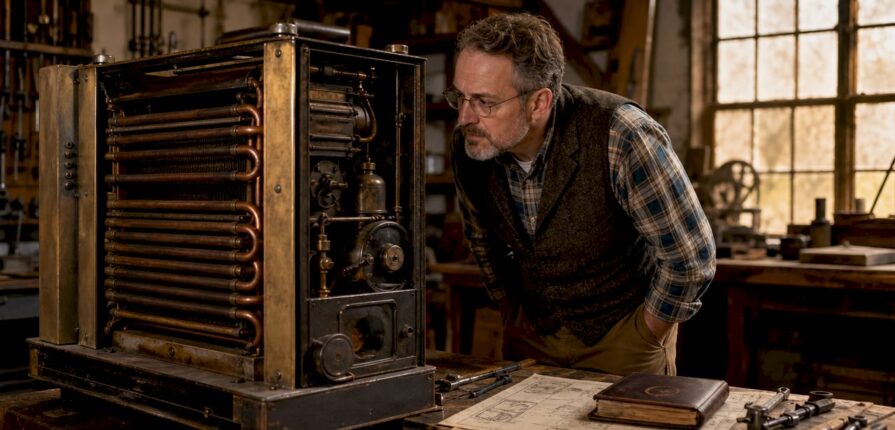
Willis Carrier’s 1902 invention of the first modern air conditioning system is defined as the moment atmospheric control became an engineering discipline, not just a comfort luxury. Carrier built his system for the Sackett-Wilhelms Lithographing & Publishing Company in Brooklyn, New York, solving a humidity problem that was ruining printed paper. That single industrial fix launched a technology now used by billions of people worldwide. Understanding the history of air conditioning helps you appreciate why modern HVAC systems work the way they do, and why the choices made in 1902 still shape the equipment in your home today.
What was the first AC system and who invented it?

Willis Carrier invented the first modern electrical air conditioning unit in 1902. His goal was not personal comfort. It was precision manufacturing. Ink on paper shifts and smears when humidity fluctuates, and the Brooklyn printing plant was losing product quality because of uncontrolled moisture in the air.
Carrier’s solution went far beyond blowing cold air. He combined cooling coils, controlled airflow, and an ammonia compressor to stabilize humidity at 55%, a level that kept paper dimensions consistent and ink dry. That 55% target was not a guess. It came from Carrier’s application of psychrometrics, the science of measuring moisture in air. No previous cooling device had used psychrometrics as an engineering foundation.
Before Carrier, inventors like John Gorrie attempted mechanical cooling as far back as the 1840s, primarily to reduce fever in hospital patients. Gorrie’s ice-making machine worked in principle but failed commercially because he lacked the financing and infrastructure to scale it. The gap between Gorrie and Carrier was not just time. It was market fit and engineering rigor.
Carrier received patent US808,897 in 1906 for an apparatus that treated air by heating or cooling a water spray to regulate humidity. That same year, textile engineer Stuart W. Cramer coined the term “air conditioning” to describe moisture control in fabric mills. Carrier adopted the phrase, and it stuck.
Pro Tip: Understanding humidity control is just as important as understanding temperature. Carrier’s original system managed both together, which is why modern HVAC systems that only cool air without addressing moisture often leave rooms feeling clammy even at low temperatures. Read more about humidity and comfort to see how this principle applies to your home.
Key milestones in Carrier’s breakthrough:
- 1902: First system installed at Sackett-Wilhelms in Brooklyn
- 1906: Patent US808,897 granted; term “air conditioning” coined by Cramer
- 1915: Carrier Engineering Corporation founded to commercialize the technology
- 1920s: First large-scale public installations in movie theaters and department stores
How did AC technology evolve from Carrier’s invention to modern HVAC?
Carrier’s industrial system was large, expensive, and required trained engineers to operate. The path from that machine to the unit in your living room took decades of refinement.
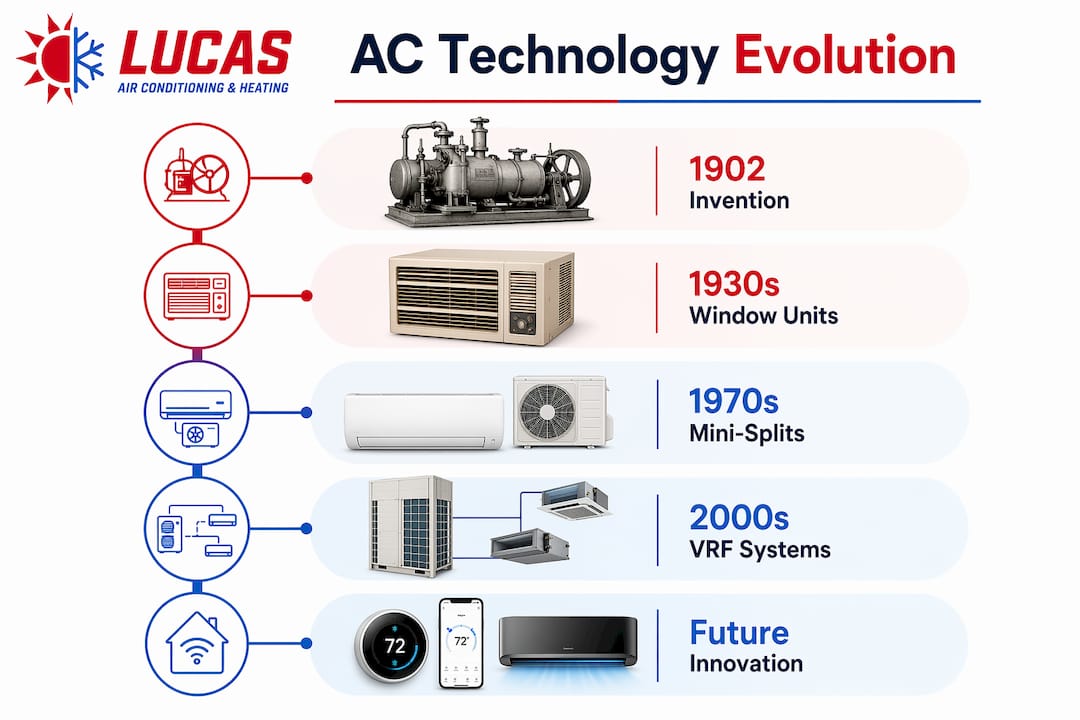
Window air conditioners became practical in the early 1930s, making residential cooling accessible for the first time. Automotive AC systems followed in the mid-1930s, first appearing as factory options on luxury vehicles. Both developments proved that AC could scale down without losing effectiveness.
The introduction of ductless mini-split systems in the 1970s, pioneered in Japan, removed the need for ductwork entirely. A mini-split connects an outdoor compressor to one or more indoor air handlers through a small conduit. This design works well in older homes where installing ducts is impractical, and it allows room-by-room temperature control that central systems cannot match.
Variable refrigerant flow (VRF) systems, a more advanced version of mini-split technology, now serve large commercial buildings by moving refrigerant directly to each zone rather than chilling water or air centrally. VRF systems recover heat from one zone and redirect it to another, which cuts energy use significantly in buildings with mixed heating and cooling needs.
| System type | Best use case | Key advantage |
|---|---|---|
| Central ducted | Whole-home or large commercial | Consistent temperature throughout |
| Window unit | Single room, rental properties | Low upfront cost |
| Ductless mini-split | Older homes, additions, garages | No ductwork required |
| Variable refrigerant flow | Large commercial, multi-zone buildings | Heat recovery between zones |
| Portable unit | Temporary or supplemental cooling | No installation needed |
Each system type traces its design logic back to Carrier’s original principle: control both temperature and humidity together. The hardware changed. The physics did not. For a deeper look at how these systems compare, the full AC evolution history covers each era in detail.
What is the environmental and societal impact of air conditioning?
AC is now a public health tool, not just a comfort product. Heat waves kill people, and access to cooling directly reduces that risk. The problem is that widespread AC use carries a serious environmental cost that Carrier could not have anticipated in 1902.
AC usage is projected to more than double by 2050, potentially generating up to 8.5 GtCO2-eq in annual emissions. That figure is roughly equivalent to the current total emissions of the United States and the European Union combined. Refrigerant leaks alone account for 60% of AC-related pollution, making refrigerant management one of the highest-leverage areas for reducing the technology’s climate footprint.
The equity dimension of this problem is sharp. High-need regions like South Asia and sub-Saharan Africa have the lowest AC availability, even though they face the most dangerous heat. Wealthier, cooler countries already have high AC penetration. This gap means that as developing regions gain access to cooling, global emissions will rise unless the technology itself becomes cleaner.
Closing the gap in cooling access for low-income regions requires sustainable energy and technologies to avoid significant additional warming. The future of AC is not about choosing between comfort and climate. It is about building systems that deliver both without trading one for the other.
The industry’s response to this challenge focuses on three areas:
- Phasing out HFC refrigerants in favor of lower-global-warming-potential alternatives like HFO blends
- Improving building envelopes through better insulation, reflective roofing, and passive cooling design
- Urban planning changes that reduce the heat island effect in dense cities
Future HVAC technology must address all three areas together. Swapping refrigerants alone will not hit climate targets if buildings continue to leak conditioned air through poor insulation. The 2026 HVAC trends point toward smart thermostats, variable-speed compressors, and tighter building codes as the most practical near-term tools.
What lessons does the first AC offer for today’s HVAC innovation?
Carrier’s success came from solving a real, measurable problem with a system designed around the physics of the problem, not around what was easy to build. That approach is a direct model for how the HVAC industry needs to handle today’s challenges.
The comfort benefits of AC were recognized only after the humidity-control system improved working environments. Nobody commissioned Carrier to make people comfortable. Comfort was a byproduct of solving an industrial problem well. That sequence matters. The best HVAC innovations today follow the same pattern: solve a specific, measurable problem first, and broader benefits follow.
Here are four principles from Carrier’s approach that apply directly to modern HVAC decisions:
- Control the whole environment, not just temperature. Carrier’s system managed humidity and temperature together. Modern systems that ignore indoor air quality, ventilation, or humidity are solving only part of the problem.
- Match the system to the building. Carrier designed for a specific facility with specific needs. Homeowners who install oversized central systems in small homes waste energy and get worse humidity control, not better.
- Use the right refrigerant for the application. Carrier used ammonia because it worked. Today’s choice of refrigerant affects both efficiency and environmental impact. Ask your HVAC contractor which refrigerant your system uses and what its global warming potential is.
- Plan for maintenance from day one. Carrier’s industrial clients had engineers on site. Residential systems need scheduled maintenance to perform as designed. A system that runs without annual service degrades in both efficiency and air quality.
Pro Tip: Before replacing an aging system, have a licensed technician assess your home’s insulation and duct condition. A new, efficient unit installed in a leaky house will underperform a well-maintained older unit in a tight building envelope. Lucasair offers step-by-step HVAC installation guidance to help you make that decision with full information.
The HVAC system types available today reflect more than a century of refinement on Carrier’s original idea. Each generation of equipment solved a specific limitation of the previous one, which is exactly the engineering discipline Carrier modeled in 1902.
Key Takeaways
Willis Carrier’s 1902 invention established that effective air conditioning requires controlling both temperature and humidity together, a principle that defines every modern HVAC system built since.
| Point | Details |
|---|---|
| Carrier’s core innovation | He used psychrometrics to stabilize humidity at 55%, not just lower temperature. |
| Patent and naming | Patent US808,897 was granted in 1906; Stuart Cramer coined “air conditioning” the same year. |
| Technology evolution | From industrial units to window ACs, mini-splits, and VRF systems, each step solved a specific limitation. |
| Environmental cost | AC use may generate up to 8.5 GtCO2-eq annually by 2050, with refrigerant leaks as the largest single factor. |
| Modern lesson | Whole-environment control, proper system sizing, and regular maintenance remain the keys to efficient HVAC performance. |
The invention that became a responsibility
Carrier built a machine to fix a printing problem. What he actually built was the foundation of how modern civilization manages indoor environments. That scale of impact was not planned. It emerged because the engineering was sound and the market need was real.
What strikes me most about the history of air conditioning is how long it took for anyone to recognize the comfort angle. Carrier was not thinking about hot summers in Florida or packed movie theaters. He was thinking about paper dimensions and ink adhesion. The fact that his solution turned out to be universally applicable is a reminder that the best technologies solve specific problems so well that the solutions generalize.
The responsibility that comes with that scale is real. AC is now a climate variable, not just a comfort product. The industry that Carrier started has an obligation to solve the emissions problem with the same rigor he applied to humidity control in 1902. That means better refrigerants, tighter buildings, and smarter systems. It also means homeowners making informed choices about what they install and how they maintain it. Understanding where this technology came from is the first step toward using it well.
— Results
Lucasair helps you choose the right HVAC system for your home
The history of air conditioning is a story of engineering meeting real-world need. That same principle guides how Lucasair approaches every installation and service call in Central Florida.

Whether you are replacing an aging system or installing AC for the first time, Lucasair’s team helps you match the right equipment to your home’s specific layout, insulation, and humidity conditions. From residential and commercial installation to routine maintenance and repairs, Lucasair brings the same problem-first thinking that Carrier used in 1902. If you have questions about which system fits your home, the HVAC installation questions guide is a practical starting point before your first call.
FAQ
Who invented the first air conditioning unit?
Willis Carrier invented the first modern AC unit in 1902 for a Brooklyn printing company. His system controlled both temperature and humidity using psychrometrics and an ammonia compressor.
What problem did the first AC system solve?
Carrier’s system solved a humidity problem that caused paper to expand and ink to smear at the Sackett-Wilhelms Lithographing & Publishing Company. Comfort cooling was a later, unplanned benefit of the technology.
When was the term “air conditioning” first used?
The term “air conditioning” was coined in 1906 by Stuart W. Cramer, a textile engineer, and was later adopted by Willis Carrier for his own systems and company.
How much will AC emissions grow by 2050?
AC usage is projected to more than double by 2050, with annual emissions reaching up to 8.5 GtCO2-eq. Refrigerant leaks account for 60% of that total.
What is the most efficient AC system type today?
Variable refrigerant flow systems offer the highest efficiency in multi-zone commercial buildings by recovering heat from one zone and redirecting it to another. For residential use, properly sized ductless mini-splits deliver strong efficiency in homes without existing ductwork.
Recommended
- Air Conditioner Invention History: A Complete Timeline – Lucas Air Conditioning and Heating
- The Evolution of the Air Conditioner: A Full History – Lucas Air Conditioning and Heating
- Who Invented Modern Air Conditioning: The Full Story – Lucas Air Conditioning and Heating
- First Air Conditioning: A Central Florida Homeowner’s Guide – Lucas Air Conditioning and Heating
