
TL;DR:
- Air volume measures the amount of air moving through a space per unit time, which is vital for HVAC performance. Proper calculation and measurement prevent high energy bills, uneven temperatures, and poor air quality.
Air volume measures the quantity of air moving through a space per unit time, typically expressed in cubic feet per minute (CFM). Every HVAC system depends on this single metric to deliver the right amount of conditioned air to every room. Get it wrong, and you pay for it in high energy bills, uneven temperatures, and poor indoor air quality. Understanding how to calculate, measure, and apply air volume data is the foundation of any well-performing home or commercial HVAC system.
What is air volume and why does it matter for HVAC?
Air volume, known in engineering as volumetric airflow rate, describes how much air passes through a duct, grille, or space within a given period. The standard unit in the United States is CFM, though metric systems use liters per second (L/s) or cubic meters per hour (m³/h). ASHRAE, the American Society of Heating, Refrigerating and Air-Conditioning Engineers, sets the baseline standards that govern how much airflow different building types require. These standards exist because too little airflow traps pollutants, while too much wastes energy and creates uncomfortable drafts.
The connection between airflow and indoor air quality is direct and measurable. A room with insufficient airflow accumulates carbon dioxide, humidity, and airborne particles faster than a well-ventilated space. For business operators managing offices, restaurants, or retail spaces, this directly affects occupant health and productivity. For homeowners, it affects sleep quality, allergy symptoms, and how hard the AC works every day.
How do you calculate air volume for a room or system?
The primary formula for calculating required airflow is straightforward: CFM = (Room Volume × ACH) ÷ 60. ACH stands for Air Changes per Hour, which is the number of times the total air volume in a room gets replaced within one hour. A 2,400 cubic foot room needing 5 ACH requires exactly 200 CFM of airflow. That single calculation tells you whether your current system is delivering enough air or falling short.
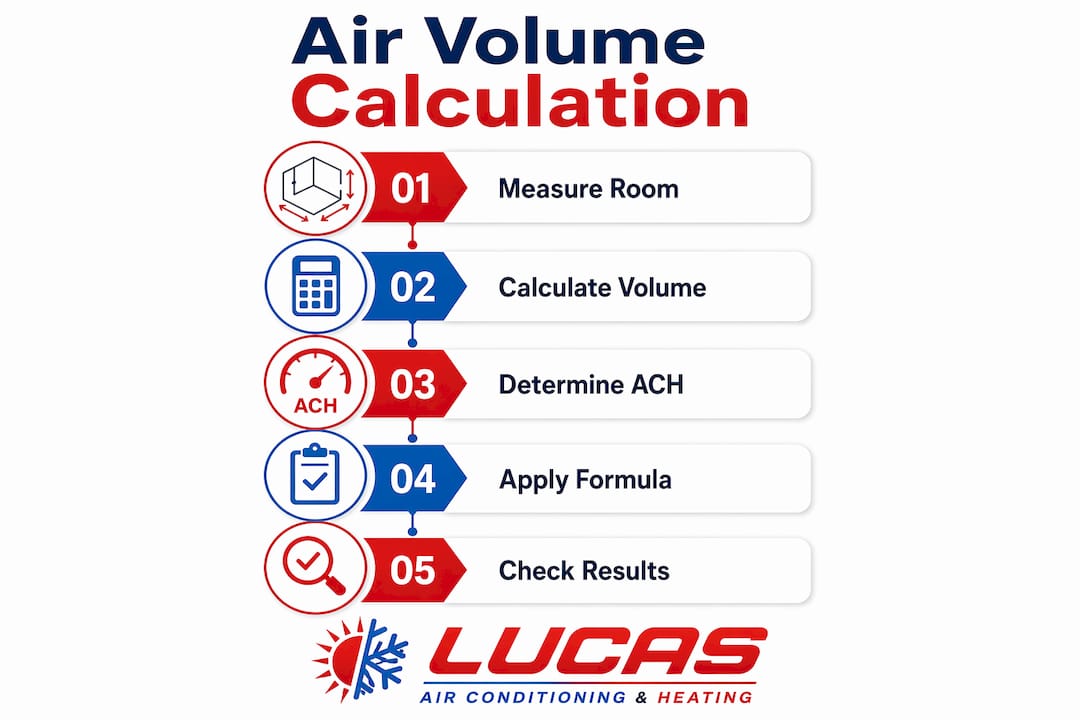
ACH targets vary by room type and use. General living areas typically need 4–6 ACH, while kitchens and bathrooms need 6–12 ACH due to moisture and odors. Commercial kitchens and medical spaces require even higher rates. For cooling system sizing, nominal airflow for cooling runs approximately 400 CFM per ton of cooling capacity. Humid climates like Central Florida often drop to 350 CFM per ton to improve moisture removal, while dry climates may use 450 CFM per ton.
The table below shows typical airflow targets by room type:
| Room type | Typical ACH | Approximate CFM (1,200 sq ft, 8 ft ceiling) |
|---|---|---|
| Living room | 4–6 | 640–960 |
| Bedroom | 4–6 | 640–960 |
| Kitchen | 6–12 | 960–1,920 |
| Bathroom | 6–12 | 960–1,920 |
| Office (commercial) | 6–10 | 960–1,600 |
| Medical exam room | 10–15 | 1,600–2,400 |
For a more detailed look at HVAC load calculations specific to Florida homes, room geometry, ceiling height, and local climate all shift the numbers meaningfully.
Pro Tip: Always calculate room volume using actual ceiling height, not a standard 8-foot assumption. Vaulted ceilings and open floor plans can add 20% or more to the true volume, which changes your CFM target significantly.
What instruments measure air volume in HVAC systems?
Two instruments dominate professional airflow measurement: air flow capture hoods and Pitot tube traverses. Each suits different parts of an HVAC system.
Air flow capture hoods (balometers) fit directly over supply and return diffusers or grilles. They capture all the air exiting or entering a register and display a direct CFM reading. Capture hoods deliver accuracy of ±2% to ±5%, making them the fastest option for grille-by-grille balancing work. The tradeoff is that they only measure terminal points, not what is happening inside the ductwork itself.
Pitot tube traverses measure air velocity at multiple points across a duct cross-section. The fundamental equation is: Airflow Volume (CFM) = Duct Cross-Sectional Area (ft²) × Average Air Velocity (fpm). Pitot tubes can achieve ±2–3% accuracy with proper procedure and give a complete picture of what is happening inside the duct. They require more time and skill than a capture hood but reveal problems that surface measurements miss.
Key considerations when choosing a measurement method:
- Capture hoods work best for quick commissioning checks and balancing at registers
- Pitot traverses are better for diagnosing duct performance and verifying system capacity
- Thermal anemometers measure velocity at a single point and suit spot checks in accessible ducts
- Pressure-based sensors lose accuracy below 0.02 in.w.g. velocity pressure, so duct air velocity should stay below 2,000 fpm to limit both noise and measurement error
Pro Tip: When using a capture hood on a large diffuser, check that the hood fully seals around the grille frame. Even a small gap lets air escape and produces a reading that is 10–15% lower than actual flow.
What factors affect accurate air volume measurement?
Measurement accuracy depends far more on technique than on the instrument itself. Multi-point duct traverses greatly improve accuracy by accounting for velocity profile variations and turbulence across the duct. A single-point reading taken at the center of a duct can be misleading because air moves faster at the center than near the walls, following a parabolic velocity profile. Averaging multiple readings across a grid eliminates that bias.
Sensor placement and alignment create their own errors. A 10° misalignment of a Pitot tube can introduce approximately 1.5% error in velocity readings. In tight duct runs where a standard Pitot tube cannot align properly, specialized probes such as pot-head or prism-head designs reduce that risk. Following ASHRAE measurement protocols for instrument placement, orientation, and number of readings keeps results within ±2–3% tolerance.
Air density is another variable most homeowners and operators overlook entirely. Air density drops about 22% from sea level to 5,000 feet elevation. Temperature and humidity also shift density, which means a CFM reading taken on a hot, humid Florida afternoon is not directly comparable to one taken on a cool morning without applying a correction factor. Ignoring density changes leads to systems that appear balanced on paper but underperform in real conditions.
Measurement accuracy depends more on proper data collection and traverse methods than on duct shape. Standard round ducts are not inherently more accurate to measure than rectangular ducts. What matters is the number of measurement points, correct sensor alignment, and applying density corrections when conditions deviate from standard.
Common pitfalls to avoid:
- Taking a single velocity reading at the duct center and treating it as the average
- Measuring near elbows or transitions where turbulence distorts the velocity profile
- Ignoring temperature and humidity when converting velocity to volume
- Skipping density correction at elevated altitudes or in extreme heat
How do you optimize air volume for comfort and efficiency?
Optimizing airflow starts with knowing your baseline. Installed HVAC performance can differ significantly from manufacturer specifications because real-world duct systems, filter conditions, and building layouts rarely match the controlled conditions of factory testing. That gap between spec and reality is where comfort problems and energy waste hide.
Follow these steps to evaluate and improve airflow in your home or business:
- Calculate your target CFM for each room using the formula CFM = (Room Volume × ACH) ÷ 60, based on the room’s purpose and occupancy.
- Measure actual airflow at each supply and return register using a capture hood or anemometer. Record every reading.
- Compare target versus actual for each zone. A room receiving less than 80% of its target CFM is underventilated.
- Inspect ductwork for leaks, kinks, or blockages. Leaky ducts can lose 20–30% of conditioned air before it reaches the room.
- Schedule duct cleaning if buildup is restricting flow. Debris accumulation narrows the effective duct area and reduces volume without triggering any obvious system alarm.
- Rebalance dampers to redirect airflow from overventilated zones to underventilated ones.
- Verify after changes by re-measuring at all registers to confirm the adjustments held.
Airflow balancing is not a one-time fix. Occupancy changes, furniture rearrangement, and seasonal temperature swings all shift how air distributes through a building. Business operators with variable occupancy, such as restaurants or retail stores, benefit from air balancing checks at least once a year.
Pro Tip: If one room in your home is always too hot or too cold, check the supply register airflow before assuming the thermostat or equipment is the problem. An undersized or partially blocked duct is the cause far more often than a failing compressor.
Duct cleaning plays a direct role in maintaining proper airflow volume. Dust, debris, and microbial growth inside ducts reduce the effective cross-sectional area, which cuts CFM delivery to affected rooms. Regular duct cleaning and air quality maintenance keeps the duct interior clear and preserves the airflow rates your system was designed to deliver.
Why most homeowners underestimate airflow
Most homeowners judge their HVAC system by two things: whether the air feels cold and whether the energy bill seems reasonable. Neither tells you whether the system is actually moving the right volume of air. A system can feel cold at the vent and still deliver 40% less CFM than the room needs, because the air coming out is simply very cold rather than abundant. That scenario forces the equipment to run longer cycles, increases wear, and still leaves corners of the room uncomfortable.
The bigger issue is that airflow problems are invisible. You cannot see a duct leak or a partially blocked register without measuring. HVAC professionals who specialize in airflow testing consistently find that systems operating for years without measurement checks are rarely delivering what the original design intended. The gap between design and reality grows over time as filters clog, ducts settle, and dampers drift.
My honest recommendation: treat airflow measurement as a diagnostic tool, not a luxury. A single professional measurement session gives you a complete picture of where your system is performing and where it is not. That data is worth more than any thermostat upgrade or filter replacement because it tells you exactly what to fix. Homeowners who invest in measurement first spend less on guesswork repairs later.
— Results
Lucasair brings professional airflow measurement to Central Florida
Knowing your target CFM is one thing. Verifying that your system actually delivers it is another. Lucasair provides professional HVAC airflow measurement and balancing services for homeowners and business operators across Central Florida, including Eustis, The Villages, and surrounding communities.

Whether your concern is uneven room temperatures, high energy bills, or indoor air quality, the Lucasair team measures actual airflow at every register, compares it against ASHRAE-based targets, and identifies exactly where the system falls short. From duct cleaning to full system balancing and HVAC maintenance, Lucasair delivers the data and the service to back it up. Schedule a visit and get real numbers, not guesses.
FAQ
What unit is air volume measured in for HVAC?
Air volume in HVAC is most commonly measured in cubic feet per minute (CFM) in the United States. Metric systems use liters per second (L/s) or cubic meters per hour (m³/h).
What is a normal CFM for a residential room?
A standard bedroom or living room typically needs 4–6 air changes per hour. For a 1,200 square foot room with 8-foot ceilings, that translates to roughly 640–960 CFM depending on the target ACH.
How accurate are airflow measurement instruments?
Air flow capture hoods deliver accuracy of ±2% to ±5%, while Pitot tube traverses achieve ±2–3% accuracy when following ASHRAE protocols for instrument placement and multiple readings.
Why does air density affect CFM readings?
Air density changes with altitude, temperature, and humidity, which shifts the relationship between air velocity and actual volume. Air density drops about 22% from sea level to 5,000 feet, so uncorrected readings at higher elevations or in extreme heat will overstate actual airflow.
How often should airflow be measured in a home or business?
Airflow should be measured during any new HVAC installation, after major duct repairs, and at least once a year for commercial spaces with variable occupancy. Homeowners benefit from a measurement check every 2–3 years or whenever comfort problems appear.
Key takeaways
Accurate air volume measurement is the single most reliable way to diagnose HVAC performance problems and prevent energy waste before it compounds.
| Point | Details |
|---|---|
| Use the CFM formula | Calculate target airflow as CFM = (Room Volume × ACH) ÷ 60 for every room you want to evaluate. |
| Match ACH to room type | Living areas need 4–6 ACH; kitchens and bathrooms need 6–12 ACH to control moisture and pollutants. |
| Choose the right instrument | Use capture hoods for quick register checks and Pitot traverses for full duct diagnostics. |
| Correct for air density | Apply density corrections for temperature, humidity, and altitude to avoid systematic measurement errors. |
| Measure before you fix | Verify actual CFM at every register before replacing equipment or upgrading thermostats. |
