
TL;DR:
- 2026 HVAC standards require higher SEER2 ratings for energy efficiency and real-world performance.
- Proper load calculations and sealing, insulation, and duct work are essential for comfort and compliance.
- Upgrading beyond minimum standards with higher SEER2 units offers long-term savings and improved humidity control.
If your HVAC system is more than ten years old and another brutal Central Florida summer just sent your electric bill past $300, you already know something has to change. The good news is that 2026 brings clearer efficiency standards that give homeowners and property managers a real framework for upgrading the right way. This guide walks you through every stage, from understanding new code requirements to choosing a contractor, so your next HVAC investment delivers lasting comfort, lower utility costs, and zero compliance headaches.
Table of Contents
- Understand 2026 HVAC standards and why they matter
- Evaluate your home and set upgrade priorities
- Budgeting, incentives, and permits for your project
- Choosing the right system and contractor
- The real key to successful HVAC upgrades in 2026: Go beyond the minimum
- Ready to plan your upgrade the right way?
- Frequently asked questions
Key Takeaways
| Point | Details |
|---|---|
| Meet 2026 code minimums | Central Florida upgrades must meet SEER2 ≥14.3 and pass permit inspections for legal operation. |
| Size HVAC systems right | Manual J load calculations prevent oversizing and humidity issues, ensuring comfort and lower costs. |
| Leverage all incentives | Stack local utility, city, and federal rebates to cut project costs by thousands. |
| Plan upgrades, not just equipment | Optimize ducts and insulation before installing new HVAC for better efficiency and air quality. |
| Choose contractors carefully | Demand written load calculations, compare quotes, and check credentials to avoid costly mistakes. |
Understand 2026 HVAC standards and why they matter
With compliance becoming stricter, it’s crucial to understand exactly what the new 2026 rules require before any upgrades begin.
The federal government rolled out the SEER2 (Seasonal Energy Efficiency Ratio 2) rating system to replace the older SEER scale. SEER2 tests use conditions that more closely mirror real-world performance, which means a SEER2 score is typically a bit lower than the old SEER number for the same unit. Don’t let that confuse you. The bar is set appropriately, and the result is a more honest picture of what your system actually delivers.
For Central Florida homeowners, the 2026 HVAC replacement standards are specific. SEER2 14.3 minimum applies to split-system air conditioners and heat pumps under 45,000 BTU/h in Climate Zone 2A, which covers most of Central Florida. Systems above that BTU threshold carry a SEER2 13.8 minimum. Both apply the moment you pull a Florida Building Code permit for a replacement, which is required by law. There is no grandfather clause for aging equipment once you start a permitted swap.
Here is a quick reference table so you can see where your planned system lands:
| System type | Capacity | SEER2 minimum (2026) |
|---|---|---|
| Split-system AC/heat pump | Under 45k BTU/h | 14.3 |
| Split-system AC/heat pump | 45k BTU/h and above | 13.8 |
| Package units | All sizes | 13.4 |
You should also know that why upgrade your HVAC system is about more than hitting the minimum. SEER2 20 and above units deliver 20 to 30% more energy savings compared to code-minimum units, which can translate to hundreds of dollars annually in a Florida home that runs the AC nearly year-round.
Key steps and risks to keep in mind:
- Pull a mechanical permit for every replacement, even a straight swap
- Verify equipment ratings before purchase using the AHRI directory
- Confirm proper system sizing with a load calculation, not just a BTU match to the old unit
- Skipping permits risks fines, insurance gaps, and major headaches when you sell
- Non-compliant systems can fail inspections and require costly re-installations
Exploring the HVAC system benefits of a properly selected unit goes beyond compliance. Correct sizing, matched to your actual home, outperforms any oversized code-minimum unit every single time.
Evaluate your home and set upgrade priorities
Once the mandatory standards are clear, the next step is to inspect your home and prioritize where upgrades will have the greatest impact.
Before you even call a contractor, understand that equipment is only one piece of the puzzle. Florida’s climate is unique because Manual J load calculation must account for the state’s high latent loads, which represent 35 to 50% of total cooling demand. Latent load refers to the moisture your system must remove from the air. Ignore it and you end up with a perfectly cool but clammy, uncomfortable home, plus mold risk above 60% relative humidity.
HVAC’s role in comfort goes well beyond temperature. Humidity control is arguably the bigger battle in Central Florida, and it starts with an accurate load calculation before any equipment is selected.
Here is a simple comparison between two common approaches:
| Approach | System selection | Humidity control | Long-term cost |
|---|---|---|---|
| Code-minimum upgrade | Basic SEER2 compliance | Moderate | Higher over time |
| Optimized upgrade | SEER2 17+ with variable speed | Excellent | Lower over 10 years |
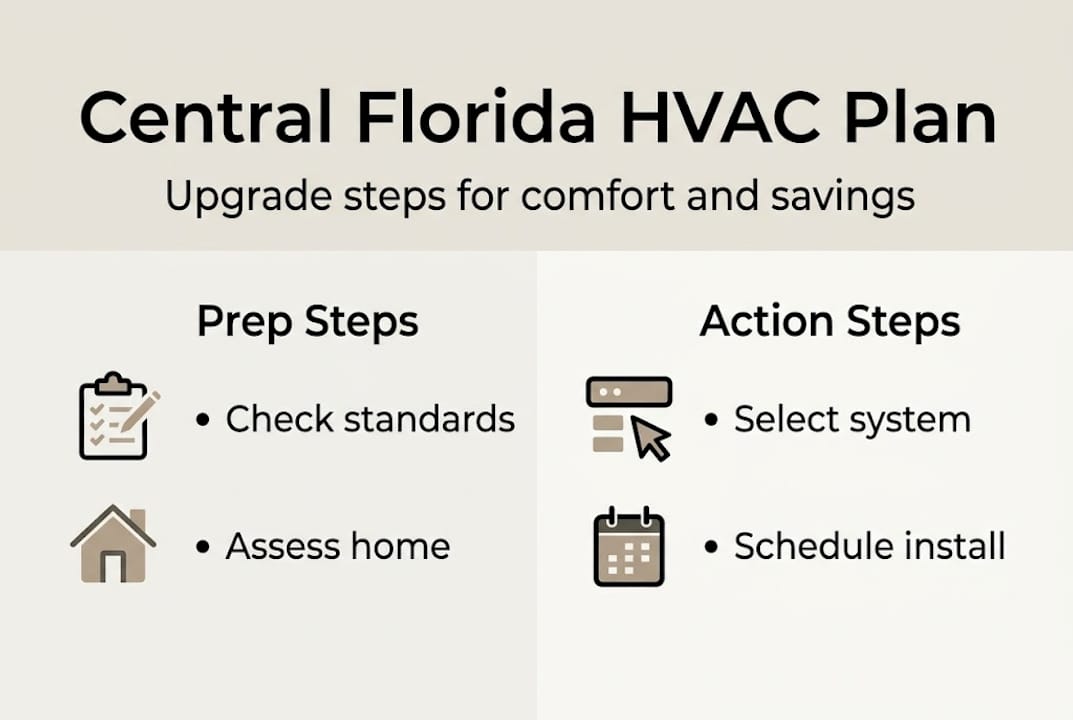
A smart upgrade should follow this sequence:
- Seal air leaks in the building envelope before replacing equipment
- Add or improve attic insulation to reduce heat gain
- Inspect and seal ductwork for leaks and poor connections
- Commission a Manual J calculation from your contractor in writing
- Select equipment sized to the load calculation, not the old unit’s tonnage
Pro Tip: Always ask your contractor to provide the Manual J report in writing before signing any contract. If they can’t or won’t, that tells you everything you need to know.
Getting this sequence right is what separates a truly comfortable home from one where the new system still struggles on a 95-degree August afternoon.
Budgeting, incentives, and permits for your project
After identifying your HVAC needs, it’s time to nail down the numbers so you can upgrade confidently and maximize savings.
Costs in Central Florida are significant, but the incentive landscape has never been better. Full system replacement in the Orlando area runs $5,800 to $15,500 depending on system type, brand, and complexity. OUC and Duke Energy rebates range from $45 to $1,150 for qualifying high-efficiency units, and the federal 25C tax credit covers up to $2,000 for heat pump installations. Permits are required and typically cost $150 to $275.
Here is a cost and incentive overview:
| Item | Typical range |
|---|---|
| Full system replacement | $5,800 to $15,500 |
| OUC/Duke rebates | $45 to $1,150 |
| Federal 25C heat pump credit | Up to $2,000 |
| Permit fees | $150 to $275 |
Permits are not optional. Replacements must meet current federal upgrade incentives and code even when you are reusing existing ducts, and duct testing is required if more than 40% of the duct system is replaced or disturbed during the project. Skipping this step can void rebates and fail inspections.
Documents you will need for rebates and permits:
- Equipment spec sheet showing SEER2 rating and model number
- AHRI certificate confirming matched system ratings
- Contractor license number and proof of insurance
- Signed installation contract with load calculation included
- Completed permit application from your local building department
- Utility rebate forms from OUC, Duke, or your provider
Pro Tip: Stack your incentives intentionally. File for your city rebate, utility rebate, and the federal 25C credit as separate submissions. Many homeowners leave money on the table by only chasing one.
For more on navigating this process, permit and rebate guidance from a licensed Central Florida contractor can save you hours and help you avoid costly missteps.
Choosing the right system and contractor
With a clear budget and all paperwork in hand, your next move is to select both the optimal HVAC setup and the right professional to execute your plan.
Central Florida’s climate strongly favors heat pumps over traditional AC and gas furnace combos. Heat pumps handle both cooling and heating efficiently, and in a state where you rarely need serious heat, they are the clear long-term winner. Variable speed systems with smart thermostat controls and ductless mini-splits for additions or problem rooms are also worth evaluating seriously.
Proper sizing combined with variable speed technology reduces energy bills 30 to 40% compared to standard single-stage units. Geothermal heat pumps push savings even further, up to 70% on heating and 50% on cooling, though the upfront cost is higher.
Ask every contractor these questions before signing:
- Will you provide a written Manual J load calculation before sizing the system?
- Which rebate programs do you help customers file for?
- What brands do you carry, and are they AHRI-matched to my specific home?
- What is your workmanship warranty, and what does it cover?
- Are you licensed, insured, and registered to pull permits in my county?
Mistakes that cost homeowners money:
- Choosing the cheapest bid without comparing scope of work
- Skipping duct evaluation and assuming existing ducts are fine
- Ignoring humidity ratings and selecting based on SEER2 alone
- Not verifying contractor credentials before work begins
- Delaying seasonal tune-ups, which reduces equipment life significantly
Oversized equipment short-cycles, meaning it turns on and off too frequently to properly dehumidify the air, leaving indoor humidity consistently above 60% RH and creating conditions where mold can develop within weeks.
For year-round performance, seasonal tune-up advice and understanding HVAC efficiency for Florida homes will help you protect your investment long after installation day.
The real key to successful HVAC upgrades in 2026: Go beyond the minimum
While following the steps above ensures code compliance, a truly successful upgrade means thinking past bare minimums, and here is why that matters.
We have seen it repeatedly: a homeowner installs a SEER2 14.3 unit because that is what the code requires, and two summers later they are calling us wondering why their bills are still high and their home still feels stuffy. The code minimum was never designed to maximize your comfort or your savings. It was designed to eliminate the worst performers from the market.
The 2026 standards represent the floor, not the ceiling. The real shift in 2026 is that the focus moves toward proactive planning and maximum efficiency, not just clearing the minimum bar. A homeowner who steps up to a SEER2 20 system with variable speed and a smart humidity control thermostat will often recover the cost difference through utility savings within five to seven years, and then enjoy hundreds in annual savings for the following decade.
Short-sighted upgrades lead to recurring discomfort and, often, a second replacement sooner than expected. Think of it this way: spending an extra $1,500 upfront for a significantly better system is far cheaper than replacing a code-minimum unit eight years from now instead of fifteen. The comfort and cost benefits of a higher-tier system compound over time in a way that code minimums simply cannot match.
Ready to plan your upgrade the right way?
Armed with a full plan and deeper insight, your next move is straightforward: get expert support to ensure every detail delivers comfort, compliance, and lasting value.
At Lucas Air Conditioning and Heating, we handle every step of the upgrade process for Central Florida homeowners and property managers. From the first load calculation to the final permit inspection, our certified technicians bring the kind of precision that protects your investment and your comfort for years.
Whether you are still exploring options or ready to schedule installation, our HVAC installation guide is a great starting point. Our team offers full HVAC installation services across the region, and we are happy to walk you through system selection, rebate filing, and permitting from start to finish. Reach out today to schedule your free comfort consultation and get the upgrade done right the first time. For more region-specific guidance, browse our Florida HVAC system tips before you call.
Frequently asked questions
What is SEER2, and how does it affect HVAC upgrades in 2026?
SEER2 is the updated federal efficiency rating standard for HVAC equipment, tested under more realistic conditions than the old SEER scale. In Central Florida, any permitted replacement must meet SEER2 14.3 minimum for most residential split systems to comply with 2026 codes.
How can I make sure my HVAC upgrade qualifies for rebates in 2026?
You need a system that exceeds the base SEER2 threshold, a written load calculation, and complete permit and installation paperwork before submitting. Orlando utility rebates reach up to $1,150 for qualifying units, and the federal 25C credit adds up to $2,000 for heat pump installations.
What triggers duct testing during an HVAC upgrade in Florida?
A duct test is mandatory when over 40% of ducts are replaced or disturbed during the project, and it must pass before the inspection closes out.
How does system sizing affect comfort and mold risk in Central Florida?
Oversized systems short-cycle and fail to properly dehumidify, causing humidity above 60% RH and increasing mold risk. A proper Manual J load calculation before equipment selection is the only reliable way to prevent this.
Recommended
- Why Upgrade Your HVAC System for Florida Homes
- Why Upgrade HVAC Systems: Comfort and Cost Benefits
- Role of HVAC Systems – How Comfort and Efficiency Affect Florida Homes
- Seasonal HVAC Tune-Ups: Protecting Florida Homes
- Best Time to Replace HVAC: Ensure Comfort and Savings – HVAC Service and Repair | Louisville, KY | Project Heating & Cooling
