
TL;DR:
- Financing options make HVAC upgrades affordable by spreading costs and combining rebates and credits.
- Energy savings from high-efficiency systems often offset monthly loan payments quickly.
- Proper planning and understanding financing types help homeowners maximize benefits and avoid pitfalls.
Replacing or upgrading your home’s HVAC system is one of the smartest investments you can make as a Central Florida homeowner, but the upfront price tag stops most people cold. A new system can run anywhere from $6,000 to $15,000 or more, and that kind of number makes it easy to keep putting off the decision. Here’s what most people don’t realize: you don’t need to pay for it all at once. Financing options, combined with utility rebates and federal tax credits, can turn a daunting expense into manageable monthly payments that are often offset by the energy savings you’ll see almost immediately. This guide breaks down exactly how to make that work for you.
Table of Contents
- Why financing matters for HVAC upgrades
- Common HVAC financing options explained
- Central Florida rebates and incentives: Lowering the cost further
- Matching financing to homeowner situations: Scenarios and caveats
- Calculating the real value: How energy savings and financing work together
- Our take: What most homeowners miss about HVAC financing
- Next steps: Upgrade your comfort with expert help
- Frequently asked questions
Key Takeaways
| Point | Details |
|---|---|
| Financing unlocks upgrades | Homeowners can access energy-efficient HVAC improvements without a large upfront payment. |
| Choose smart financing | Match the financing type to your credit situation and plans to avoid costly mistakes. |
| Stack rebates with loans | Combining tax credits, rebates, and financing can significantly reduce the total cost. |
| Savings cover payments | In many cases, monthly energy savings can offset most or all of a loan payment. |
| Watch for hidden costs | Know the risks with PACE and deferred interest options before committing to a plan. |
Why financing matters for HVAC upgrades
The single biggest reason Central Florida homeowners delay HVAC upgrades isn’t comfort or inconvenience. It’s money. When a system fails in August, you’re sweating through 95-degree heat and staring at a quote that feels impossible. Financing changes that equation entirely.
Instead of draining your savings or waiting until you’ve built up enough cash, financing lets you spread the cost over time while the new system starts working for you right away. That matters more than people think, because a modern high-efficiency system doesn’t just keep your home cooler. It actively reduces what you pay every month on utilities.
The HVAC upgrade benefits go well beyond comfort. When you upgrade from an older, low-efficiency unit to a current SEER2 (Seasonal Energy Efficiency Ratio 2) rated system, your air conditioner works less to do more. That translates directly into lower electric bills. In many Central Florida homes, those savings run $100 or more per month, which can offset a significant portion of your monthly loan payment.
Utility rebates make the picture even better. Programs through providers like FPL, OUC, and Duke Energy reward you for choosing high-efficiency equipment. When you stack those rebates on top of financing, the actual out-of-pocket cost shrinks further. Orlando rebates yield 18-31% electricity savings for qualifying upgrades, which is a meaningful benchmark for any homeowner running the numbers.
Here’s what smart financing actually solves:
- Eliminates the cash barrier so you can upgrade now, not later
- Preserves your emergency fund for true emergencies
- Lets energy savings start immediately, often covering part of the payment
- Pairs with rebates and credits to reduce the total financed amount
- Improves home comfort without waiting years to save up
“The ROI on a financed HVAC upgrade is often better than people expect, because the energy savings begin on day one while the loan pays down over time.”
Financing isn’t a last resort. For most homeowners, it’s simply the smarter way to approach a major home improvement.
Common HVAC financing options explained
Not all financing is created equal, and choosing the wrong type can cost you more than you bargained for. The primary financing methods available to Central Florida homeowners each come with their own trade-offs.
| Financing type | Best for | Key benefit | Key risk |
|---|---|---|---|
| Dealer/contractor financing | Fast approval, all credit types | Quick, promotional APR available | Deferred interest if not paid off in time |
| PACE financing | Low credit scores, long-term owners | No credit check, property tax repayment | Attaches to property, complicates sale |
| HELOC or home equity loan | Homeowners with equity | Lowest rates available | Home is collateral |
| FHA Title I loan | Limited equity, moderate credit | Government-backed, accessible | Slower process, income limits |
| Utility rebates | All homeowners with qualifying systems | Reduces financed amount directly | Requires documentation and pre-approval |
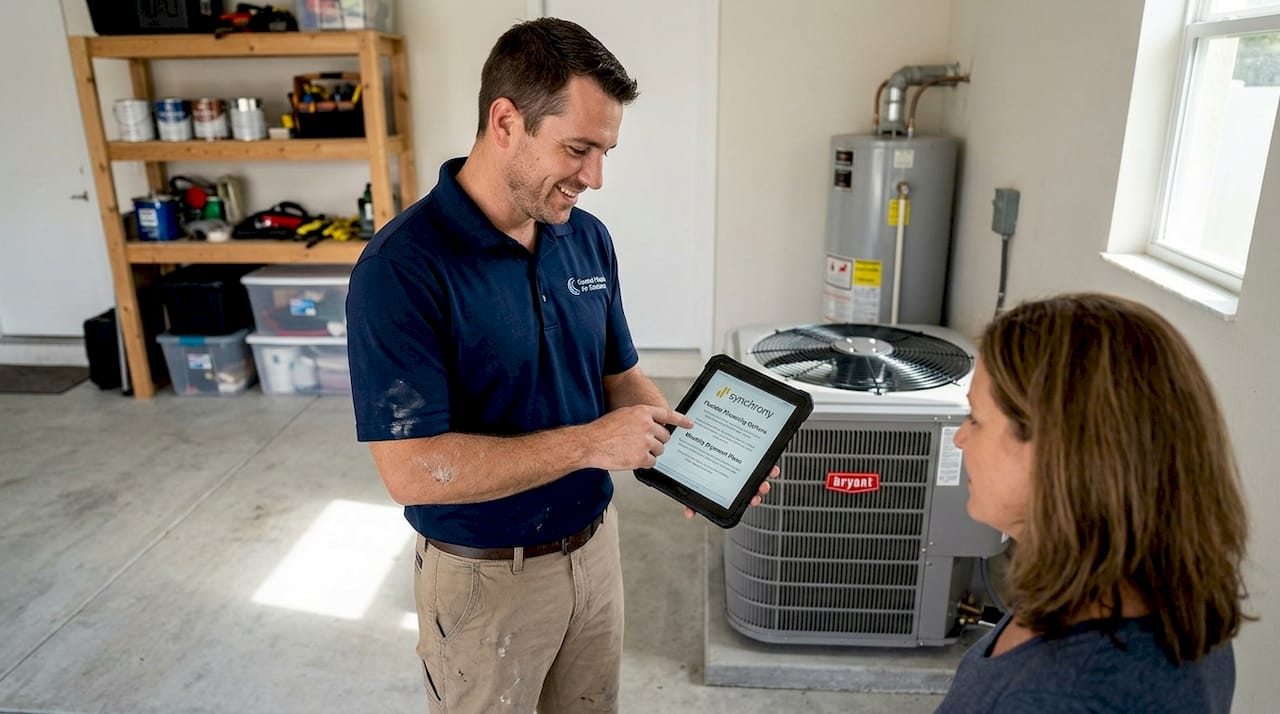
Dealer or contractor financing, often through lenders like Synchrony or GoodLeap, is the fastest route. You apply on the spot and can often get approved the same day. Promotional rates, sometimes advertised as 0% APR, are appealing but carry a serious risk we’ll cover shortly.
PACE (Property Assessed Clean Energy) financing is unique because it doesn’t rely on your credit score. Repayment happens through your property tax bill. That sounds convenient, but it means the loan is tied to your home, not to you personally.
Home equity products, including HELOCs (Home Equity Lines of Credit), offer the lowest interest rates because your home secures the loan. If you have equity built up and aren’t in a rush, this is often the most cost-effective path. Check HVAC loan types and rates to compare what’s available locally.
Pro Tip: Before you sign anything, ask your contractor whether their financing partner uses deferred interest or true 0% APR. Those are very different products, and the answer will change your decision.
For financing for HVAC upgrades in Central Florida, the right choice depends on your credit score, how much equity you have, and how long you plan to stay in the home.
Central Florida rebates and incentives: Lowering the cost further
Rebates and tax credits are the part of the HVAC upgrade equation that most homeowners either overlook or underestimate. Used correctly, they can take thousands of dollars off the amount you need to finance.
Here’s what’s available for Central Florida homeowners in 2026:
| Incentive | Amount | Requirement |
|---|---|---|
| Federal Section 25C tax credit (AC) | Up to $600 | Qualifying high-efficiency system |
| Federal Section 25C tax credit (heat pump) | Up to $2,000 | Heat pump installation |
| HEEHRA rebates | Income-based, up to $8,000 | Income eligibility required |
| FPL/OUC/Duke utility rebates | Varies by provider | SEER2 16 or higher |
The federal tax credits and utility rebates are stackable, meaning you can claim a federal credit and a utility rebate on the same system. That combination can reduce your financed amount by $1,000 to $3,000 or more before you make a single payment.
Here’s how to approach rebates the right way:
- Check eligibility before purchasing. Some rebates require pre-approval or specific equipment models.
- Confirm your utility provider’s requirements. FPL, OUC, and Duke each have their own SEER2 thresholds and paperwork processes.
- Keep all documentation. Invoices, model numbers, and SEER2 ratings are required for most claims.
- Apply for rebates promptly. Many programs have funding caps and close once the budget is exhausted.
- Stack where possible. Federal credits, state programs, and utility rebates can often be combined.
Pro Tip: Ask your HVAC contractor to confirm that the system they’re recommending qualifies for both federal credits and your utility’s rebate program before the install date. Changing equipment after the fact is a headache. Check current HVAC rebates and rebate program resources to see what’s active in your area.
Matching financing to homeowner situations: Scenarios and caveats
The right financing option isn’t the same for every homeowner. Your credit score, how long you plan to stay in your home, and how urgently you need the upgrade all shape which path makes the most sense.
Here’s how to think through your situation:
- Good credit, planning to stay long-term: A HELOC or home equity loan gives you the lowest rate and predictable payments.
- Lower credit score: PACE financing or select dealer programs designed for bad credit situations can still get you approved.
- System failed and you need it replaced today: Dealer financing through your contractor is the fastest path to approval and installation.
- Planning to sell within a few years: Avoid PACE. Because it attaches to the property, it can complicate your sale or reduce buyer interest.
- Want the lowest total cost: Combine a home equity product with all available rebates and credits for the best overall outcome.
The deferred interest trap deserves special attention. Many promotional financing offers advertise “0% interest for 18 months,” which sounds great. But if you don’t pay off the full balance before the promotional period ends, the lender charges retroactive interest on the original loan amount, often at 26% to 29% APR. On an $8,000 loan, that can add roughly $3,000 to what you owe overnight.
Pro Tip: If you choose a deferred-interest plan, set a calendar reminder three months before the payoff deadline. That gives you time to make a lump-sum payment or refinance if needed.
Knowing when to upgrade your HVAC is just as important as knowing how to finance it. If your system is over 10 years old and repairs are becoming frequent, the math usually favors replacement. Understanding HVAC efficiency in Florida’s climate helps you see why delaying often costs more than acting.
Calculating the real value: How energy savings and financing work together
Let’s put some real numbers on this so you can see the full picture.
Assume you finance a $10,000 HVAC system at 8% APR over 60 months. Your monthly payment comes out to roughly $202. Now consider that Orlando HVAC upgrade ROI data shows 18-31% electricity savings for upgraded systems. If your current bill runs $300 per month, a 25% reduction saves you $75. If it runs $400, you’re saving $100 or more.
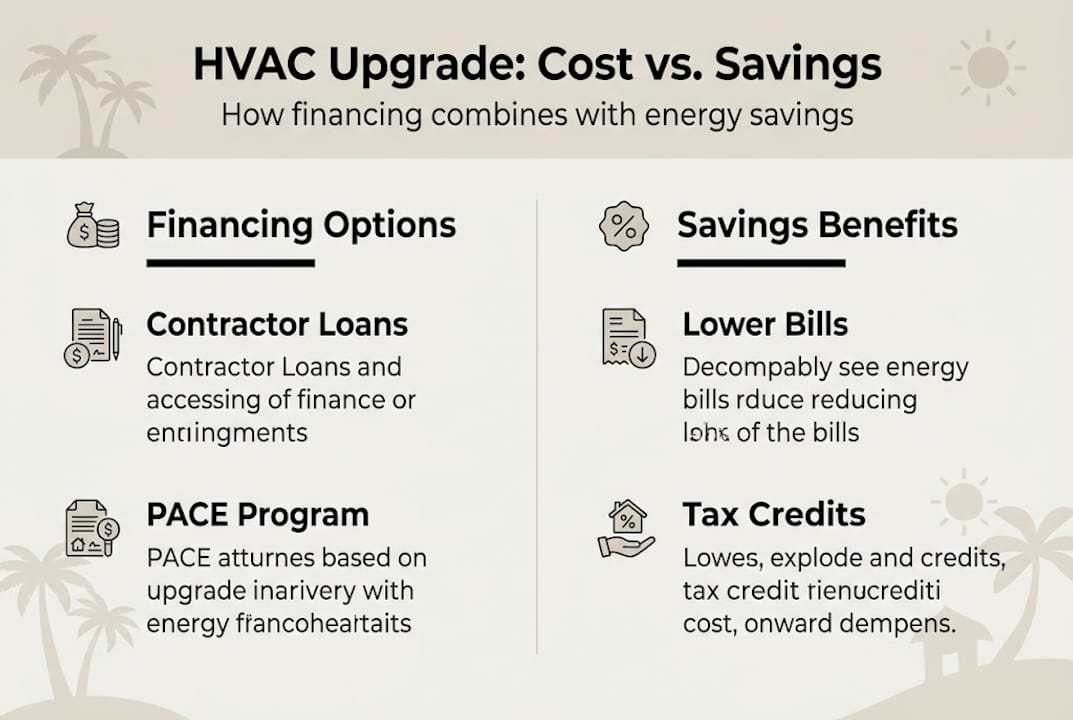
That means your real net cost each month might be closer to $100 to $130 after energy savings, not $202.
Here’s what makes the long-term math even more compelling:
- Loan payments end. After 60 months, the payment disappears but the savings continue.
- Energy costs tend to rise. Locking in a high-efficiency system now means your savings grow as utility rates increase.
- Rebates reduce the financed amount. A $2,000 rebate on a $10,000 system means you’re only financing $8,000, lowering your payment further.
- Home value increases. A modern, efficient HVAC system is a selling point that buyers notice.
“Financing accelerates ROI because the efficiency gains start immediately, while the loan balance decreases over time.”
The upgrade ROI becomes even clearer when you factor in avoided repair costs on an aging system. Older units don’t just cost more to run. They cost more to keep running. Understanding system types explained can help you choose the right equipment for maximum efficiency in Central Florida’s heat.
Our take: What most homeowners miss about HVAC financing
After working with homeowners across Central Florida, we’ve noticed a pattern. Most people focus entirely on the monthly payment and stop there. That’s a mistake.
The monthly payment is just one number. What matters more is the total amount you’ll pay over the life of the loan, whether the financing type fits your actual plans for the home, and whether you’ve captured every rebate and credit available to you. A slightly higher monthly payment on a true 0% loan often beats a lower payment on a deferred-interest plan that could explode at month 19.
We’re also candid about this: financing works best when it’s paired with the right system. A cheap unit with great financing is still a cheap unit. The cost benefits of upgrading are real, but only when the equipment is properly sized and installed. That’s where local expertise matters. A contractor who knows Central Florida’s humidity, heat load, and utility programs will steer you toward a system that actually delivers the savings you’re counting on. Take a long-term view, and the numbers almost always make sense.
Next steps: Upgrade your comfort with expert help
If you’ve been putting off an HVAC upgrade because the cost felt out of reach, the options covered here show there’s a realistic path forward for almost every homeowner. The combination of financing, rebates, and energy savings makes upgrading more accessible than most people realize.
At Lucas Air Conditioning and Heating, we help Central Florida homeowners navigate every part of this process, from choosing the right system to identifying rebates and financing that fit your situation. Whether you need a full replacement or want to explore your options, our step-by-step installation guide is a great place to start. Our HVAC installation services and HVAC repair services are built around your comfort and your budget. Reach out today and let’s find the right solution for your home.
Frequently asked questions
Can I finance an HVAC upgrade with bad credit in Central Florida?
Yes, PACE and select dealer financing options have flexible requirements that don’t rely on a strong credit score, though terms and rates will vary.
Are HVAC rebates and tax credits stackable with financing?
Yes, you can claim rebates and federal credits even when using a loan, and SEER2 16 or higher systems typically qualify for the best incentives, reducing your financed total.
What happens if I can’t pay off a zero-interest HVAC loan in time?
Missing the promotional payoff deadline on a deferred-interest plan means retroactive high interest is charged on the original balance, which can add thousands to what you owe.
How much can I expect to save on utilities after an HVAC upgrade?
Central Florida homeowners typically see 18-31% electricity savings after upgrading, which often translates to $100 or more off the monthly bill.
Is PACE financing a good idea if I’m selling my home soon?
No, because PACE attaches to the property and transfers with the home, which can complicate your sale and reduce buyer interest.
