
TL;DR:
- Proper air balancing improves HVAC efficiency and eliminates hot spots and uneven temperatures.
- In Florida’s humid climate, balancing also enhances humidity control and indoor air quality.
- Annual professional assessments ensure optimal airflow, reduce energy costs, and maintain system performance.
Most homeowners assume their thermostat is the only thing standing between them and a comfortable home. But up to 20% HVAC efficiency loss is common in homes where airflow is simply unbalanced, meaning the system works harder while delivering uneven results. Air balancing fixes that at the source. This guide breaks down what air balancing actually is, how the process works, what real benefits to expect, and why Florida homes face a tougher challenge than most. If you’ve been dealing with hot spots, stuffy rooms, or climbing energy bills, the answers are here.
Table of Contents
- Understanding air balancing: Core concepts and definitions
- How air balancing works: Methods and step-by-step procedure
- Benefits of air balancing: Comfort, efficiency, and indoor air quality
- Florida essentials: Local challenges and expert tips for effective air balancing
- Why most air balancing advice leaves Florida homes uncomfortable
- Get Central Florida’s trusted air balancing and HVAC services
- Frequently asked questions
Key Takeaways
| Point | Details |
|---|---|
| Air balancing prevents inefficiency | Proper airflow adjustments avoid up to 20% energy loss and uneven comfort in homes. |
| Professional expertise is critical | Certified pros use advanced tools and standards for accurate, lasting results. |
| Benefits include comfort and IAQ | Balanced systems deliver consistent temperatures, humidity control, and clean indoor air. |
| Florida homes need annual checks | Humidity-driven drift and long cooling seasons make regular maintenance essential in Central Florida. |
Understanding air balancing: Core concepts and definitions
Air balancing is the process of testing, adjusting, and verifying HVAC system airflow for even distribution throughout your home. It’s not just about making every room the same temperature. It also means maintaining the right humidity levels, hitting design airflow targets, and keeping static pressure in check so the system runs without strain.
A few terms are worth knowing before going further:
- CFM (cubic feet per minute): The volume of air flowing through a duct or vent. Each room in a home has a designed CFM target based on its size and use.
- Static pressure: The resistance air faces moving through your duct system. Too much resistance forces your blower motor to work harder and wear out faster.
- Thermal equilibrium: When every room in the home reaches its target temperature at roughly the same time without one zone overheating or under-cooling another.
| Parameter | Typical target range | What goes wrong when off |
|---|---|---|
| Supply CFM | Per room design spec | Hot/cold spots, pressure imbalance |
| Static pressure | 0.1 to 0.5 in. w.g. | Blower strain, short cycling |
| Humidity (FL) | 45% to 55% RH | Mold risk, sticky discomfort |
The role of your HVAC system in home comfort goes far beyond just heating and cooling. When airflow is uneven, rooms at the end of long duct runs get starved of conditioned air while rooms near the air handler get blasted. That imbalance shows up as:
- One bedroom that’s always too warm
- Humidity that feels heavy in certain areas
- The system running constantly without reaching set temperature
- Increased dust buildup in some rooms
“Even a well-sized HVAC system will underperform if airflow isn’t properly balanced. The equipment is only as effective as the delivery system behind it.”
Understanding HVAC efficiency in Florida makes it clear why these issues are amplified here compared to northern climates. The solution often isn’t a new system. It’s proper balancing of the one you already have, which is one of the strongest arguments for upgrading or optimizing your HVAC before spending on full replacement.
How air balancing works: Methods and step-by-step procedure
Once you understand what air balancing is, it helps to know how professionals actually perform it. The process is more systematic than most homeowners expect.
Key methodologies include proportional and predictive balancing, with proportional balancing making relative adjustments across all outlets and predictive balancing using mass flow calculations for faster, more precise results. Both follow a disciplined process.
Here is how a professional air balancing job typically unfolds:
- System assessment: The technician reviews the original design documents, equipment specs, and duct layout.
- Design check: Confirms whether installed ductwork matches ACCA Manual D specifications for your home’s load.
- Baseline measurements: Using a flow hood or anemometer, the tech records actual airflow at every supply and return register.
- Duct traverses: A pitot tube is inserted into main duct branches to measure velocity pressure and calculate true airflow.
- Damper adjustments: Volume dampers in the duct system are opened or closed to redirect airflow toward rooms that need more, and away from rooms getting too much.
- Verification: A second round of measurements confirms every outlet now meets or closely approximates the design CFM.
- Certification: The technician documents all readings in a report, which can be used for warranty purposes or building inspections.
Comparison: DIY vs. professional air balancing
| Approach | What you can do | What requires a pro |
|---|---|---|
| DIY | Adjust manual dampers, check vents | Measure CFM, static pressure, duct traverses |
| Professional | Full certification and documentation | ASHRAE 111/62.1/ACCA D compliance |
Pro Tip: Airflow balancing standards like ASHRAE Standard 111 define the exact testing procedures professionals must follow. When hiring a contractor in Central Florida, ask specifically whether they follow ASHRAE or ACCA protocols. That question alone will tell you a lot about their experience level.
In Florida’s climate, the stakes for getting this right are higher than most places. A poorly balanced system in July doesn’t just mean a warm bedroom. It means your system runs nonstop, your humidity spikes, and your energy bill reflects all of it.
Benefits of air balancing: Comfort, efficiency, and indoor air quality
With the process clear, the practical payoff becomes easier to see. Air balancing isn’t a luxury service. For Central Florida homeowners, it’s one of the most impactful things you can do short of replacing the system entirely.
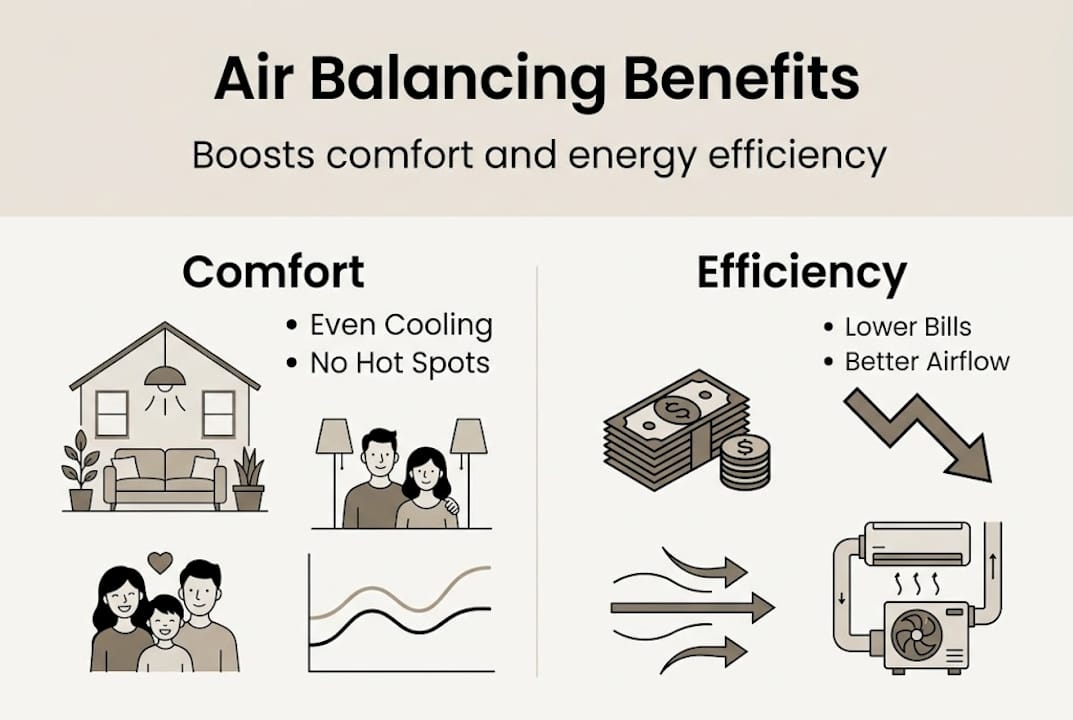
Comfort gains you’ll actually feel:
- Rooms that previously ran 5 to 8 degrees warmer than the thermostat setting come back into range
- Humidity control improves because conditioned air reaches the spaces where moisture builds up
- The system cycles normally instead of running for hours with no relief
- Sleeping rooms feel cooler and less stuffy during summer nights
Proper air balancing can improve system performance by 25 to 40%, and preventing that 20% efficiency loss compounds over years of operation. For a Florida home running its AC nine or ten months a year, that math adds up fast.
“In a humid climate like Central Florida, a balanced system doesn’t just cool your home. It actively manages moisture, reducing the risk of mold and improving the quality of the air you breathe every day.”
For indoor air quality (IAQ), the impact is just as significant. When airflow is uneven, some rooms get poor ventilation. Stale air, allergens, and dust particles linger instead of being drawn back through the filter. A properly balanced HVAC system keeps air circulating, filtration working consistently, and fresh air exchange happening as designed.
Consider a typical scenario in Central Florida: A 2,000-square-foot home built in the early 2000s with original ductwork. The master bedroom runs 7 degrees warmer than the living room. The homeowner has replaced the thermostat twice and set the temperature to 72 degrees, but the bedroom never feels comfortable. After a professional balance, the technician finds two dampers partially closed from a previous repair and a collapsed flex duct section reducing supply to the master. After corrections, every room is within 2 degrees of each other, humidity drops by 8 percentage points, and the monthly electric bill falls noticeably. That’s a real-world outcome that a thermostat swap could never deliver.
Florida essentials: Local challenges and expert tips for effective air balancing
Central Florida’s climate creates HVAC demands that most general guidance simply doesn’t address. High humidity and long cooling seasons make air balancing more critical here than in temperate states.
Central Florida homes face high humidity and latent load, requiring duct sealing and tailored balancing methods that account for moisture, not just temperature. A latent load is the energy required to remove humidity from the air, separate from simply lowering temperature. When airflow is off, your system removes less moisture per cycle, which is why some homes feel clammy even with the AC running.
Key considerations for Florida homeowners:
- Duct leakage in unconditioned attics is extremely common and defeats even a perfectly balanced system
- Post-install drift is real: ducts shift, dampers move, and flex duct sags over time
- Systems sized for cooling often struggle with dehumidification if airflow isn’t matched to design intent
- High outdoor temperatures mean supply air temperatures need to be carefully controlled to avoid overcooling some rooms while undercooling others
Pro Tip: Schedule air balancing and a duct inspection together at least once a year. Central Florida’s cooling season runs from March through October, and any imbalances that developed over the off-season will show up fast once demand picks up. Local HVAC experts who know the Florida climate understand these seasonal patterns and can catch problems before they become expensive.
When hiring a professional, look for certifications from ASHRAE, ACCA, NEBB (National Environmental Balancing Bureau), or AABC (Associated Air Balance Council). These credentials indicate training in the specific tools and standards required for accurate balancing. HVAC services in Mount Dora and surrounding areas from certified technicians give you much more than a comfort fix. They give you documented proof that your system meets current ventilation and efficiency standards.
Why most air balancing advice leaves Florida homes uncomfortable
Here’s something most articles won’t say directly: generic air balancing tips are written for a generic climate. They assume your biggest problem is temperature variation, so they tell you to adjust dampers and call it done. Florida doesn’t work that way.
Humidity is often the primary comfort complaint in Central Florida, and it’s almost always a ventilation and airflow problem, not a thermostat problem. Post-install drift is common, and annual checks integrating IAQ and ventilation standards are essential for homes in high-humidity climates. In Florida, that’s not optional advice. It’s maintenance reality.
We’ve seen homes where the homeowner spent money on UV air purifiers and dehumidifiers when the actual fix was a $200 balancing service that redirected airflow to the problem rooms. The underlying comfort needs of your HVAC system can’t be addressed by add-on equipment if the foundation of airflow distribution is broken. DIY damper adjustments might bring minor relief, but they rarely fix the duct design gaps and latent load mismatches that make Florida homes truly uncomfortable. For real, lasting results, certified balancing tied to ASHRAE and ACCA standards is the only approach that holds up through a full Florida summer.
Get Central Florida’s trusted air balancing and HVAC services
If any of the patterns described in this guide sound familiar, your home may be due for a professional air balance. Uneven temperatures, sticky humidity, and high energy bills in Central Florida are rarely a sign that your system is too old. They’re usually a sign it needs proper calibration.

At Lucas Air Conditioning and Heating, we serve homeowners and property managers across Central Florida with certified HVAC solutions built for this climate. Whether you need a full HVAC service from our team, a preventative maintenance agreement to keep your system balanced year-round, or you’re searching for a reliable HVAC contractor in The Villages, we bring veteran-backed professionalism and regional expertise to every job. Contact us today to schedule your air balancing assessment.
Frequently asked questions
Can I balance my home’s air system myself?
Basic damper adjustments are possible for homeowners, but precise balancing requires specialized tools like flow hoods and anemometers that only certified professionals carry.
How often should air balancing be done in Florida homes?
Annual checks are strongly recommended because of humidity-driven post-install drift and Central Florida’s extended cooling season, which puts consistent stress on HVAC systems.
Does air balancing really lower energy bills?
Yes. System performance can improve by 25 to 40% with proper balancing, which directly translates to lower monthly energy costs over the life of the system.
What are the signs that my home needs air balancing?
Uneven room temperatures, high humidity, short cycling, and energy bills that seem too high for your square footage are the most common indicators of a system out of balance.
What standards should professional air balancing follow?
Professionals should follow ASHRAE Standard 111 for measurement and testing procedures, alongside ASHRAE 62.1/62.2 for ventilation and ACCA Manual D for duct design compliance.
