
TL;DR:
- HVAC accounts for a significant portion of energy use in Florida’s industrial facilities due to climate conditions.
- Implementing technologies like VFDs, smart controls, and heat recovery can reduce energy costs by up to 30%.
- Upgrading HVAC systems enhances resilience, worker comfort, and regulatory compliance beyond just cost savings.
For facility managers running warehouses and manufacturing plants in Central Florida, HVAC is rarely the first line item that gets scrutinized. But it should be. Even modest efficiency gains, when applied across thousands of square feet of conditioned space, translate into serious dollar savings. Florida’s heat and humidity push HVAC systems harder than almost anywhere else in the country, and utilities in the Southeast achieve up to 0.39% sales savings through efficiency programs alone. This guide walks you through the technologies, strategies, and ROI math that make energy-efficient HVAC a smart move for Central Florida industrial operations.
Table of Contents
- Understanding HVAC energy consumption in Central Florida industry
- Key technologies that improve industrial HVAC energy efficiency
- Strategies for balancing indoor air quality and energy efficiency
- Applying energy efficiency: Planning, upgrades, and ROI for Florida facilities
- A fresh perspective: Why energy efficiency in Florida’s industrial HVAC is deeper than cost savings
- Connect with HVAC efficiency experts in Central Florida
- Frequently asked questions
Key Takeaways
| Point | Details |
|---|---|
| HVAC is a major energy driver | In Central Florida facilities, HVAC systems contribute substantially to overall energy use and operating costs. |
| Upgrades deliver rapid ROI | Modernizing HVAC with VFDs and smart controls can cut energy use by 15–30% and often pays for itself in under two years. |
| Balance IAQ with efficiency | Facilities must manage the trade-off between indoor air quality and energy savings—smart systems make it possible. |
| Efficiency is a strategic asset | Industrial HVAC efficiency is crucial for cost control, sustainability, and long-term operational resilience. |
Understanding HVAC energy consumption in Central Florida industry
HVAC is one of the biggest energy consumers in any industrial building, but Florida’s climate makes it an even heavier burden. The combination of year-round heat, high humidity, and the need for precise environmental control in manufacturing processes means your cooling and dehumidification systems run almost constantly. Understanding the commercial HVAC impact on your energy bill is the first step toward managing it.
Florida’s statewide average energy savings from efficiency programs sits at 0.11%, with Tampa Electric (TECO) leading the state in program performance. That number sounds small until you multiply it across a facility drawing hundreds of kilowatts daily. Across an entire year, even a fraction of a percent adds up to thousands of dollars.
On the manufacturing side, the data is striking. Manufacturing energy intensity dropped 52% between 1998 and 2022, according to the EIA’s Manufacturing Energy Consumption Survey. That kind of progress didn’t happen by accident. It came from deliberate upgrades, smarter controls, and better operational practices.
“Manufacturing energy intensity fell 52% from 1998 to 2022, driven by technology upgrades and operational improvements across all major industrial sectors.”
The sectors that use the most energy in Florida manufacturing are chemicals, paper, and metals. Together, they account for the lion’s share of industrial energy demand. If your facility falls into one of these categories, your HVAC system is almost certainly a major cost driver.
Here’s a quick look at how HVAC energy use breaks down across common industrial settings:
| Facility type | HVAC share of energy use | Primary driver |
|---|---|---|
| Chemical manufacturing | 20-30% | Process cooling, ventilation |
| Paper and pulp | 15-25% | Humidity control, drying support |
| Metal fabrication | 15-20% | Cooling, fume extraction |
| General warehousing | 30-40% | Space conditioning |
Key factors driving HVAC energy use in Central Florida industrial facilities include:
- Continuous cooling demand due to Florida’s climate, even in winter months
- High latent loads from humidity that force dehumidification systems to work overtime
- Process heat generated by equipment that adds to the cooling burden
- Large open floor plans that make temperature zoning difficult without smart controls
Using a commercial HVAC checklist to audit these factors gives you a clear starting point for identifying where energy is being wasted.
Key technologies that improve industrial HVAC energy efficiency
Once you understand where energy goes, the next question is what to do about it. Several proven technologies deliver measurable results in industrial settings, and the good news is that most of them pay for themselves quickly.
Variable frequency drives (VFDs) are one of the highest-impact upgrades available. Traditional motors run at full speed regardless of demand. VFDs adjust motor speed to match actual load, which cuts energy use dramatically during partial-load conditions. Because industrial facilities rarely run at peak demand 100% of the time, VFDs reduce both energy consumption and mechanical wear on fans, pumps, and compressors.
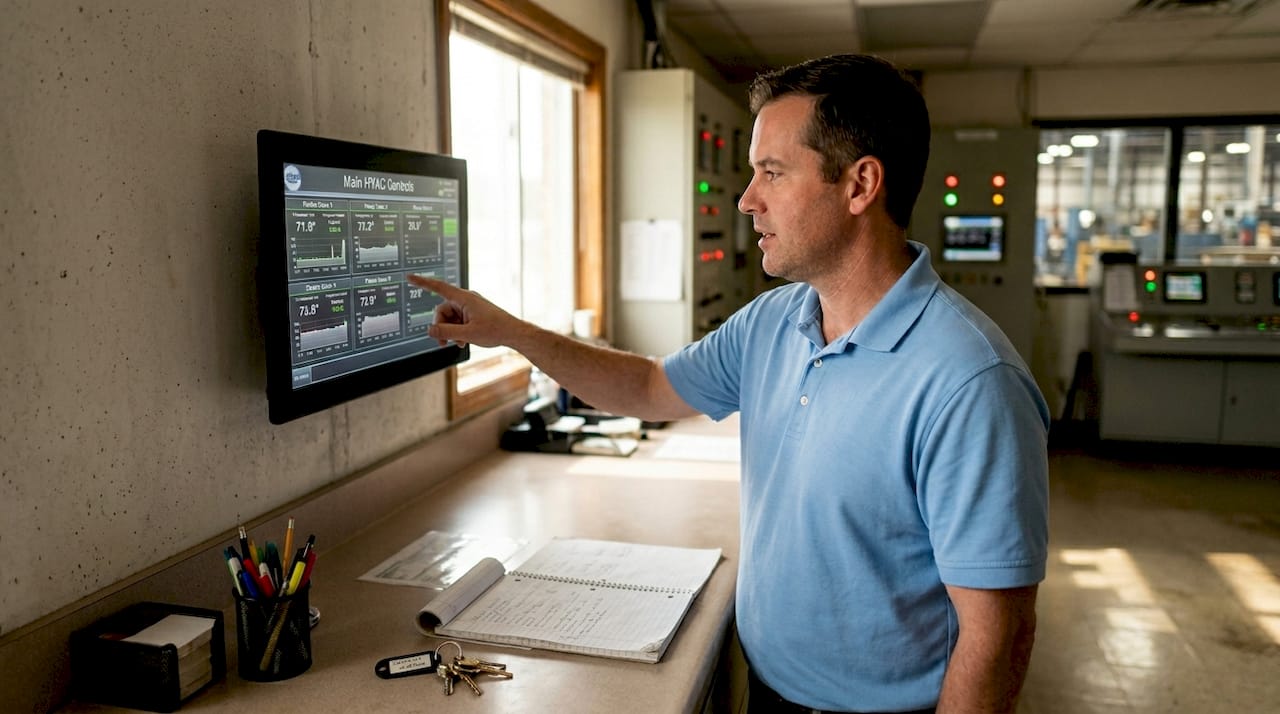
Building management systems (BMS) and smart controls take efficiency a step further by coordinating all HVAC components in real time. Instead of each unit operating independently, a BMS optimizes the entire system based on occupancy, outdoor conditions, and production schedules. Overcooling, one of the most common and costly inefficiencies in large facilities, gets eliminated almost immediately.
Waste heat recovery is the technology most facilities overlook. Manufacturing processes generate enormous amounts of heat that typically gets vented outside. Capturing that heat and redirecting it for space heating, water heating, or pre-conditioning incoming air can offset a significant portion of your HVAC energy load.
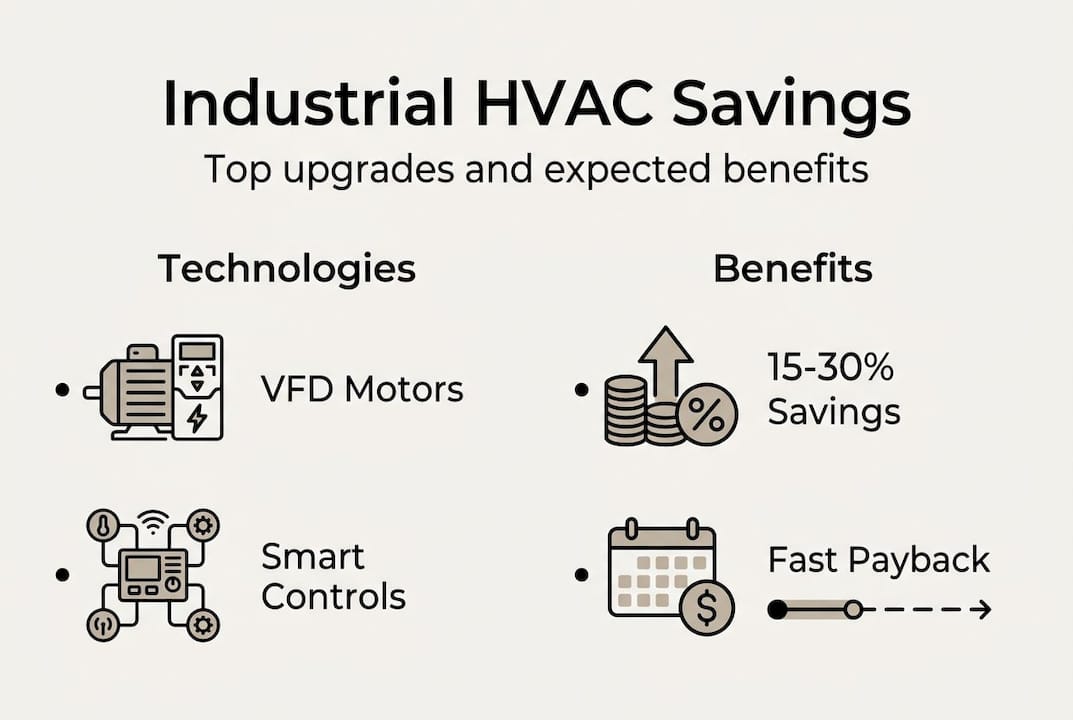
The numbers back this up. VFDs and smart controls can yield 15 to 30% energy savings in industrial HVAC applications. For a facility spending $200,000 annually on HVAC energy, that’s $30,000 to $60,000 back in your budget every year. Understanding the full HVAC upgrade benefits helps you build a compelling case for capital investment.
| Technology | Typical energy savings | Best application |
|---|---|---|
| Variable frequency drives | 20-50% on motor loads | Fans, pumps, compressors |
| Smart BMS controls | 10-25% system-wide | All HVAC components |
| Waste heat recovery | 15-30% of heating load | Process-heavy facilities |
| High-efficiency chillers | 15-20% on cooling | Large cooling systems |
Pro Tip: Pair VFDs with smart controls for maximum savings. VFDs reduce the energy consumed by motors, while smart controls ensure those motors only run when and at the level they’re actually needed. Together, they compound your savings rather than simply adding them.
A solid HVAC maintenance guide also ensures that newly upgraded equipment performs at its rated efficiency rather than degrading over time.
Strategies for balancing indoor air quality and energy efficiency
Here’s the tension that most facility managers feel but rarely talk about openly: improving indoor air quality (IAQ) and cutting energy costs often seem to pull in opposite directions. More ventilation means more conditioned air being exhausted and replaced. Tighter filtration means higher static pressure and harder-working fans. The result is that chasing IAQ without a plan can actually increase your energy bill.
High IAQ demands can increase energy use by 10 to 20% without recovery and smart control methods in place. That’s a significant penalty, especially in facilities where air quality is non-negotiable due to worker safety or product quality requirements.
The good news is that waste heat recovery directly addresses this problem. One documented industrial case showed 1,260 MWh per year saved through thermal energy recovery, delivering approximately €54,600 in annual savings with a payback period of just 1.7 years. When you recover the energy that would otherwise be lost through ventilation exhaust, you can maintain high air change rates without paying the full energy penalty.
Here’s a practical step-by-step approach to maintaining IAQ without sacrificing efficiency:
- Audit your current ventilation rates. Many facilities over-ventilate by default. Compare your actual air change rates to ASHRAE standards for your specific processes.
- Install demand-controlled ventilation (DCV). DCV systems use CO2 sensors and occupancy data to adjust fresh air intake in real time, ventilating only as much as needed.
- Add energy recovery ventilators (ERVs). ERVs capture heat and moisture from exhaust air and transfer it to incoming fresh air, slashing the conditioning cost of ventilation.
- Zone your facility by air quality need. High-contamination areas like welding bays need aggressive ventilation. Office areas and storage zones do not. Separate treatment prevents over-conditioning clean areas.
- Monitor continuously. Real-time IAQ data lets you catch problems early and adjust settings before they become either air quality violations or energy waste.
Pro Tip: Use real-time monitoring dashboards that display both IAQ metrics and energy consumption side by side. When you can see both numbers at once, your team makes better decisions faster. Check out the latest HVAC tips and news for updates on monitoring technology and best practices.
Applying energy efficiency: Planning, upgrades, and ROI for Florida facilities
Understanding the technology is one thing. Turning it into a funded, approved, and executed project is another. Here’s how to move from awareness to action in a way that gets buy-in from ownership and finance.
Start with a professional energy audit. A qualified HVAC engineer will map your current energy flows, identify the biggest waste points, and rank upgrades by cost-effectiveness. This document becomes your business case. Without it, upgrade proposals tend to stall because the numbers aren’t specific enough to justify capital allocation.
Once you have audit data, prioritize upgrades by payback period. The evidence is clear: waste heat recovery recovers 165 kW in documented industrial cases, with a 1.7-year payback and approximately €54,600 in annual savings. That’s a compelling return by any standard.
“Industrial HVAC upgrades including VFDs, smart controls, and heat recovery consistently deliver payback periods under two years when properly scoped and installed.”
Actions that maximize both energy and cost impact in Florida facilities:
- Schedule upgrades during planned maintenance windows to avoid production disruption
- Bundle multiple upgrades to reduce mobilization costs and qualify for larger utility incentives
- Apply for Florida utility rebate programs before purchasing equipment, since many incentives require pre-approval
- Negotiate performance guarantees with equipment vendors to protect your ROI projections
- Track energy use monthly after installation to confirm savings and catch any performance drift
HVAC upgrades yield 15 to 30% energy savings in industrial applications. For a facility with a $150,000 annual HVAC energy spend, that’s $22,500 to $45,000 in annual savings. Deciding to upgrade your HVAC system becomes straightforward math when the payback is under two years.
Pro Tip: Florida’s utility incentive programs and federal energy efficiency tax credits can reduce your net upfront cost by 20 to 30%. Factor these into your ROI calculation before presenting to ownership. Pairing incentives with seasonal HVAC tune-ups and a structured HVAC maintenance checklist ensures your upgraded system performs at peak efficiency year after year.
A fresh perspective: Why energy efficiency in Florida’s industrial HVAC is deeper than cost savings
Most facility managers frame HVAC efficiency as a cost reduction exercise. Cut the bill, improve the margin, move on. That framing isn’t wrong, but it’s incomplete, and it causes facilities to underinvest.
Efficient HVAC systems do more than save money. They make your facility more resilient to Florida’s increasingly intense heat events. They improve worker comfort and reduce heat-related fatigue on the production floor, which shows up in productivity and retention numbers. They position your facility favorably when customers, partners, or regulators start asking about your environmental footprint, and that day is coming faster than most managers expect.
There’s also a regulatory angle that rarely gets discussed early enough. Energy efficiency investments made today reduce your exposure to future compliance costs as building codes and emissions standards tighten. The facilities that act now build operational flexibility. The ones that wait get forced into rushed, expensive upgrades with no time to optimize.
Understanding the full HVAC role in comfort and productivity reframes efficiency as a strategic investment, not just an expense line. The facilities winning in Central Florida’s industrial market aren’t just cutting costs. They’re building infrastructure that supports growth, resilience, and reputation.
Connect with HVAC efficiency experts in Central Florida
If you’re ready to turn these strategies into real results for your facility, Lucas Air Conditioning and Heating is built for exactly this kind of work. Founded by Army Veteran Cameron Lucas in Eustis, Florida, Lucas Air brings hands-on expertise to commercial and industrial HVAC challenges across Central Florida.
Our business HVAC repair workflow is designed to minimize downtime for large facilities, and our HVAC repairs team handles everything from emergency fixes to planned upgrades. For long-term energy savings, our HVAC preventative maintenance agreement keeps your system running at peak efficiency through every season. Contact us today to schedule a commercial assessment and start building your efficiency ROI.
Frequently asked questions
How much can industrial HVAC upgrades reduce energy costs?
Industrial facilities typically achieve 15 to 30% energy savings after upgrading to VFDs and smart controls. The exact savings depend on your current system’s age and efficiency baseline.
What is the typical payback period for energy-efficient HVAC upgrades?
Payback periods can be as short as 1.7 years with waste heat recovery, and most major industrial HVAC upgrades pay back within two years when utility incentives are factored in.
How does indoor air quality (IAQ) affect industrial HVAC efficiency?
High IAQ requirements can raise energy use 10 to 20% if recovery systems and smart controls are not implemented alongside ventilation improvements.
Which industrial sectors use the most HVAC energy in Florida?
Chemicals, paper, and metals dominate manufacturing energy use in Florida and nationally, making HVAC efficiency especially critical for facilities in these sectors.
Why is energy efficiency important for Central Florida industrial HVAC systems?
Florida’s climate creates high year-round HVAC demand, meaning even small efficiency improvements deliver large cumulative savings while supporting your facility’s sustainability goals.
Recommended
- Why Upgrade HVAC Systems: Comfort and Cost Benefits
- HURRY! This Offer Ends May 30, 2018! – Lucas Air Conditioning and Heating
- HVAC Tips & News Archives – Lucas Air Conditioning and Heating
- Streamline Your Business HVAC Repair Workflow Easily
- Energie besparen in huis: complete handleiding 2026 – Holland Electric Duurzaam
