
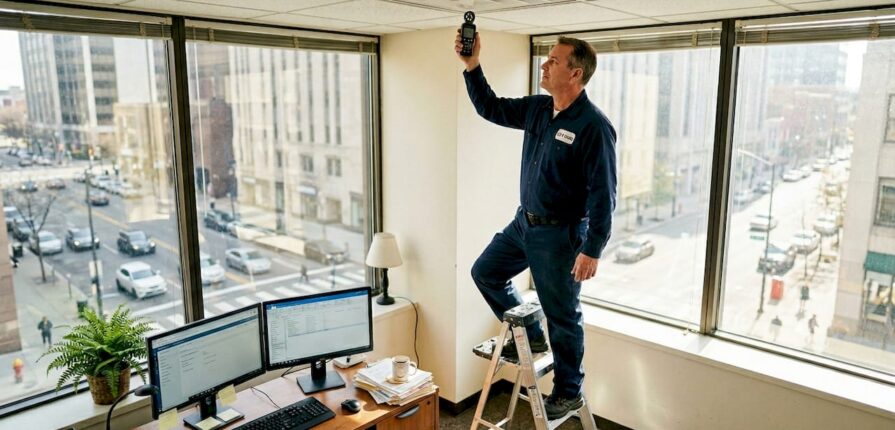
Swapping out a dirty filter every few months feels like enough, but it barely scratches the surface of what your HVAC system can do to reduce infection risk indoors. Most homeowners and property managers in Central Florida are surprised to learn that ventilation strategy, filtration grade, and even airflow direction all play a measurable role in whether airborne pathogens linger or disappear. The science has moved fast, especially since 2020, and the standards have followed. This guide breaks down what actually works, what the latest requirements demand, and how you can apply it to your home or commercial property right now.
Table of Contents
- How HVAC systems help prevent infection spread
- Key HVAC technologies and upgrades for infection control
- ASHRAE Standard 241: What homeowners and managers need to know
- Maintenance, pitfalls, and energy considerations in humid climates
- A Florida expert’s perspective: What most people miss about HVAC infection control
- Take the next step: Expert HVAC solutions for safer air
- Frequently asked questions
Key Takeaways
| Point | Details |
|---|---|
| Layered HVAC controls | Ventilation, filtration, UV, and airflow management work together to reduce infection risk. |
| Upgrades boost protection | MERV-A 11+ filters and UVGI offer significant, proven reductions in airborne pathogen levels. |
| Regular maintenance is essential | Seasonal HVAC checkups prevent bacterial growth and keep infection controls working in humid climates. |
| No solution is perfect | Combining multiple strategies, not relying on one device, offers the best indoor air safety. |
How HVAC systems help prevent infection spread
Your HVAC system does far more than heat and cool the air. When designed and maintained correctly, it becomes one of the most powerful tools you have against airborne illness. HVAC systems control infections by diluting airborne pathogens, filtering aerosols, inactivating microbes, and managing airflow and pressures throughout a building. That four-part framework is the foundation of modern infection risk management.
Understanding the role of HVAC in Florida homes matters even more here than in most states. Central Florida’s heat and humidity push systems to run longer and harder, which means both the opportunity and the risk are amplified. After a major storm, when windows get opened and debris enters ductwork, or during peak occupancy at a commercial property, the system’s infection control capabilities are tested in real time.
Here is a quick breakdown of the four core mechanisms:
- Ventilation: Brings in fresh outdoor air to dilute pathogen concentration indoors
- Filtration: Physically captures aerosol particles before they recirculate
- UV treatment (UVGI): Uses ultraviolet light to inactivate bacteria and viruses on surfaces and in airstreams
- Airflow management: Controls pressure differentials to prevent contaminated air from migrating between zones
The ASHRAE 241 guidelines, published in 2023 and now the industry benchmark, formalized these mechanisms into a single standard for infection risk management. No previous standard addressed infection control this directly.
| Method | Primary mechanism | Best use case |
|---|---|---|
| Increased ventilation | Dilution | High-occupancy spaces |
| MERV-A 11+ filtration | Particle capture | Homes and offices |
| UVGI | Microbial inactivation | Air handlers, ducts |
| Pressure control | Airflow direction | Medical, commercial |
“The goal is not to eliminate every pathogen instantly, but to reduce exposure consistently over time through layered, engineered controls.”
For Central Florida properties, this layered approach is especially important. Humidity accelerates microbial growth, and seasonal storms can disrupt systems in ways that temporarily spike indoor contamination. Getting each layer right is what separates a safe indoor environment from one that just feels comfortable.
Key HVAC technologies and upgrades for infection control
Understanding the basic mechanisms leads us to the next question: which upgrades make the most difference? The answer depends on your building type, budget, and how much risk you are managing, but a few technologies stand out consistently.
MERV and MERV-A filters are the starting point. MERV stands for Minimum Efficiency Reporting Value, and the higher the number, the smaller the particles it captures. MERV-A is a more accurate version of the rating that accounts for how filters perform when electrostatically charged particles are neutralized over time. MERV-A 11+ filters, UVGI, and HEPA filtration are highly effective at reducing airborne pathogens, and their real-world performance is well documented.
UVGI (Ultraviolet Germicidal Irradiation) uses UV-C light to break down the DNA of bacteria and viruses. It works best when installed inside air handlers or duct systems where air passes the lamp repeatedly. It does not filter particles, but it inactivates them, which is a meaningful distinction.
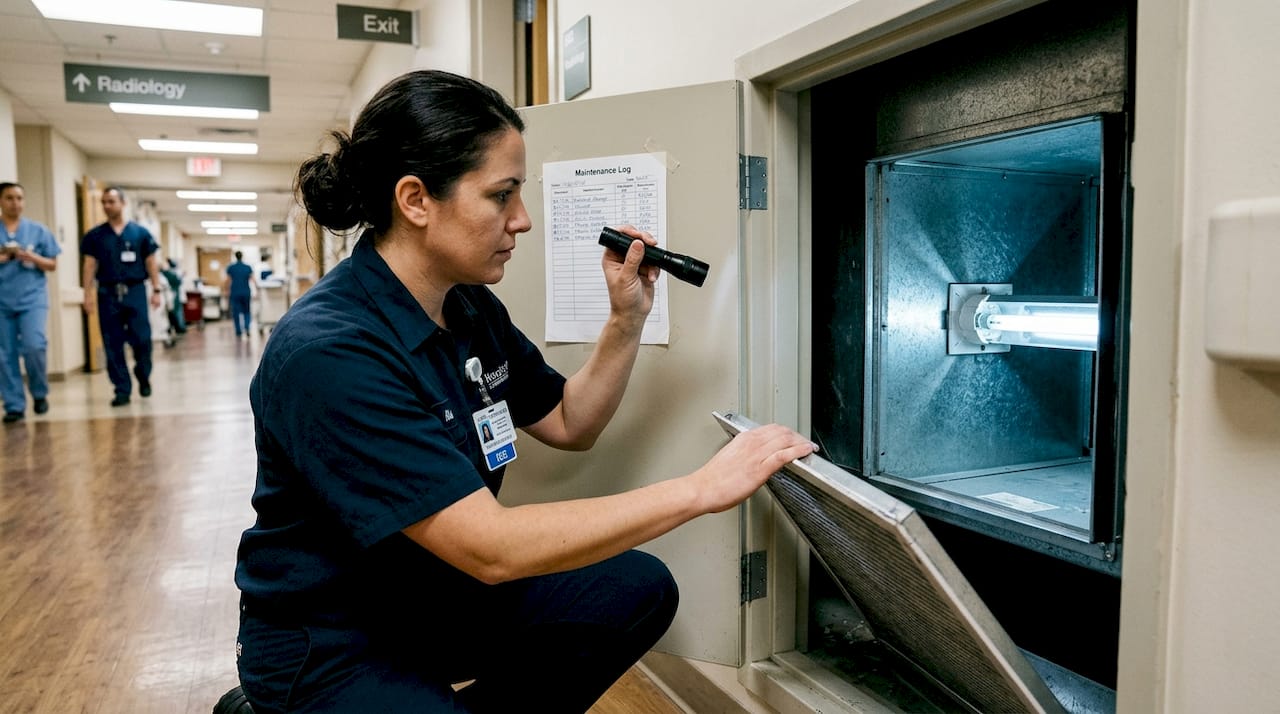
HEPA filtration captures 99.97% of particles at 0.3 microns, making it the gold standard for particle removal. It is most practical in standalone air purifiers or in commercial systems with enough static pressure to push air through the dense filter media.
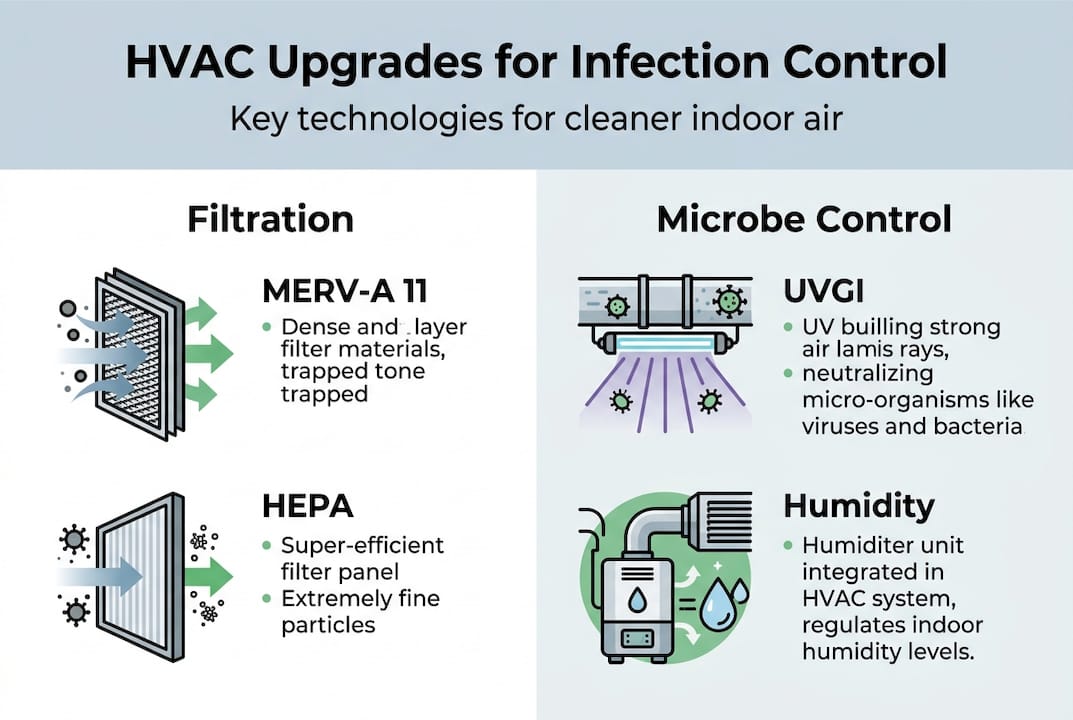
Here is how these technologies compare side by side:
| Technology | Particle removal | Microbial inactivation | Energy impact |
|---|---|---|---|
| MERV-A 11 filter | High | None | Low to moderate |
| HEPA filter | Very high | None | Moderate to high |
| UVGI | None | Very high | Low |
| Combination | Very high | Very high | Moderate |
Pro Tip: In Central Florida’s humid climate, pair any filtration upgrade with a whole-home dehumidifier. High humidity reduces filter effectiveness and creates conditions where mold and bacteria thrive even in a well-filtered system.
For upgrading your HVAC system, here is the recommended priority order:
- Upgrade to MERV-A 11 or higher filters immediately
- Add UVGI to the air handler for continuous microbial inactivation
- Install a whole-home dehumidifier to control moisture
- Consider HEPA-grade portable units for high-risk rooms or zones
- Schedule a professional airflow audit to verify pressure balance
In high-occupancy scenarios like a commercial office or a vacation rental with frequent turnover, these upgrades pay for themselves quickly in reduced sick days, fewer complaints, and better indoor air quality scores.
ASHRAE Standard 241: What homeowners and managers need to know
With the technology landscape in mind, it is critical to know the legal and best-practice standards shaping the industry. ASHRAE Standard 241 is the most significant update to indoor air quality guidance in decades, and it directly affects how you plan, operate, and document your HVAC system.
ASHRAE Standard 241 mandates Infection Risk Management Mode (IRMM), building readiness plans, and higher standards for both new construction and existing buildings. IRMM is essentially a protocol your system can switch into during elevated infection risk periods, like flu season or a local outbreak, to increase ventilation rates and filtration intensity.
Here is what the standard requires in practical terms:
- Building readiness plan: A documented strategy for how your system will respond to infection risk events
- Operations and maintenance (O&M) requirements: Scheduled filter changes, coil cleaning, and system inspections
- Minimum filter ratings: MERV-A 11 for most occupied spaces in new and existing buildings
- Ventilation baselines: Minimum outdoor air rates that must be maintained even during energy-saving modes
- Post-storm restart procedures: Documented steps for safely restarting systems after weather events
For most Central Florida homeowners, full compliance is voluntary unless your local jurisdiction has adopted the standard. But for commercial property managers, especially those in healthcare, education, or hospitality, the standard is increasingly being referenced in lease agreements, insurance requirements, and local code updates.
Pro Tip: Even if compliance is not required for your property today, documenting your HVAC maintenance and filter changes creates a paper trail that protects you legally and demonstrates due diligence to tenants, guests, or inspectors.
Reviewing a solid HVAC maintenance guide is a practical first step toward meeting these requirements without overhauling your entire system. Many properties are closer to compliance than they realize, and a professional assessment can identify the gaps quickly.
Maintenance, pitfalls, and energy considerations in humid climates
Even with the right systems and standards, upkeep and climate realities have the final say. Here is how to stay ahead.
Central Florida’s heat and humidity create a uniquely challenging environment for HVAC infection controls. Moisture is the enemy of almost every filtration and disinfection strategy. When filters get wet, they lose efficiency and can become breeding grounds for mold. When drip trays overflow or coils stay dirty, microbial growth accelerates inside the very system meant to protect you.
Neglected HVAC can breed resistant bacteria like Legionella, especially after storms or hurricanes. Clean filters, coils, and drip pans are not optional maintenance items; they are your first line of defense against a system that actively spreads illness instead of preventing it.
At the same time, filtration is cost-effective but energy-intensive in humid climates, and no solution is 100% effective. Higher-grade filters create more resistance in the airstream, which forces your blower motor to work harder and consume more electricity. In Florida, where systems run nearly year-round, that energy cost adds up.
Here are the most common pitfalls to avoid:
- Skipping HVAC maintenance scheduling after a storm because the system “seems fine”
- Running the system on a single filtration strategy without layering other controls
- Ignoring standing water in drip trays, which is a direct Legionella risk
- Delaying coil cleaning, which reduces both efficiency and infection control
- Failing to document filter changes and service visits
For preparing HVAC after storms, always inspect the outdoor unit, check for debris in ductwork, and verify that drain lines are clear before restarting the system. A full restart without inspection can push contaminated air through every room in the building.
“Bi-annual professional maintenance is the minimum in Florida. Seasonal inspections before summer and before storm season are the practical standard for properties serious about infection control.”
The energy trade-off is real, but manageable. Running a variable-speed blower at a lower continuous setting uses less energy than cycling on and off repeatedly, and it keeps air moving through filters more consistently, which improves pathogen capture rates over time.
A Florida expert’s perspective: What most people miss about HVAC infection control
We have covered the science, tech, and standards, but here is what real-world experience in Central Florida reveals. Meeting the minimum standard is not the same as being protected. A MERV-A 11 filter installed in a system with a dirty coil, a cracked drip tray, and no dehumidification is not doing its job. The standard gives you a floor, not a ceiling.
Property managers and homeowners consistently get tripped up in two ways. First, they rely on a single strategy, usually filter upgrades, and assume the problem is solved. Second, they delay repairs because the system is still running. A system that runs but leaks moisture or recirculates contaminated air is worse than one that simply needs a tune-up.
The real MVPs of infection control are not the flashiest upgrades. They are seasonal HVAC tune-ups, consistent filter changes, and moisture management. Those three habits, done reliably, outperform a high-end UV system that never gets serviced. In a humid, storm-prone climate like Central Florida, discipline beats technology every time.
Take the next step: Expert HVAC solutions for safer air
Ready to put infection control into practice? Here is how Lucas Air can help.
Knowing what to upgrade is only half the equation. Getting it installed correctly, sized for your specific property, and maintained on a schedule that actually works for Central Florida’s climate is where the real protection comes from.
At Lucas Air Conditioning and Heating, we specialize in exactly this kind of tailored work. Whether you need a step-by-step HVAC installation for a new system, a preventative HVAC maintenance plan to stay ahead of filter and coil issues, or a full assessment of your residential and commercial HVAC installation options, our team brings local expertise and veteran-level accountability to every job. Contact us today to schedule your assessment and start breathing easier.
Frequently asked questions
What is the minimum HVAC filter rating recommended for infection control in 2026?
ASHRAE recommends MERV-A 11 as the minimum filter rating for infection risk reduction credit in both new and existing buildings as of 2026.
Do UV lights in HVAC systems really kill viruses like COVID-19?
Yes. UV-C inactivates over 99% of SARS-CoV-2 surrogates in air handling systems when properly installed and maintained.
How often should HVAC maintenance be performed in Central Florida for infection control?
Bi-annual or seasonal professional maintenance is the practical standard, with a focus on filters, coils, and drip trays. Neglected maintenance breeds resistant bacteria in humid conditions, making regular service non-negotiable in Florida.
Does a single HVAC upgrade eliminate all airborne infection risk?
No. No solution is 100% effective, and layering multiple controls, filtration, ventilation, UVGI, and moisture management, is the only reliable way to meaningfully reduce risk.
